
There’s a problem with impressions. They tell brands how many people were exposed through a sponsorship, but not whether those people took action, made a purchase, stayed loyal, or became more valuable customers over time. That’s why a recap focused on reach can still leave decision-makers asking, “Was the sponsorship worth the investment?”
Measuring sports sponsorship ROI is meant to answer one basic question: Did the partnership move the needle on the desired business outcome? Armed with that answer, a brand can then decide what to do next based on audience response, customer behavior, and financial value.
This guide explains a practical approach to measuring sponsorship ROI, from choosing metrics to making renewal decisions.
Start With the Business Question
Sports sponsorship ROI and sponsorship effectiveness answer two different questions. ROI tells us how much was made in increased profit from a sponsorship versus what it cost. Effectiveness shows whether the sponsorship achieved a non-financial goal such as increasing brand awareness, generating more leads, strengthening customer loyalty, or increasing sales.
A lift in brand awareness can be a good result without affecting the bottom line. Estimated media value shows exposure, but may not connect to a desired business outcome. The Association of National Advertisers (ANA) and Marketing Accountability Standards Board sponsorship accountability framework makes this same distinction between financial ROI and return on objectives.
Before the season begins, answer these four questions:
- Goal. What should this partnership change?
- Activation. What will the brand and rights holder do to create that change?
- Evidence. Which data will show whether it worked?
- Decision. What result would support renewal, a change, or an exit?
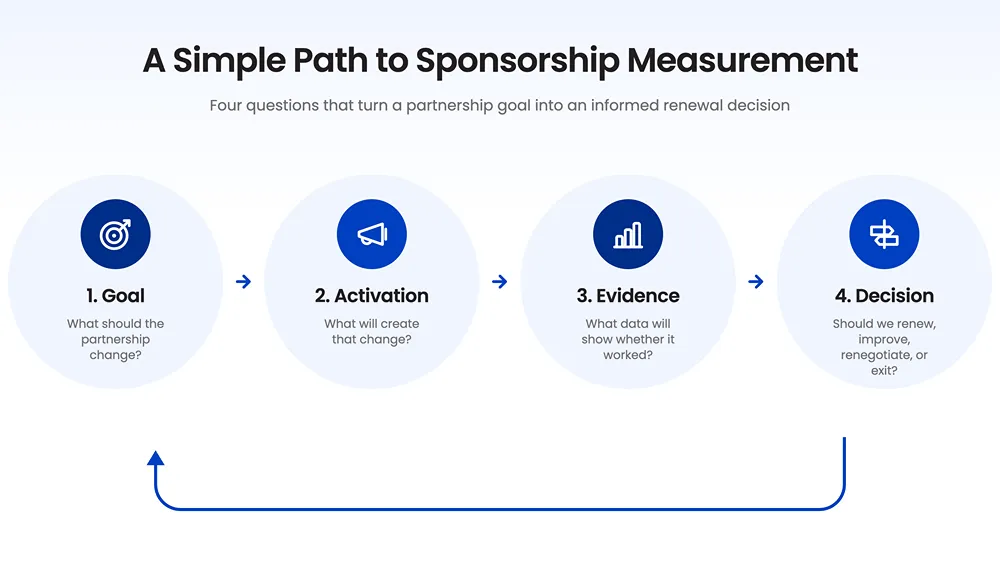
Record the baseline, target, data source, owner, and attribution method at the same time so the team can’t make them up when the results come back. The SponsorCX sports sponsorship measurement guide explains how those measures fit across the sponsorship lifecycle.
Choose Sponsorship Metrics That Match the Goal
Most programs need evidence at these three levels.
1- Delivery
First, confirm that the sponsorship assets were delivered as promised and that the target audience was reached. Track fulfillment, placement, audience fit, and the quality of the exposure.
Impressions are still part of the equation, but they need to be defined in context with business objectives. The Interactive Advertising Bureau (IAB) and Media Rating Council (MRC) media measurement guidelines explain that an impression can count even if no one sees the ad. How is that possible? Impressions are often counted when an ad starts loading on a digital page. That does not mean that a person actually saw it. Impressions measure opportunities to see an ad. Viewability and attention metrics provide evidence that someone saw it.
That’s why it’s important to separate impressions from what people actually saw, noticed, and remembered.
2- Audience Response
Next, measure what people did or if or how their perceptions changed. Brand measures may include:
- Awareness
- Message association
- Favorability or liking
- Consideration
- Purchase intent
Engagement measures may include:
- Content completion
- QR scans, registrations
- Product trials
- Opt-ins
- Event participation
Metrics should be driven by a desired action. Instead of total attendance, use something like scan-to-register rate. For hospitality programs, just measuring how many people attended has limited value. Guest quality and the kind of follow-up and opportunities that were created for guests are stronger evidence.
3- Business Results
For a growth objective, focus on:
- Qualified leads
- Conversion
- Incremental customers
- Margin
- Repeat purchase
- Churn
- Customer lifetime value
Consumer brands may draw on promo codes, loyalty data, retailer data, or matched markets.
Business-to-business sponsors can connect hospitality and activation records with CRM opportunities and business account revenue.
Some partnerships aim to improve market access, recruiting, community participation, employee engagement, or stakeholder relationships. Take into account those outcomes, but report them as return on objectives (ROO) unless there’s a credible way to connect them to financial results.
The closer a metric gets to revenue or profit, the more important attribution becomes. A sale during the season may not have been caused by the sponsorship.
Use the Strongest Supportable Attribution
Attribution is meant to estimate what would have happened if there were no sponsorship in place. There are many variables that can influence results such as marketing, price point, distribution, time of year, and how the team is playing. The right sponsorship performance measurement plan depends on what is known about the spend and how much can be allocated to measurement.
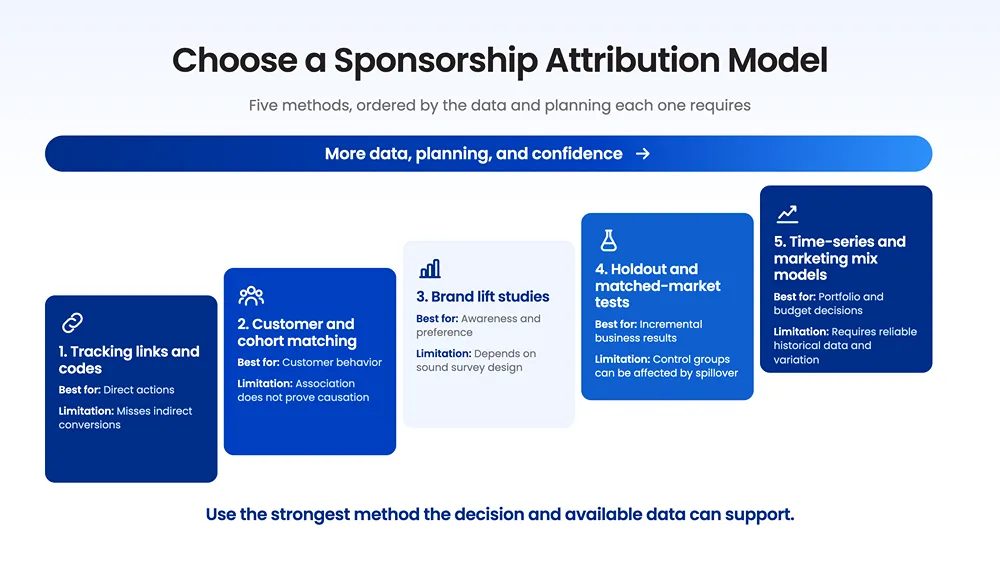
Use consistent campaign tags for trackable activations. Google Analytics guidance on custom campaign URLs recommends consistent source, medium, and campaign parameters so results are not split across reports.
For bigger decisions, controlled tests provide stronger evidence than last-touch reporting. Google's explanation of incrementality testing describes comparing a treatment group with a control group to estimate the results caused by the activity.
Label each result by how it was measured:
- Directly tracked
- Estimated through an experiment
- Modeled
- Used only as a directional signal
This helps decision-makers see which findings are most reliable.
Measurement becomes easier when objectives, rights, activations, proof, and results reside in the same system. See how SponsorCX supports brand sponsorship management across a full portfolio.
Calculate Sports Sponsorship ROI
Use financial ROI only when the benefit can be attributed with confidence.
Sports sponsorship ROI = (attributable incremental profit minus total sponsorship investment) divided by total sponsorship investment multiplied by 100
Total investment includes the rights fee and the costs required to activate and measure the partnership. Depending on the program, that may include:
- Creative
- Production
- Supporting media
- Agency fees
- Travel
- Hospitality
- Staffing
- Technology
- Research
Use incremental profit rather than revenue when margin data is available. If not, describe the calculation as return on spend rather than profit ROI.
A Simple Example
Let’s assume a brand spends $600,000 on rights, $250,000 on activation and supporting media, and $50,000 on measurement. Its total investment is $900,000.
A matched-market analysis estimates $1.8 million in incremental revenue. At a 45 percent contribution margin, that revenue produces $810,000 in incremental profit before sponsorship costs.
ROI = ($810,000 minus $900,000) divided by $900,000 multiplied by 100 = negative 10 percent.
The partnership generated revenue but the brand did not recover its full cost. Before deciding what to do next, check whether the analysis missed repeat purchases, whether the activation was fully delivered, and whether the next period could perform better. Report the negative result rather than replacing it with a more flattering exposure number.
For more detail on cost and valuation choices, see how SponsorCX approaches calculating sponsorship ROI.
Compare Results with Useful Benchmarks
Good partnership reporting shows what changed, how strong the evidence is, and what the team should do next. Three comparisons usually provide enough context:
- Target: Did the partnership meet the goal approved before launch?
- Baseline: Did results improve compared with the period before the sponsorship or expected business-as-usual performance?
- Alternative: How did the result compare with a prior season, another partnership, or a channel focused on the same audience and goal?
Always show the period, audience, denominator, and measurement method. A year-over-year comparison may be misleading if one season included a championship run, a major pricing change, or wider distribution.
Report for Action and Renewal
In-season reporting should help the team act while there is still time to make changes aimed at improving performance. Show what has been delivered, progress against targets, data gaps, and the next actions. Review the report after major events or on a regular monthly schedule.
The renewal report should answer four questions:
- What was the partnership expected to accomplish?
- What was delivered and what did it cost?
- What changed and how strong is the evidence?
- Should the brand renew, improve, renegotiate, or exit?
ROI is one part of the final decision. Leaders should also consider strategic fit, audience quality, activation potential, fulfillment, data access, rights flexibility, and the cost of improving the program. Weak short-term ROI may justify a test or renegotiation. Strong reach with poor audience fit may support an exit.
Make Measurement Useful
Effective sponsorship measurement allows brands to link results to business objectives. It also provides a way to determine if the sponsorship caused the change with some certainty. Together, these measures provide leaders a clearer view of sports marketing ROI and sponsorship effectiveness.
SponsorCX helps sponsorship teams:
- Centralize contracts, objectives, assets, costs, and evidence
- Automate tasks, timelines, and reporting workflows
- Track fulfillment, activation, and performance across every partnership
- Report results with the context leaders need for renewal decisions
Book a SponsorCX discovery call to see how a connected system can support your measurement process.
You make sponsorships happen. SponsorCX makes it simple.