
You’ve lived this moment. Probably more than once.
You’ve spent days toiling over a sponsor proposal. You’ve polished the sponsorship deck. You’ve lined up sponsor level examples. You hit send. You’re hopeful. Then… silence. Or worse, a polite “Thanks, we’ll get back to you,” followed by nothing.
What went wrong? It wasn’t the effort. And yet so many proposals never get to yes. Too many properties forget that sponsors are only interested in WIIFM (What’s In It For Me?).
Here’s why so many proposals fail.
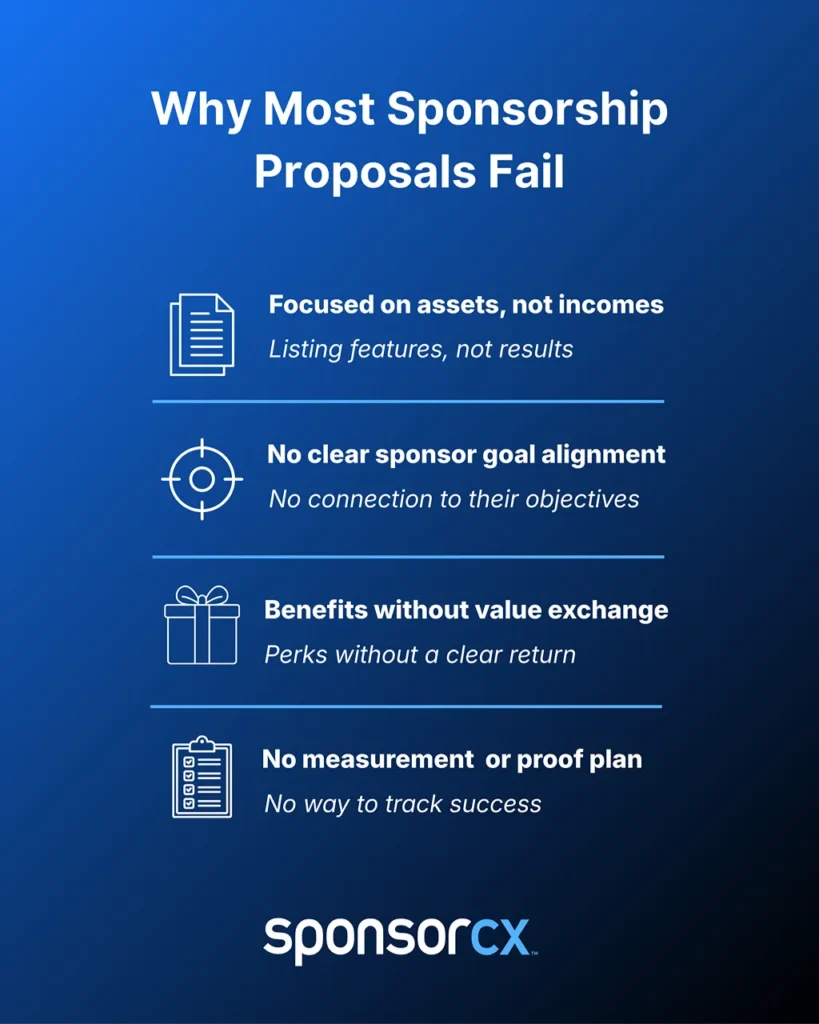
Most sponsorship proposals focus on what’s being sold, not the problem the sponsor is trying to solve or the goals it wants to achieve. They list event sponsorship levels, sponsorship tiers, and benefits, but never connect the dots on the way to desired business outcomes. The sponsor is left doing the heavy lifting.
Picture a marketing director skimming your proposal. She’s not hunting for logos and impressions. She’s asking:
- How does this fit our goals?
- Can I explain this to my boss?
- Can I justify the price tag?
- How do we measure success?
If your sponsor proposal doesn’t answer those questions fast, it falls flat–fast.
This article is about fixing that.
You’ll learn how to make a sponsorship proposal that’s clear, persuasive, and easy to say yes to. We’ll walk through what sponsors look for, what to cut, and how to frame sponsorship benefits and ROI so your proposal feels like a solution, not another pitch.
What Sponsors Need to Believe Before They Say Yes
You already know that most brand managers are drowning in sponsorship decks. Their inboxes are full of people asking for support or partnership, which usually translates to: “Give us money and we’ll put your logo on a banner.”
From the sponsor’s perspective, saying “yes” is a risk. Persuasion is less about piling on fact after fact and more about how decision-makers think. Sponsors have a limited budgets and bosses to answer to. If they invest in your property and it flops, their reputation takes the hit.
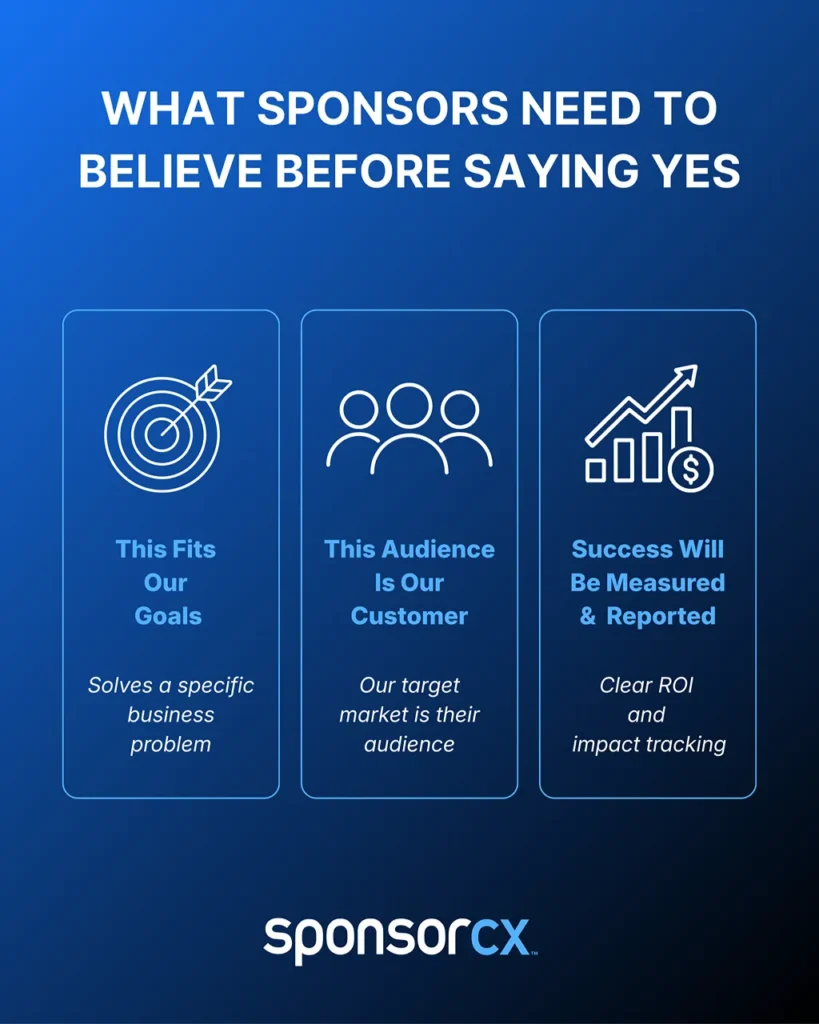
Before a sponsor is willing to cut a check, they need to believe three things:
- That you understand their specific business problems and the opportunity fits (Are they trying to reach Gen Z? Launch a new product? Drive foot traffic?)
- That your audience is their target customer
- That you have a plan to prove the investment worked. Success can’t be a mystery. You’ll need show how results will be tracked, reported, measured, and reviewed.
This is where most proposals fail. If yours is just a list of your needs, gussied up with sponsorship levels and logos, it’s going straight to the trash. You must pivot from “here is what we do” to “here is how we help you win.”
A persuasive sponsorship proposal earns trust before it asks for a commitment.
The Anatomy of a Persuasive Sponsorship Proposal
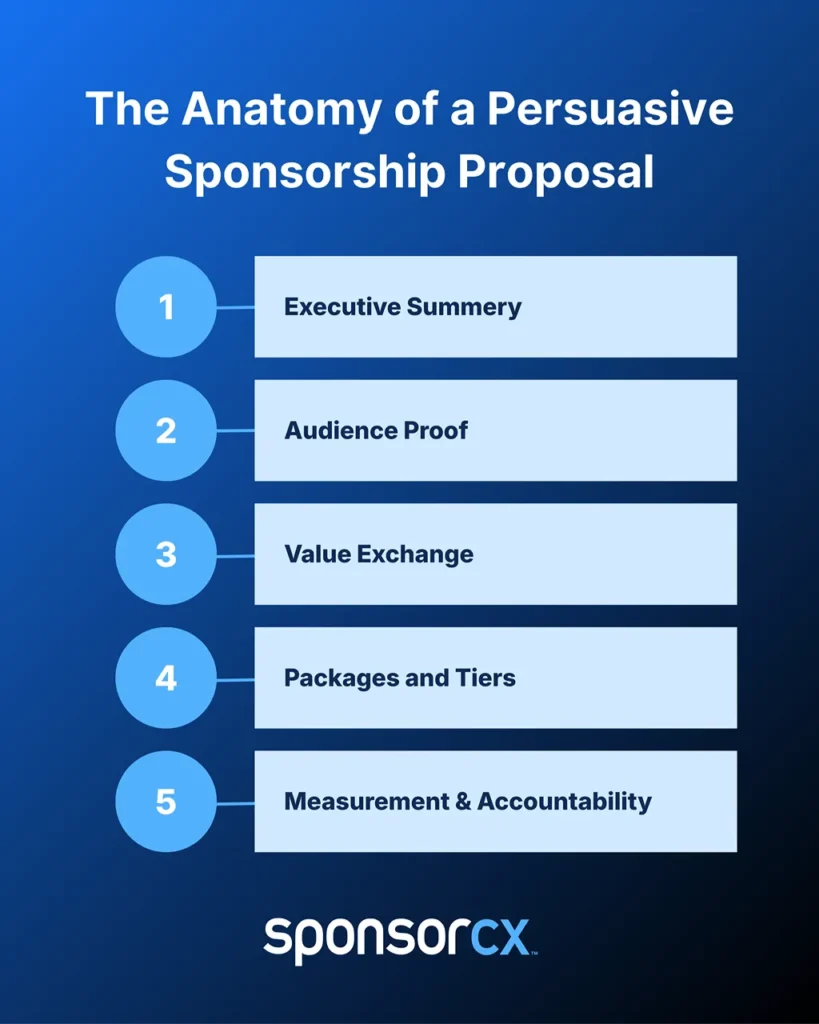
The best proposals follow a logical flow that builds trust as the reader moves through the pages. It helps to review best practices that separate compelling proposals from those that get passed over. Here’s how to structure yours for maximum impact.
Executive Summary That Earns Attention
The first page of your sponsor proposal shouldn’t be “about us” or a history of your organization. It should be a mirror. Reflect back to the sponsor its goals.
Start with a “State of the Union.” Acknowledge the challenges the sponsor’s industry is facing and briefly explain why this specific partnership is the solution. Think of this as the “hook.” If they don’t see their own goals reflected in the first thirty seconds, it’s over.
Your executive summary should answer, quickly:
- Who this is for
- Why it matters to them
- What problem it helps solve
Think of it as a short brief, not an intro letter. If a sponsor only reads this section, they should understand why the opportunity exists and why it’s relevant to their goals.
Keep it clear and tight. This is not the time for cleverness.
Audience Proof Sponsors Trust
Sponsors aren’t buying your event; they are buying access to your people. Instead of saying “we have a large following,” give them the data that matters. They want relevance over reach. This section should define who the audience is:
- Demographics: Age, location, and income levels.
- Psychographics: What do they care about? What do they buy?
- Engagement: Don’t just list follower counts. Show how many people show up, click, and participate.
- Affinity: Why the audience matters to the prospective sponsor
When you learn how to make a sponsorship proposal that leads with data, you take the guesswork out of the equation for the brand. Caution: Don’t overload with data. Focus on framing.
Clear Value Exchange (Not a Benefits Salad)
This is the heart of a persuasive sponsorship proposal. Many people make the mistake of creating a “benefits salad”—a giant, unorganized list of every possible perk, from social media shoutouts to free t-shirts. This is overwhelming and feels cheap.
Instead, focus on a clear value exchange. If the sponsor gives $X, they get a specific solution to their problem. For example, if they need lead generation, focus on an activation that captures emails rather than just putting their logo on a jumbotron. Clarity beats quantity every time. Instead of a long list of benefits, explain the value exchange in simple terms:
- What the sponsor gives
- What the sponsor gets
- Why the exchange makes sense
Packages That Clarify, Not Confuse
This is where you define your event sponsorship levels. However, stay away from the boring “Gold, Silver, Bronze” tier names. They don’t mean anything. Use names that reflect the value of the tier.
When building your sponsorship tiers, keep these tips in mind:
- Limit the choices: Too many options lead to “analysis paralysis.” Three to four tiers are usually the sweet spot.
- Create clear differences between levels: Show them what a “Title Sponsor” looks like versus a “Supporting Sponsor.”
- Create a “Best Value” tier: Highlight the level that provides the most balanced sponsorship benefits and ROI.
A well-organized sponsorship proposal template should make it easy for the sponsor to see exactly where they fit.
Measurement and Accountability
One of the biggest reason sponsors don’t renew is lack of proof. You need to show them how you will measure success before the event even starts. This is where belief turns into action. Show them what will be measured, how results will be shared, and when performance will be reviewed. Examples include:
- Digital tracking: Clicks, impressions, and mentions.
- On-site data: Booth visits or coupon redemptions.
- Post-event report: Commit to sending a wrap-up report within 30 days.
When a sponsor sees that you have a leading-edge automated way to track these metrics, they feel much more comfortable saying yes. They know they won’t have to scramble to justify the spend to their leadership later on. Always tie measurement back to the value exchange.
Putting It All Together
Learning how to win sponsorship is really about learning how to build a business case. Whether you’re sending a digital sponsorship deck or a physical sponsor proposal example, the goal is the same: make it impossible for them to say no because the value is so obvious.
By moving away from “begging” and toward “solving,” you position yourself as a professional partner rather than just another line item in their budget.
How to Tell a Persuasive Sponsorship Story
Data might close the deal, but it’s the story that opens the door. Create a narrative the sponsor can follow, repeat, and advocate for. If you want to move beyond a simple transaction and create a real partnership, you have to move people emotionally. Nothing does that better than a compelling success story where the sponsor is the hero and you are the trusted guide.
Most properties start their sponsorship decks by talking about themselves—how long they’ve been around, their mission statement, and their list of needs. Flip the script. The goal of your sponsorship is to help the sponsors see themselves in successful outcomes.
Make the Sponsor the Protagonist
Your event, your history, or your audience size is not the hero. Open by showing you understand the challenge the sponsor is trying to solve. When a sponsor feels understood, they stay engaged. Cast the sponsor as hero and the challenge they face as the antagonist.
Next, introduce your role in the story as a guide and facilitator. You provide access, context, and opportunity. Instead of saying, “We are hosting a 5K run,” tell the story of the sponsor helping a community coming together to hit a fitness milestone or support a local cause
To keep the story clear, use a simple narrative flow:
- The challenge: The sponsor’s goal
- The obstacle: The antagonist
- The solution: How this sponsorship helps remove the obstacle
- Victory: What success looks like
As you reveal the details, connect each one back to the story. When you frame your event sponsorship levels around these emotional pillars, the value of the partnership skyrockets.
Use Vivid Proof Instead of Generalizations
Instead of saying your event is “exciting,” describe the moment the lights go down and 5,000 people hold up their phones. Instead of saying your audience is loyal, tell the story of a fan who has attended for ten years straight.
This is where a sponsor proposal example can really shine. If you can point to a previous partnership where a brand solved a problem through your platform, you’re not just making promises—you’re showing a proven track record.
Bridge the Gap with Benefits and ROI
The happy ending of your story is the sponsorship benefits and ROI. This is where the emotional connection meets business logic. You’ve set the stage and built the tension; now, show exactly how the happy ending looks.
Whether you are using a standard sponsorship proposal template or building something custom, make sure the narrative remains consistent. Every bullet point and every one of your sponsorship tiers should feel like a natural chapter in the story you’re telling together.
When a brand can see itself in your story, “getting to yes” becomes the only logical conclusion.
Real World Examples and Templates
When you’re learning how to make a sponsorship proposal, it helps to see how the pros do it. Below are three real-world examples that show what a strong proposal may look like on a single page. These are intended as good examples that contain the important components, not as hard fast structures.
Example 1: Event sponsor proposal (Major race)
The partnership: Bank of America as presenting partner of the Boston Marathon beginning in 2024.
How a one-page sponsor proposal could frame it:
Sponsor goal: Community impact and broad visibility tied to a respected civic event
The promise: “You’ll be seen, but you’ll also be connected to something people care about.”
What the sponsor gets
- Presenting partner association across the event experience
- Community-facing programming (the part that makes the partnership feel bigger than signage)
Event sponsorship levels
- Presenting Partner (category leader)
- Official Partner (strong presence and a defined activation lane)
- Supporting Partner (limited, specific deliverables)
Why this works
- The “yes” is easier because the story is clear: big event, public good, long-term commitment.
- The sponsor can justify it without stretching: it’s not a random buy– it’s an aligned platform.
- The sponsorship tiers feel like choices and are simple to understand.
Example 2: Creator sponsor proposal (Audience-first partnership)
The partnership: 7 Brew announced a partnership with Dude Perfect, including integration into content and an on-site activation concept.
How a single page sponsor proposal could frame it:
Sponsor goal: Reach a family-friendly audience with repeat attention, not one-time impressions
The promise: “Your brand shows up inside content people chose to watch.”
What the sponsor gets:
- Sponsored video integrations (planned, not random)
- A physical touchpoint that reinforces the partnership beyond the screen
Sponsorship levels
- Series Sponsor (multiple integrations over a set time window)
- Episode Sponsor (one hero video and supporting shorts)
- Social Add-On (posts, link, and promo code support)
Why this works
- The offer is built around fit and repetition. That’s how you get sponsorship value in creator land.
- It’s easy to measure: views, clicks, code usage, and lift in branded search can all tie back to sponsorship benefits and ROI.
- The sponsorship deck becomes a plan, not a pitch.
Example 3: Nonprofit sponsor proposal (Local impact and a clear moment)
The partnership: Boys & Girls Clubs of Metro Denver announced Suncor Energy U.S.A. as presenting sponsor of its 2025 gala.
How a single page sponsor proposal could frame it
Sponsor goal: Local goodwill and visible leadership in the community
The promise: “Your sponsorship directly fuels youth outcomes, and your brand is seen supporting it.” For nonprofits, it also helps to know what counts as sponsorship recognition versus advertising.
What the sponsor gets:
- Presenting sponsor recognition tied to a specific event moment
- Clear community story the sponsor can share with employees and stakeholders
Event sponsorship levels:
- Presenting Sponsor
- Leadership Sponsor
- Supporting Sponsor
Why this works
- The sponsor can repeat the story in one sentence.
- It’s time-bound (a gala), which creates urgency and a clean decision window.
- The sponsor can point to tangible outcomes, which supports internal approval.
Sponsorship Proposal Template
Here’s a proposal template designed to be flexible enough for events, creators, and nonprofits. It’s tight and easy for sponsors to skim, understand and approve.
Cover Page
- High-quality visual that reflects the partnership context
- [Your Event / Brand Name] x [Sponsor Brand Name]
- Optional subhead: one short line that hints at the sponsor’s goal
The Opportunity (Executive Summary)
2–3 short paragraphs that answer three questions:
- What is the sponsor trying to achieve right now?
- Why this opportunity fits those goals
- What success looks like at a high level
Write this from the sponsor’s point of view. This section should stand on its own if nothing else is read.
The Sponsor’s Goal
1–2 sentences that clearly state:
- The business or marketing objective
- The outcome the sponsor cares most about
Keep it specific and plainspoken.
The Audience Fit
3–4 bullets using real, defensible data:
- Age range and life stage
- Primary location or market
- Key interests or behaviors
- Buying power or decision influence
Only include what supports fit. Cut anything that doesn’t.
The Idea (What We’ll Do Together)
3–5 bullets that describe the partnership in action:
- What the sponsor will be part of
- How the audience encounters the brand
- Why this approach supports the sponsor’s goal
This should read like a plan, not a list of perks.
The Value Exchange
Up to 5 bullets that clearly explain:
- What the sponsor provides
- What the sponsor receives in return
- Why the exchange makes sense
Avoid long benefit grids. Focus on outcomes and clarity.
Partnership Levels
Limit this to three tiers max.
For each tier, include:
- Tier Name
- Best for: one clear sentence describing the sponsor type or goal
- 4–6 concrete deliverables, written in plain language
Use tiers to guide decisions, not to pad value.
Measurement and Accountability
4 bullets that explain:
- What will be measured
- How results will be shared
- When performance will be reviewed
- Who owns reporting and follow-up
This section reduces risk and builds confidence.
Proof of Success
Include one of the following:
- A short sponsor proposal example from a past partnership
- A brief testimonial or outcome summary
Keep it factual and concise.
Follow-Up and Close: Turning a “Maybe” into a Yes
You’ve done the hard work. You’ve researched the brand, built a persuasive sponsorship proposal, and hit send. But now it’s just half time. Now comes the part that makes most people nervous: the waiting game.
Even the best sponsor proposal can get buried in a busy manager’s inbox. You might think following up is annoying. It’s not. it’s professional. If you believe your partnership provides real value, you owe it to the sponsor to stay on their radar. Here is how to handle the home stretch without losing your cool.
Timing is Everything
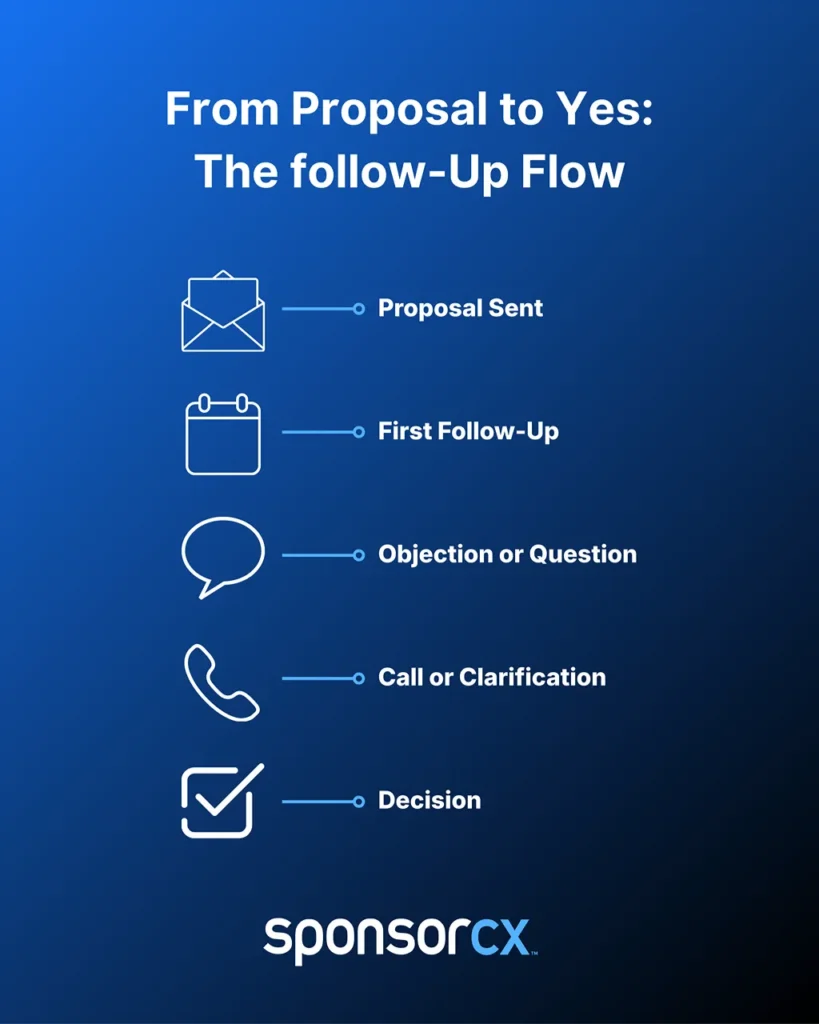
If you follow up too fast, you seem desperate. If you wait too long, the momentum dies. As a general rule, give your prospective sponsor three to five business days before checking in for the first time.
If you still haven’t heard back after the first follow-up, wait another week. If the third check-in goes unanswered, it’s probably time to move on or pivot your strategy. Remember, silence usually isn’t a “no”—it’s just a “not right now” or “we need more information.”
What to Say (And What to Skip)
When you reach out, keep it brief and helpful. Your goal is to be a partner, not a pest.
- Do say: “I wanted to see if you had any questions about the audience data I shared.”
- Do say: “I saw [News about their company] and it made me think our partnership would be even more timely.”
- Don’t say: “Just checking in again.” (This adds zero value.)
- Don’t say: “Did you see my last three emails?” (This is a lame attempt to make them feel guilty. Not a great foundation for a partnership.)
Handling Objections in Writing
When a sponsor does reply with a “no” or a “maybe,” don’t panic. Objections are just requests for more information.
- “It’s not in the budget”: Don’t walk away yet. Ask if they have a smaller “pilot” budget or if they’d like to see your entry-level sponsorship tiers. Sometimes, getting a foot in the door with a smaller sponsor level example is better than nothing.
- “We aren’t doing events this year”: Pivot. Remind them that your sponsorship deck includes digital assets, newsletter mentions, and social media reach that don’t require an in-person presence.
- “I’m not sure about the ROI”: This is your cue to offer a more detailed breakdown of your measurement plan. Show them how you track sponsorship benefits and ROI so they feel the investment is safe.
Simple follow-up email (3–5 days)
Hi [Name],
I wanted to follow up on the sponsor proposal I shared last week. Based on what you mentioned about [goal], I think the [specific tier or idea] may be the best fit.
Happy to answer questions or walk through it together if helpful.
Best,
[Your Name]
When to Pivot to a Call
If you find yourself going back and forth over email more than three times, it’s time to get on the phone. Tone of voice and real-time brainstorming can solve in five minutes what might take five days to type out.
If they ask for a major change to your sponsorship proposal template or want to negotiate pricing, say: “That’s a great point. It’s probably easier to hash that out in a quick 10-minute chat so I can make sure I’m giving you exactly what you need. Do you have time Thursday?”
Simple Follow-Up Scripts
The “Value-Add” Follow-Up (5 days after sending)
“Hi [Name], I’m sure your week has been a whirlwind. I wanted to send over a quick note regarding theproposal I sent last Tuesday. Since we last spoke, we’ve confirmed [New Speaker/New Metric], which I think aligns perfectly with your goals for Q3. Happy to answer any questions when you have a moment.”
The “Handling Price” Pivot
“I completely understand that the ‘Innovation Tier’ is a significant investment. If the budget is tight right now, would you be open to looking at our mid-range event sponsorship levels? We could focus specifically on the [Specific Benefit] to ensure you’re still getting the reach you need within a more comfortable price point.”
The “Gentle Final” Check-In
“Hi [Name], I haven’t heard back, so I’ll assume the timing isn’t quite right for this specific event. I’ll take [Brand Name] off our active list for now to make room for other partners, but I’d love to stay in touch for future opportunities. All the best!”
Closing a deal is about persistence and empathy. When you master how to make a sponsorship proposal and pair it with a professional follow-up, you stop being a salesman and start being a valuable business ally. How ever you follow up, make sure your tone matches the tone of the original proposal.
Next Steps
Getting to “yes” isn’t about luck; it’s about preparation and professional storytelling. We’ve covered everything from building a high-impact executive summary to structuring event sponsorship levels. By moving away from a “benefits salad” and toward a data-driven persuasive sponsorship proposal, you position yourself as a partner who cares about the bottom line.
Remember, a great sponsor proposal is just the beginning. The magic happens when you combine your unique audience story with clear sponsorship tiers and a rock-solid plan for measuring sponsorship benefits and ROI. Whether you are looking at a sponsor proposal example for inspiration or building a fresh sponsorship deck, keep the focus on the value you create for the brand. The next step is doing.
If you’re ready to move beyond one-off proposals and instead manage with consistency, structure, and confidence, SponsorCX can help. Our platform provides state-or-the the tools to organize proposals, track engagement, and guide sponsors from first conversation to signed agreement without losing momentum.
You bring the opportunity. Your sponsors bring the goals. SponsorCX helps connect the two.
If you have questions or want to see how teams use SponsorCX to streamline how they get sponsorship, let’s start a conversation.