This piece draws on a recent conversation between Jim Andrews, host of SponsorCX's webinar series, and Gordon Kane, a sponsorship veteran who helped launch Sprint's sponsorship of the 1994 World Cup and later led partner development for the San Jose Earthquakes in MLS.
Kansas City was never supposed to be a World Cup story. It's the smallest host city in the tournament, tucked in the Midwest, nowhere near a coast. But talk to anyone tracking sponsorship and hosting strategy right now, and Kansas City keeps coming up as the surprise winner. The city didn’t host any games, but it convinced teams to live there.
That distinction between hosting an event and hosting a relationship is the real story of this World Cup. FIFA rewrote the economics of hosting the World Cup. The fallout is reshaping how properties, brands, and cities think about sponsorship, fan experience, and revenue. If you manage partnerships for a team, a venue, or a brand, there are lessons here you can use long before the next mega-event lands near you.
Winning the Host City Race Without Hosting the Most Games
Kansas City hosted six matches. On paper, that's a modest slate. But the organizing committee made a different bet. Instead of competing for game days, it went after training camps. Argentina, The Netherlands, England, and Algeria all set up their base camps in the Kansas City area. Even when those teams played matches in other cities, they returned to their Kansas City-area base camps afterward.
That single decision changed the tournament's economics for the city. Fans travel with their national teams. If Argentina is based in Kansas City, Argentine fans are staying in Kansas City hotels, eating in Kansas City restaurants, and filling Kansas City bars, whether or not Argentina plays there that week. One expert who advised US World Cup sponsors as far back as 1994 put it simply: Kansas City turned itself into a hub for "soccer tourism," not just soccer.
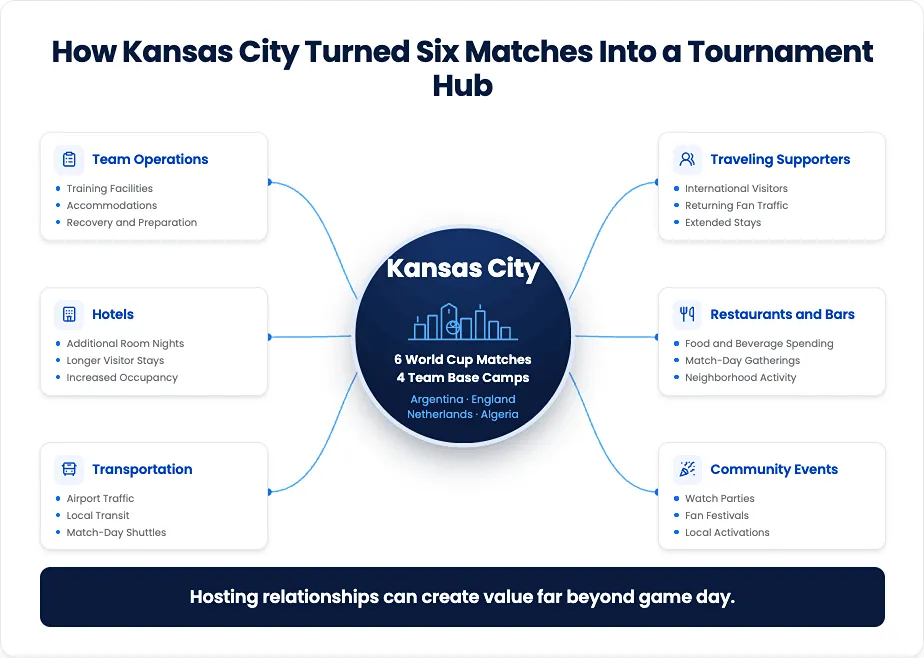
The lesson for sponsorship teams is about where you choose to plant your flag. A city, a brand, or a property doesn't need the biggest event on the calendar to win the most attention. It needs to become the place people want to return to. That's a positioning decision, and it's one any team or venue can make regardless of size.
FIFA Kept the Revenue and Handed Cities the Bill
Most major sporting events follow a familiar model. A host country sets up an organizing committee that runs operations and keeps ticketing and sponsorship revenue. Under the 2026 hosting model, FIFA retained control of major revenue streams, including ticketing and global sponsorships. Host cities were responsible for substantial operational costs including security, transport, stadium readiness, and watch parties. FIFA kept the sponsorship and ticketing revenue for itself.
That split created a problem cities didn't fully see coming. Local sponsorships were restricted so they'd never compete with a FIFA sponsor category. That limited how much revenue cities could recover on their own.
Boston is a good example. The Boston host committee faced limits on local sponsorship opportunities while nearby Foxborough confronted an estimated $7.8 million security bill. On top of that, international fans weren't prepared for transport logistics. Scottish fans arrived expecting to walk to the match, the way they would at home. Instead, they found themselves paying $80 for a round-trip train ticket.
If you work in property sponsorship, this is worth a closer look. When an event owner controls the revenue lines but pushes costs down to the local level, the math only works if you build alternate revenue paths early. Several host cities have already told FIFA they won't sign the same terms for the 2031 Women's World Cup. That pushback is itself a signal. You’ve got to know exactly what you're agreeing to control, and what you're agreeing to pay for, before you sign anything.
The Bay Area's Workaround Is a Model Worth Copying
Not every host city accepted the constraints as final. The Bay Area took a different route. The region worked through the Bay Area Host Committee, a long-term organization created to attract and support major sporting events across the region. It sold sponsorships under its name. By developing a broader regional identity around the Bay Area Host Committee, organizers created additional opportunities to involve local partners without positioning every activation as a direct FIFA sponsorship.
The same logic carried over to watch parties. The Bay Area spans several cities, Oakland, San Francisco, San Jose, with no single natural gathering point. Instead of trying to run one centralized watch party, the host committee let each city run its own and supported it from the sidelines. That kept costs local and let each community host an event that fit its geography.
This is a pattern any sponsorship team can use to its advantage. When a bigger partner's rules limit what you can sell or how you can activate, building a parallel entity, even an informal one, can open doors the primary brand can't. It's the same principle behind co-branded fan clubs, licensed local activations, or city-specific sponsorship tiers that sit outside a league's national deals.
Watch Parties Became This Tournament's Real Sponsorship Asset
Every host city has leaned on watch parties to give fans a way to experience the tournament without a ticket. What's notable is how much brand activity has clustered around them. McDonald's is backing Chicago Fire's watch parties as part of its new naming rights deal for the club's stadium. Airbnb sponsored free SEPTA rides home after World Cup matches in Philadelphia. These aren't afterthought sponsorships. They're becoming the primary way brands reach fans who will never set foot in the stadium.
Chicago never signed on as a host city at all, and its MLS team still found a clear opportunity. Chicago Fire took over a venue and opened it to fans who wanted to watch. That move built goodwill with existing fans and introduced the sport to a much larger, more casual audience, all without a ticketed event.
For sponsorship managers, watch parties deserve the same strategic attention as in-stadium activation. They reach a bigger audience, cost less to execute, and create a direct, memorable association between a brand and a shared, low-pressure moment. If your organization treats watch parties as a marketing afterthought, this tournament is a good argument for reconsidering that.
Transportation and Hospitality Are an Overlooked Sponsorship Category
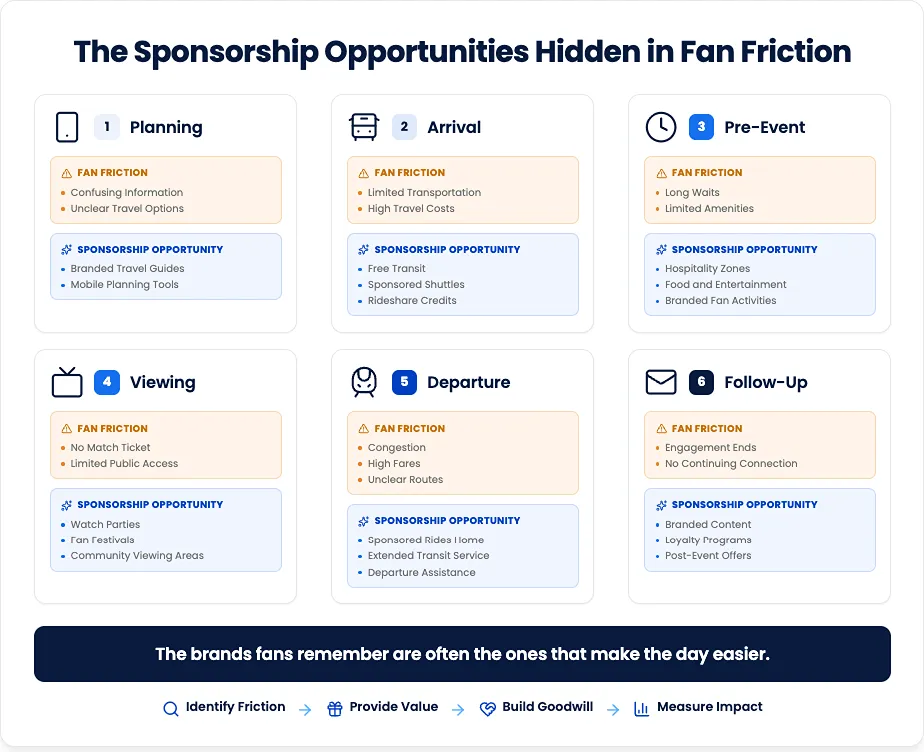
Kansas City built a bus system connecting downtown to the stadium for fifteen dollars round trip, with six pickup points around the city. It's affordable, it works, and it solves a real problem for fans without other transportation to and from the game. Nobody has sponsored it yet.
That's an opportunity gap. Airbnb's free transit rides in Philadelphia show what's possible when a brand picks up a cost fans would otherwise absorb themselves. Fans remember who made their day easier, not just who put a logo on a jumbotron. Transportation, shuttle service, and last-mile hospitality can cost considerably less than naming rights or jersey patches while serving a broad cross-section of attendees.
If you're building a sponsorship pitch for the next major event in your market, or even for a single sold-out home game, look at the friction points fans experience getting in and out of the venue. Whoever solves that friction earns a level of goodwill that's hard to buy through traditional signage.
What European and South American Fandom Can Teach American Teams
The contrast between how American and international fans experience their teams keeps surfacing in conversations about this tournament. It points to something sponsorship teams often miss. At many European clubs, a season ticket is treated as a birthright, not a transaction.
Borussia Dortmund's famous standing terrace, the Yellow Wall, charges roughly €19 a ticket. Resell it, and you're banned from ever buying another one. The team could charge far more but It doesn't because the value isn't in maximizing that one ticket. It's in keeping a section of fans who show up loud, consistent, and multigenerational, for decades.
American sports, by contrast, tend to treat tickets as pure revenue events, priced for whatever the market will bear on a given day. That's partly about mobility. Fans move between cities more often in the US, so a team can't count on a season ticket holder's grandchildren still living nearby. But it's also a choice about what a franchise wants its fan base to be.
Scottish and Argentine fans who traveled to this tournament didn’t behaving like customers. They behaved like owners of something. That kind of loyalty is hard to manufacture, but pricing decisions either protect it or erode it. A family priced out of games today may represent a generation of fans the team will not have 20 years from now. Any sponsorship or ticketing strategy worth building should ask which of those two outcomes it's optimizing for.
Building Your Own Legacy from This Tournament
The World Cup ended. The crowds went home. Most of what made this tournament work won't show up in a highlight reel. It's in the decisions: which fans a city chose to court, how a brand showed up where cameras weren't pointed, and how tickets got priced when nobody was watching closely enough to notice.
None of that requires a global tournament to replicate. It requires clear thinking about where your organization's leverage is. It requires the discipline to track the partnerships, costs, and renewals that make a strategy like this work over time.
You're the one building relationships, chasing renewals, and making the case for the next sponsorship dollar. That's a lot to carry. SponsorCX gives you one place to centralize every partner and contract detail, automate renewal reminders and deliverables, track performance against goals, and report results in a way that makes the value of your program obvious. You keep building the relationships that matter. SponsorCX helps you prove those relationships are working.
You make innovative sponsorship happen. SponsorCX makes it simple.