This conversation comes from a recent SponsorCX webinar hosted by Jim Andrews, who sat down with Bre Auberry, Global Brand Director, Cultural Marketing for the LEGO Group. Together they unpack a distinction that trips up even experienced sponsorship teams: What’s the difference between passion marketing and cultural marketing?
Andrews brings decades of sponsorship industry experience to the conversation, while Auberry draws on a career that spans JPMorgan Chase, 100 Thieves, and her own cultural marketing agency, Black Thread, before landing at LEGO. Their discussion explores why loving a sport or a festival isn't the same as understanding the community built around it. The difference matters for anyone trying to build a partnership that lasts.
Two Terms, One Big Difference
A brand can spend millions sponsoring the right team, the right festival, the right athlete, and still walk away with nothing but a logo on a jersey. Meanwhile, another brand spends a fraction of that and becomes part of the culture itself: quoted in rap lyrics, referenced in group chats, expected at the same event every single year.
The difference is whether the brand understood the community it stepped into, or just borrowed its stage.
For property owners and brand sponsorship managers, Auberry’s distinction between passion marketing and cultural marketing isn't academic. It changes how you pitch a partner, what you promise them, and whether the relationship survives past the first activation.
Passion Marketing Gets You in the Room
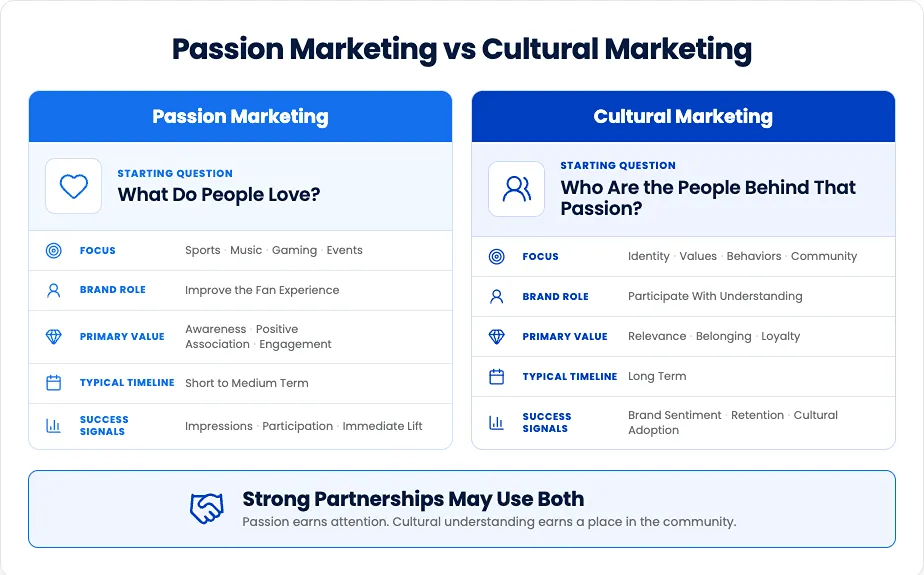
Passion marketing starts with what people already love: a sport, a genre of music, a game. It's the easiest kind of marketing to justify, because the data is everywhere. Sponsor a team, and you reach people already paying attention, already in a good mood, already leaning in.
That's valuable. It builds awareness. It builds positive association. It gets your name in front of the right eyeballs at the right moment. Most sponsorship deals live here, and there's nothing wrong with that.
But passion marketing has a ceiling. It reaches people because of what they're watching, not because of who they are. It borrows attention and borrowed attention disappears the moment the sponsorship contract ends.
Think about a beer brand that sponsors a music festival and offers a simple perk: bring back a warm beer, get a cold one. It's a small gesture, but fans start expecting it every year. It becomes part of how they remember the festival. That's passion marketing done well. It doesn't require the brand to say anything about who those fans are. It just requires showing up in a way that makes the experience better. That's a real and worthwhile goal, even if it stops short of cultural marketing.
Cultural Marketing Goes One Layer Deeper
Cultural marketing asks a different question. Instead of "what do people love watching," it asks, "who are the people behind that love, and what do they believe, value, and do because of it?" It’s all about affinity.
Take basketball. Passion marketing sponsors the game. Cultural marketing recognizes the fashion, the music, the language, and the identity built up around the game, and shows up inside that larger world, not just courtside.
This is harder to do well, because it requires fluency in a community you may not be part of. Auberry uses golf as an example: she's learning to play, but she knows she doesn't yet have the instinct a lifelong golfer has. Hand her a cultural marketing brief for golf today, and a serious golfer might spot the gaps immediately: terminology that feels forced, an unfamiliar ritual, or a reference that doesn’t quite land. Surface-level effort is easy to see through if you're actually inside the culture.
That's the cost of skipping the groundwork. Communities can tell the difference between a brand that studied them and a brand that skimmed a trend report.
Red Bull offers a useful example of doing this well. It didn't start by asking who its audience was. It started by deciding what it stood for: pushing limits, taking risks, chasing the extreme.
From there, it looked for the specific corners of culture where that identity already lived: skydiving, breakdancing, late-night events built around risk and adrenaline. The identity came first, and the audience followed from it. That’s an important sequence. Start with the community, and you risk chasing a moving target. Start with what your brand stands for, and the right communities become easier to find.
Attention Is Not the Same as Relevance
Here's where a lot of sponsorship teams get tripped up. A campaign generates buzz, the mentions spike, and someone on the brand side declares victory: "We're culturally relevant now."
Maybe. Or did the brand just get loud for a minute?
Auberry points to a real example: Hennessy’s social media stunt around the off-season announcement of NBA superstar, LeBron James. It was teased as major news that instead turned out to be a partnership reveal. It generated enormous conversation but also drew backlash from people who felt misled. A high volume of chatter is not proof of cultural standing. Sometimes it only proves that a stunt attracted attention.
Contrast that with a campaign built around clear intention, even a controversial one. When a brand knowingly leans into a message and accepts the disagreement that follows, that's a strategic choice with a point of view. When a brand generates noise without a clear point of view behind it, that's just noise. Both can trend. Only one builds something that lasts.
The property-side lesson: don't let a brand partner mistake impressions for relevance. Help them understand what they're actually building, not just what they're generating.
Culture Can Adopt You Without Asking
Sometimes a brand becomes culturally significant without meaning to. Auberry's clearest example is the Nike Air Force 1. The white version became a symbol of pristine style, kept spotless, referenced constantly in music. The black version took on an entirely different meaning in certain communities, tied to a harder, more confrontational identity. Nike didn't script either association. The culture did.
This cuts both ways for property owners. It means a fan base can shape how a sponsor is perceived in ways neither party planned. It also means paying close attention to how your own audience is already talking about a prospective partner, because that conversation may already be underway before you ever sign a deal.
Do the Work Before You Ask for a Seat
If cultural marketing requires fluency, where does that fluency come from? Not from social listening alone, and not from demographic data alone. It comes from bringing people from the community into the room, people who can catch what an outsider would miss.
Auberry is direct about this: entering a community without doing that work is one of the fastest ways to get it wrong. Creative choices, especially, need to be made with full understanding of what they signal. Whether through casting, color, or positioning, a community will interpret what a brand’s creative choices signal, intended or not.
This is where property owners have real leverage. You likely know your audience better than any prospective sponsor does. You know their pain points, their unwritten rules, what they'll welcome and what they'll reject. That knowledge is worth more to a brand than a media kit full of demographics. It’s the difference between offering sponsorship inventory and providing audience insight a brand cannot get anywhere else.
Ask the Right Questions Before You Build the Deal
Before any partnership is solidified, both sides need a clear answer to one question: Is this passion marketing or cultural marketing? Not every brand needs to go deep. Some brands are well served by staying visible, associating with something people love, and stopping there. That's a legitimate choice, not a lesser one.
But if the goal is deeper cultural relevance, that intention must be explicit from the start. What does the brand stand for? What is it willing to be part of? Where is it willing to go? Skip that conversation, and you risk building a campaign with no clear direction, one that culture can pick up and run with in ways you never intended.
For partnerships seeking cultural relevance, one useful gut check is this: Would the audience notice if the brand left? If the answer is no, the partnership may not have earned a meaningful place in the community.
Measure What Reflects the Goal
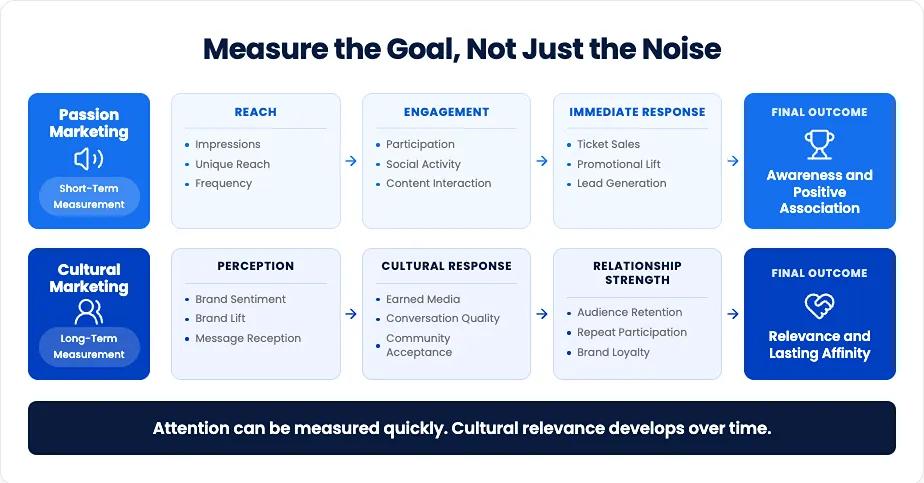
Cultural marketing doesn't move on the same timeline as a ticket promotion. Don’t measure it like one. There's no single dashboard that captures it, and any team claiming otherwise is oversimplifying.
Instead, look at a mix of signals:
- Brand sentiment and lift studies
- Earned media and how it's framed
- Social listening that tracks whether the right conversations are happening
- Audience data that shows who's walking in the door, buying, and coming back
Retention matters here as much as reach. Cultural marketing depends more on whom it attracts and retains than on how many people it reaches over a single weekend.
Passion marketing can often be measured in the short term: impressions, engagement, immediate lift. Cultural marketing asks for patience, because the return appears in loyalty and associations that develop over years.
That patience is uncomfortable for teams used to reporting quarterly wins. Say it plainly to a brand partner up front: if you want cultural marketing, don't expect the same reporting cadence as a ticket promotion. Set expectations early. Track the slower signals carefully. Don’t scramble to justify the spend with numbers that were never meant to capture it.
Passion marketing and cultural marketing aren't competitors. Most partnerships need at least some of the first, and only some need the second. The mistake is not knowing which one you're doing, and building a strategy that can't tell the difference.
You know your audience. You've built the relationships, done the groundwork, and earned the trust that makes a partnership more than a logo placement. What you need is a way to manage those partnerships without losing the details that make them work: the deadlines, the deliverables, the renewal conversations that decide whether a brand stays or walks.
You make cultural marketing happen. SponsorCX makes it simple. SponsorCX helps you keep every agreement, deliverable, deadline, and renewal conversation in one place. Request a demo to see how clearer partnership management can support stronger, longer-lasting sponsor relationships. Reach out for a demo today.