The Innovation Pipeline: How Emerging Tech Is Shaping the Future of Sports Sponsorship
Practical ways innovation is changing sales, activation, and measurement
Have You Lived This Moment?
It’s 48 hours before the renewal call with Peak Protein Bars. You promised measurable lift from a jersey patch, LED ribbon takeovers, a TikTok creator, and an in-app AR filter. At 9:13 a.m., Jamie, the CMO, Slacks: “Show me sales from exposed fans vs. control.” Panic starts.
Your broadcast folder is missing the out-of-town feed where virtual boards ran different creative. The TikTok post wasn’t tagged. The QR code drove traffic but few logins, and the discount code leaked to a deal site. Your slide with “1.6M impressions” feels like grasping at straws. The CFO expects proof, not platitudes. PowerPoint and bravado won’t cut it.
The fix: plug into the innovation pipeline. AI verifies what ran. Computer vision creates virtual inventory you can sell by market. Clean rooms prove lift without sharing raw personal data. AR turns in-venue hype into actions you can count. When these pieces work together, sponsorship becomes a growth channel with contextual placements, real outcomes, and numbers that make the CFO smile.
The State of Innovation in Sponsorships
Fan attention is split across broadcasts, social clips, and second screens. The upside: better data pipes and AI in sports sponsorship make targeting and measurement clearer than ever. Data clean rooms are moving from “pilot” to “standard,” giving brands and rights holders a safe way to plan, activate, and prove results without trading raw PII. It’s time to update your stack—and your playbook.
Glossary of Terms
- Contextual units: sponsor placements triggered by the moment (e.g., a “shot difficulty” lower-third after a big play)
- Raw PII (Personally Identifiable Information): names, emails, phone numbers, addresses—unmasked information you don’t share
- Hashed IDs: scrambled identifiers that match audiences without revealing who people are
- Incremental lift: extra actions or sales caused by the sponsorship, not just correlated with it
- Geo offer: promotion that changes based on location
- UTM (Urchin Tracking Module): tag added to a link so analytics can see where a visitor came from and why they clicked
- Token-gated Access: Only people who hold specific digital tokens can access certain content, products, or experiences.
- Attribution Creep: When multiple vendors each claim credit for a result.
What’s in the Innovation Pipeline
To move from buzzwords to results, think in five lanes of emerging sports technology you can package, sell, and measure.
1) AI in Sports Sponsorship (Going Prime Time)
What it is: AI analyzes game situations in real time and turns them into simple, fan-friendly insights like “shot difficulty,” “player gravity,” or instant “play finder” recaps.
Why it matters: These contextual units are ad slots triggered by the moment, not cookies. They’re relevant and privacy-friendly.
How to use: Pair the AI moment (e.g., a buzzer-beater probability graphic) with a sponsor overlay or quick presenter read and a clear call to action (scan, save, shop, sign up).
2) Computer Vision & Virtual Signage
What it is: software that finds your brand on screen and measures visibility (placement, duration, clarity), plus virtual ads that change by market on the same broadcast.
Why it matters: you sell more inventory without adding hardware and you can confirm exactly what ran.
How to use: offer market-specific creative to multinational sponsors, test messages by region, and scale the winners.
3) Data Clean Rooms (Plan + Measure Without Raw PII)
What it is: a privacy-safe environment where both sides bring hashed identifiers to compare overlap, build segments, and measure lift. Raw PII stays put.
Why it matters: you can link exposure to site visits, app actions, and sales without sharing customer files. Data Clean rooms are becoming standard but not vendor-like.
How to use: set up the clean-room connection during contracting and pre-register the study design (windows, controls, success thresholds) so everyone agrees before launch.
4) Immersive Sponsorship (AR) That Converts
What it is: mobile or in-venue augmented reality that overlays digital effects on the real world using filters, 3D objects, simple games. Everything is tied to a concrete offer.
Why it matters: fans don’t just watch; they do something you can track: scan, unlock, redeem, share, or join.
How to use: trigger AR during a big moment (goal, home run, player intro) and tie it to a one-step redemption (wallet pass, code, tap-to-claim) so outcomes are clear.
5) Blockchain Partnerships (Beyond Collectibles)
What it is: token-gated access to content, voting, or experiences.
Why it matters: done right, tokens become utility, not hype—another way to structure loyalty and access.
How to use: lead with benefits (priority entry, exclusive content, early merch, member pricing). Use plain language. Hide the tech; show the value.
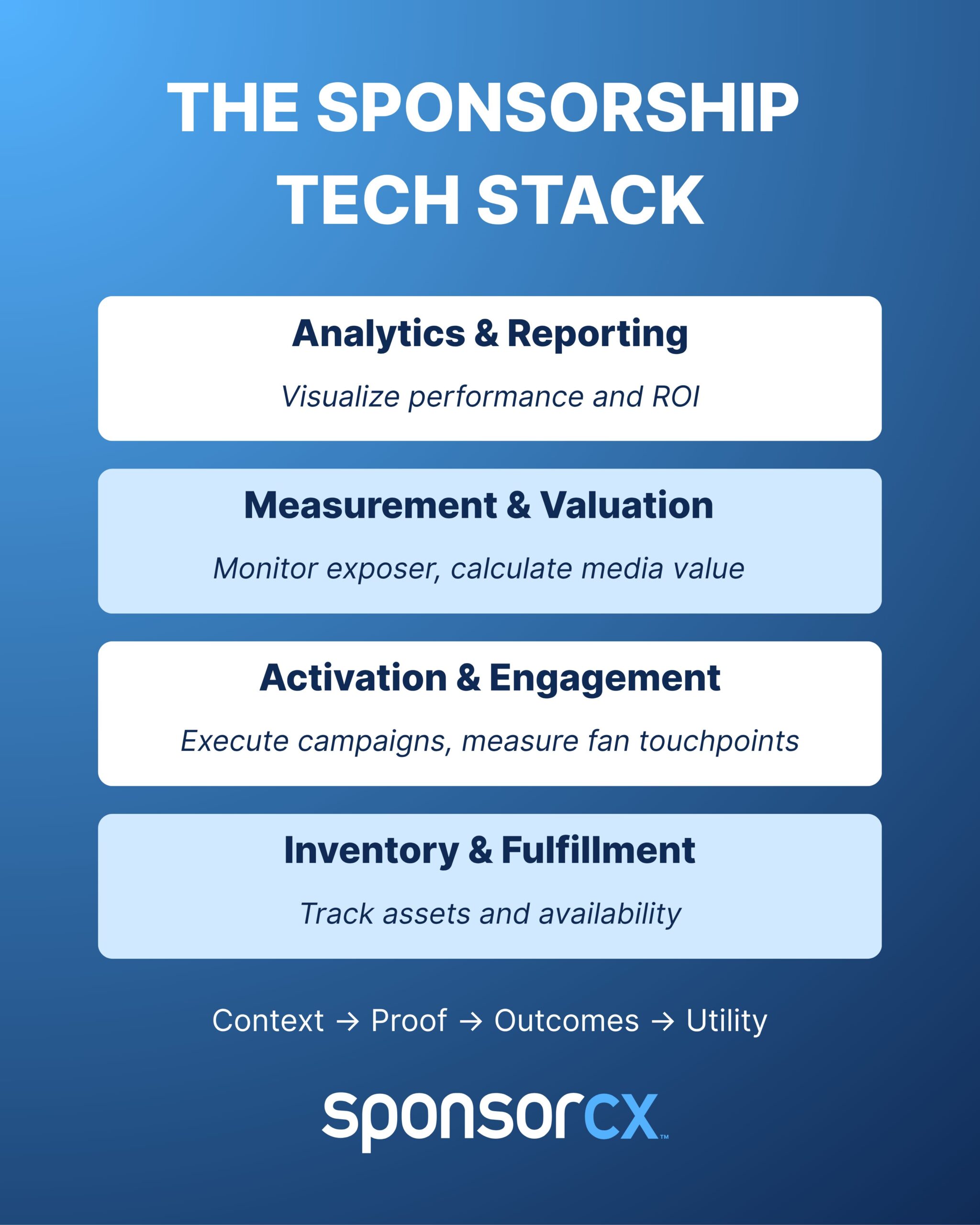
How the lanes connect:
- AI and computer vision create context and proof
- Clean rooms convert that proof into business outcomes
- AR turns moments into trackable actions
- Blockchain adds utility for super-fans
That’s the pipeline.

How Innovation Changes the Sponsorship Lifecycle
Winners treat sales, activation, and reporting as one loop powered by tech-driven sponsorships.
Prospecting & Packaging
- Use data, not hunches. AI ranks categories and accounts using CRM, ticketing, web/app events, and social signals
- Build an ideal customer profile (ICP) per market. Who buys, where, and when? Which assets drive trial, email capture, app installs, or purchases?
- Map assets to outcomes. Virtual boards for geo offers; AR for coupon unlocks; creator co-posts for sign-ups.
- Auto-assemble proposals. Dynamic pricing, localized creative, timelines, and a measurement plan with KPIs, control groups, and the clean-room method
- Pre-wire legal. Put clean-room language, consent, and retention terms in the Master Services Agreement (MSA)
- What you hand a buyer: a target list, an asset-to-outcome matrix, sample creative, and a one-page verification + lift plan
Activation
- Assume two screens. Package broadcast graphics, short-form recuts, creator co-posts, and a simple in-venue trigger (AR, QR, or NFC) tied to a real offer
- Tag everything. UTMs, coupon logic, and app events so every unit can be read
- Localize virtual boards. Market A gets one offer; Market B gets another
- Run it like a live show. A run-of-show doc, a “hot-swap” bench of backup creative, and a daily scorecard so weak units get replaced before the next game
- Guardrails. Brand-safety checks, frequency caps, ADA-friendly AR, and an offline fallback
Renewals
- Show the full line, not one stat. Verified exposure (what ran) → engagement (clicks, participation, dwell) → incremental outcomes (sales/actions vs. control)
- Speak finance. Add cost per outcome, incrementality, and payback period
- Close the loop. Lock winners into next season and retire what didn’t work. Capture learnings in a simple, shareable playbook
Measurement That Proves Value
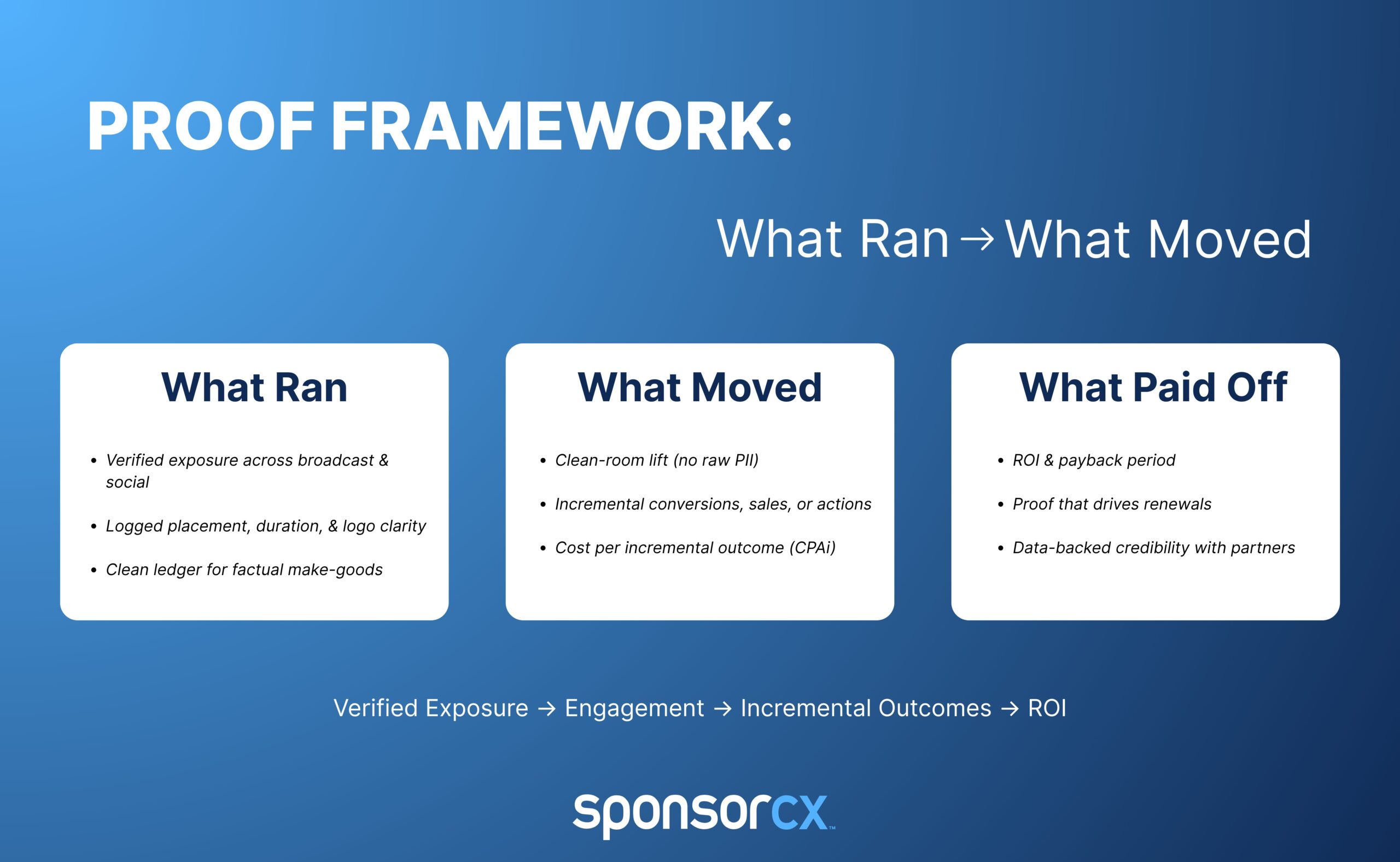
You don’t win renewals with adjectives. You win with proof. Use this framework:
What Ran. Use computer vision to log where, how long, and how clearly each placement appeared across broadcast and social. Track share of screen, occlusion, and logo quality. Keep a clean placement ledger so make-goods are factual, not emotional.
Tip: put a single “What Ran” slide near the front with totals by asset, and link to the ledger.
What Moved. Run clean-room lift studies. Define exposed vs. matched control, set the read window, and match hashed IDs to site visits, app events, or sales. No raw PII changes hands. Report incremental conversions, cost per incremental outcome, and payback period. This is your credibility engine.
Tip: pre-register the plan (eligibility rules, windows, de-duplication) so no one rewrites the rules after results arrive.
Immersive KPIs for AR. Treat AR like a funnel, not a magic trick:
- Participation rate: opens / eligible fans
- Dwell time & interactions: time engaged, taps, collects
- Unlocks & redemptions: use single-use tokens to prevent leakage
- CRM append (where permitted): connect to profiles for future targeting
Quick scorecard: Verified exposure → Engagement events → Incremental outcomes → CPA(i) → ROI/payback
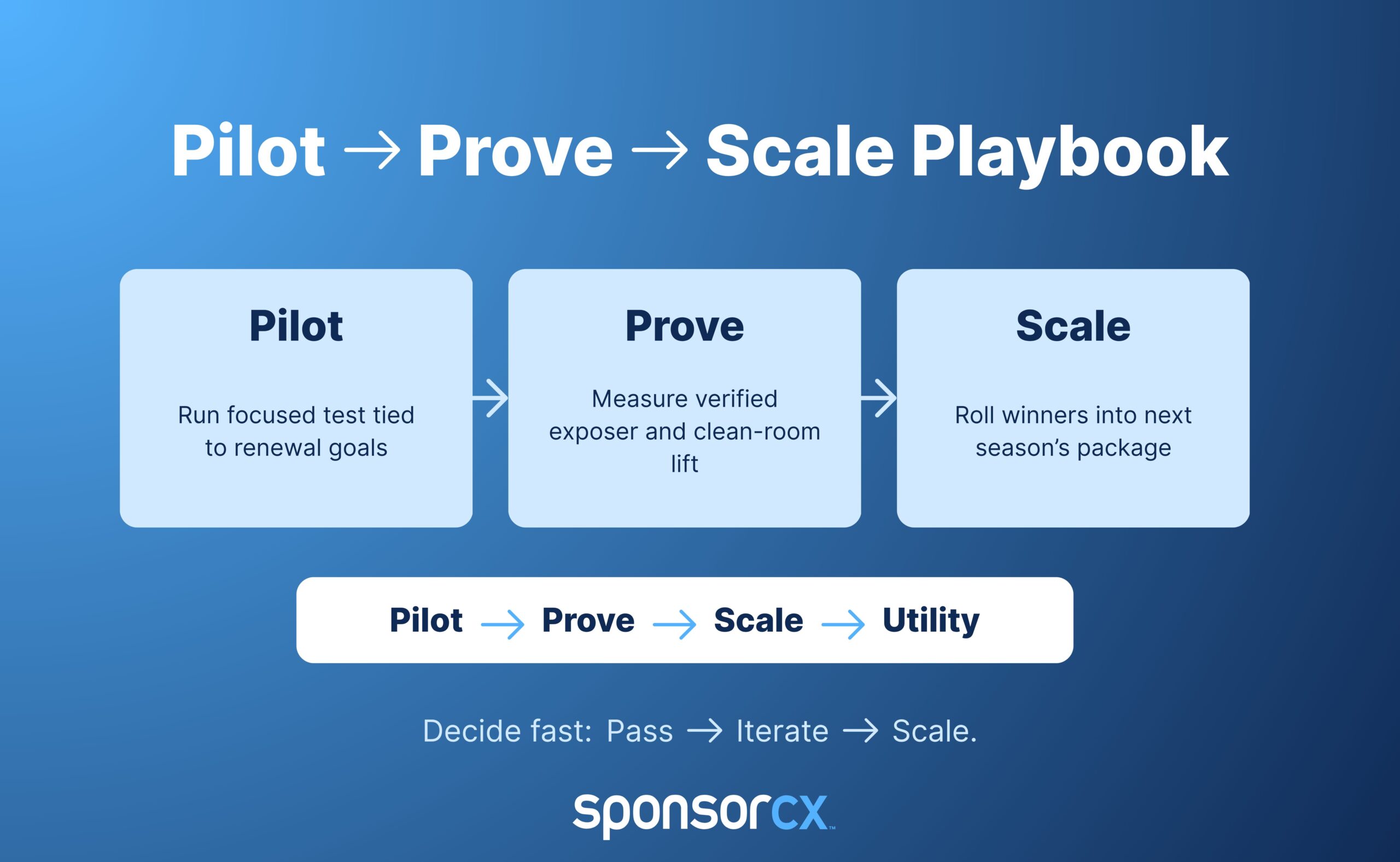
Playbook: Pilot → Prove → Scale
Before you bet the season, run a focused, measured pilot. Keep it small enough to move fast and instrumented enough to be conclusive.
- Pick 1 or 2 high-yield pilots tied to renewal goals
Examples:
— AI prospecting to open a new sponsor category this quarter
— Virtual signage with market-specific creative across two broadcasts
— In-venue AR during player intros with a coupon tied to concessions - Set the data foundation. Consented IDs, clean event tracking, and clean-room access for both sides. Document the event schema and QA steps.
- Instrument for proof up front. Verify exposure (what ran), tag engagement (owned + social), and run a lift study (what moved). Pre-agree on thresholds, windows, and control size. Decide how you’ll de-duplicate outcomes across partners.
- Contract the data. Define what’s shared (aggregates only), retention windows, and roles. Align legal now, not the week of renewal.
- Operational cadence
— One owner: a single person is accountable
— Run-of-show: write the step-by-step plan
— Daily scorecard: check performance every day
— Swap fast: keep backup creative and replace weak performers
— Issue log: track problems and fixes - Decide quickly
— Hit the target? Scale it and increase the price
— Missed once? Try a stronger offer or creative
— Missed again? Scrap it and move on
Pilot one-liner template: fill in items in parentheses
“Run [asset/tech] in [market/games] for [dates] to achieve [business outcome]; success = [metric/threshold]; measured via [verification + clean-room].”
Here’s a great next-step resource.
Risks & Guardrails
New tools help; sloppy process hurts. Keep these rules to protect privacy, keep attribution honest, and deliver fan value that matters.
Privacy & Security
- Define purpose and lawful basis before any data match
- Move aggregates only—no raw PII
- Set retention windows, role-based access, and audit logs
- Encrypt in transit and at rest; pen-test vendors; manage keys
- Add a DPA and assign data steward roles
- Verify consent language covers measurement and personalization
- Keep a breach playbook and practice it
Attribution Creep
- Pre-register the measurement plan: eligibility rules (viewability, geo/time windows), control/holdout design, and de-duplication across partners
- Use a single-source-of-truth hierarchy: clean-room lift > modeled attribution > last-touch
- Lock reporting windows and variance tolerances; if numbers conflict, the pre-registered method wins
- Consider an independent verifier for large or political renewals
Fan Value or Nothing
- Every immersive touch should deliver a clear benefit (discount, exclusive content, VIP access)
- Reduce friction: one-tap opens, wallet passes, ADA-friendly effects, and an offline fallback
- Use single-use tokens to prevent code leaks; cap frequency
- Tie redemptions to POS/app events so revenue shows up in the read
- Ship only what moves the needle
Near-Term Outlook: The Future of Fan Engagement
If you’re planning beyond the next season, expect three shifts to define innovation in sports and innovation in sports marketing.
- AI-native broadcasts go mainstream. Model-driven graphics trigger as the game unfolds. Sponsor placements tie to context including lower-thirds, replay frames, presenter reads with targeting rules and proof.
- Short-form monetization gets baked in. Packages will price repeatable highlights (templated auto-cuts), creator co-posts (approved talent posting your clip), and companion content (behind-the-scenes tied to a live moment). Contracts will spell out clip counts, windows, geo rights, and music. Success = completes, saves, shares, CTR, and redemptions—not just views.
- Clean-room collaboration becomes the cost of entry.
— Planning: audience overlap, lookalikes, and de-duplicated reach without exposing raw PII
— Measurement: lift vs. matched control, with pre-registered methods
— Readiness checklist: hashed ID strategy, consent language, event schema, QA process, and a clear measurement plan everyone signs
FAQs
What’s a clean room in plain English?
A privacy-safe workspace where you and a sponsor compare audiences and measure results using masked data. No raw personal info changes hands.
Why do we need control groups?
So you can tell the difference between people who would have acted anyway and people who acted because of the sponsorship.
Is AR just a gimmick?
Not if you tie it to a clear offer and measure redemptions. If fans get real value and you can track it, AR becomes a performance channel.
What’s the minimum to start?
One pilot, one clean-room connection, and basic computer-vision verification. Prove a win. Then scale.
Implementation Timeline (Fast but Doable)
- Week 1–2: Plan. Pick the pilot. Define outcome metrics and success thresholds. Start clean-room legal language.
- Week 3–4: Set up. Tag events and coupons; load creative variations; confirm virtual-signage markets; finalize run-of-show.
- Week 5–8: Run. Go live. Daily scorecards. Swap underperformers. Keep ops tight.
- Week 9–10: Read. Pull verification. Run the lift study. Calculate CPA(i) and payback.
- Week 11: Decide. Scale or retire. Lock learnings into next season’s packages.
Bottom Line
If you want renewals, make three upgrades now:
- Clean-room collaboration for planning and proof
- Verification and outcome measurement in every package
- A small testbed for immersive tied to real, redeemable value
Teams that do this win share while others argue about impressions.
You have ideas and enthusiasm. SponsorCX is the guide. We can help you:
- See what really ran with verified exposure across broadcast and social
- Prove what moved with privacy-safe clean-room lift
- Scale what works with dashboards that turn results into next season’s package
Reach out today and set up a no-obligation demo with a SponsorCX rep.