Alan, director of partnerships for a regional sports venue, sat at his desk surrounded by open tabs including email, spreadsheets, along with his brand-new sponsorship management platform. The software looked powerful on paper. It tracked assets, listed deadlines, and even sent automatic reminders. But when a top sponsor called to ask why its signage hadn’t been installed for opening night, Alan didn’t have an answer. His software couldn’t tell him who dropped the ball, or how to fix it.
Alan is not alone. Across the industry, many sponsorship managers face the same issue: lots of tools, not enough teamwork. Sponsorship management companies often promise end-to-end automation, yet few deliver genuine partnership. They sell platforms, not problem-solving.
Technology can organize your sponsorship assets, track engagement, produce reports, and help manage budgets. But people, process, and purpose working together is the formula for success. The right company doesn’t just help you manage sponsorships, it helps you maximize them.
This article explores how to spot a company that behaves like a true partner rather than just a vendor. You’ll learn what to look for, what questions to ask, and why collaboration, not code, drives long-term value.
The Shift from Tools to True Partnership
Before you can identify the right partner, it helps to understand how the best sponsorship management companies evolved—and where many still fall short.
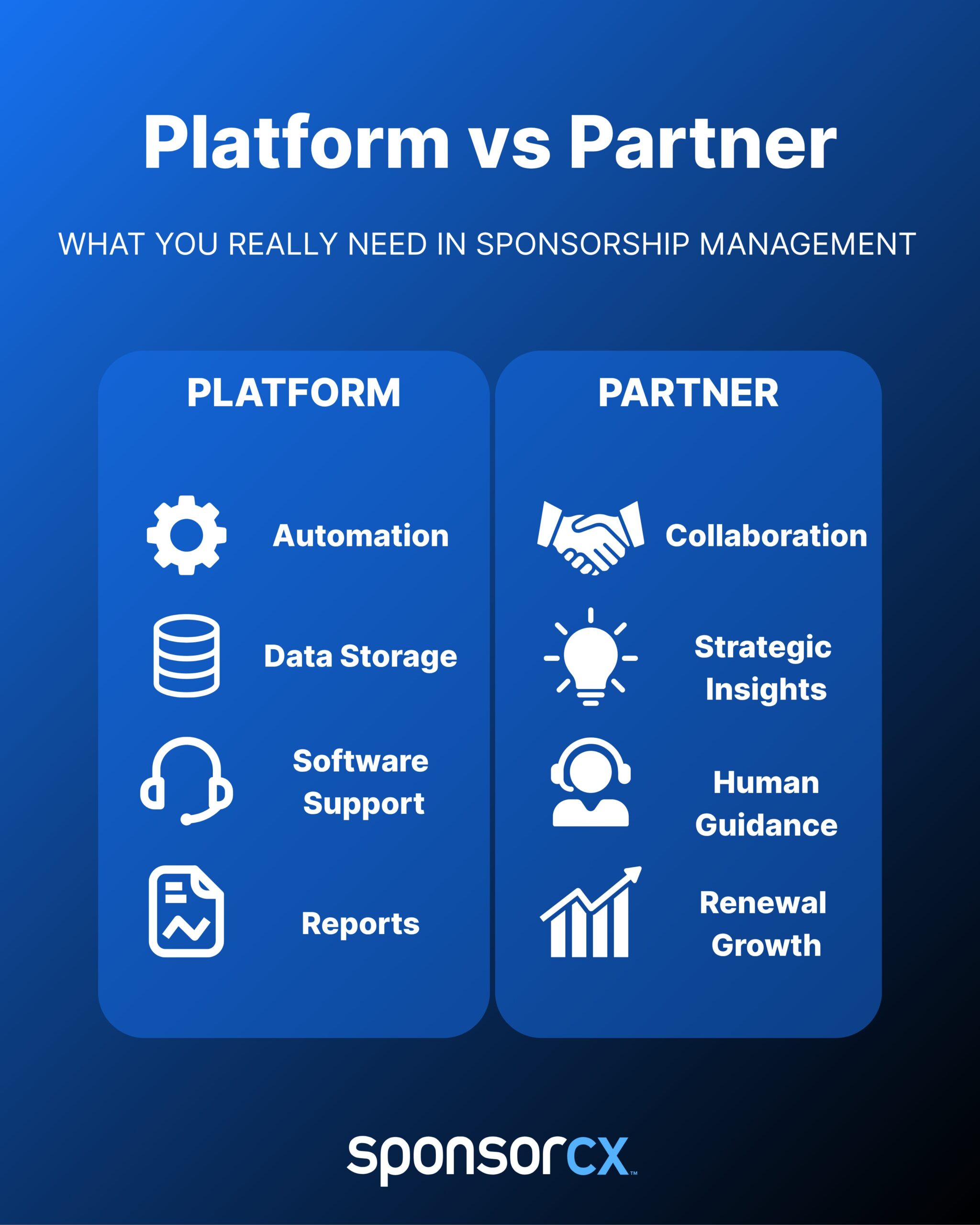
- The Software Trap. When early sponsorship service providers entered the market, they focused on automation: digitizing contracts, replacing spreadsheets, and tracking deliverables. Those were important innovations. But many properties soon realized that while the software could organize data, it couldn’t drive renewal strategy or sponsor engagement. A platform can keep you organized. A partner helps you perform.
- Partnership Defined. A genuine sponsorship partner acts as an extension of your internal team. It doesn’t disappear after onboarding; it collaborates on planning, activation, and reporting. It shares accountability for results. Instead of simply saying, “Here’s your dashboard,” a good partner asks, “How can we help you make these numbers tell your story?”
According to a 2024 SponsorUnited study, sponsorships with consistent mid-season engagement meetings between brand and property were 31 % more likely to renew. That’s not a software statistic. It’s a successful partnership-building strategy.
- Why This Shift Matters Now. Sponsorship has evolved into a performance-driven business. Sponsors expect data-backed proof, brand alignment, and community impact. Sponsorship management companies that offer tools without context leave teams guessing.
Modern organizations need sponsorship strategy support, and that means partners who can translate metrics into meaning. The future belongs to firms that combine systems, service, and strategy into one integrated offering.

What a True Sponsorship Partner Brings to the Table
- Strategic Guidance, Not Just Functionality. A platform gives you features. A partner gives you foresight. Before implementation, a great company conducts workflow interviews, audits your asset library, and helps you map your sales funnel. It understands that your CRM isn’t just for tracking leads; it’s for strengthening relationships.
Consider a mid-market soccer club that switched from a basic software license to a partner-driven model. Its new provider helped redesign the sales funnel, automate reporting, and align asset inventory with sponsor KPIs. Within one season, the club increased renewal rates by 22 % and reduced fulfillment errors by half.
That’s the difference between buying a tool and building a system with a partner.
- Human Support and Relationship Management. Automation can send reminders; people can sense urgency. A true sponsorship partner assigns a dedicated success team that understands your sponsors, goals, and pace. Real partners share a common purpose. It doesn’t hide behind ticketing portals. It joins your weekly calls, interprets your data, and acts before small issues become crises.
When a professional hockey team’s LED rotation malfunctioned during playoffs, its partner’s account manager coordinated between operations, creative, and vendor teams within hours. The sponsor’s message ran on schedule. No deliverables lost. No renewal risk.
- Ongoing Optimization. Partnership isn’t a one-time transaction; it’s continuous evolution. Top sponsorship management firms schedule quarterly reviews to examine campaign performance, flag underused assets, and help set benchmarks for renewal discussions. Good partnerships serve both property sales goals and sponsor brand building. Properties and brands must partner strategically.
A platform stores your metrics. A partner uses them to sharpen your strategy.
- The Payoff. When organizations pair strong technology with consultative partnership, they see tangible gains: faster activation cycles, cleaner reporting, higher sponsor satisfaction, and stronger renewal rates. The outcome isn’t just operational efficiency; it’s relationship durability.
Five Core Capabilities Every Sponsorship Management Partner Should Offer
Even the most strategic sponsorship service providers need robust systems. Here are the baseline capabilities to expect when evaluating end-to-end sponsorship solutions:

- Unified CRM and Asset Tracking. Every sponsorship detail, from inventory to contracts, should live in a single system. A partner helps configure your sponsor relationship management tools so that sales and activation teams see the same data in real time. Imagine walking into a renewal meeting with every activation log, image, and exposure stat at your fingertips. That’s not convenience. It’s credibility.
- Fulfillment and Activation Tools. Your partner should turn complexity into clarity. Real-time deliverable tracking, automated reminders, and fulfillment checklists ensure that nothing falls through the cracks. More importantly, partners help you act on what the data shows including adjusting timelines or reallocating assets before a missed deliverable becomes a broken promise.
- Performance Measurement and Reporting. Metrics matter only if they lead to insight. Look for a company that provides dynamic dashboards and sponsor-ready reporting templates. The goal isn’t to overwhelm with numbers; it’s to show value at a glance. Some sponsorship management companies even benchmark your results against peer organizations to highlight performance gaps and opportunities.
- Integrations and Scalability. Your sponsorship management platform should connect seamlessly with CRM systems, analytics tools, and ticketing databases. But scalability also means human adaptability. You want a partner who can support growth as inventory expands or your strategy shifts. The best providers don’t just accommodate your change; they help plan for it. Check out our “How to Build a Scalable Sponsorship Inventory Structure that Grows with You.”
- Consulting and Training Services. An underrated sign of partnership is investment in education. Top firms offer onboarding workshops, custom playbooks, and training sessions that help your team master the system. They empower you to be independent, but remain available when you need strategic guidance.
So, what does real partnership look like in action?
The Partnership Mindset in Action
When the unexpected happens, the gap between sponsorship platform vs partner becomes obvious.
A collegiate athletics department once discovered that its sponsor’s mid-season campaign had been left off the content calendar. Its system flagged the omission but offered no solution. Its partner, however, quickly arranged alternate digital assets, provided a make-good plan, and personally handled the sponsor call. The result? A smooth recovery and an early renewal.
That’s the partnership mindset: collaboration over transaction.
- Shared Success Metrics. True partners measure what matters. They align their KPIs with yours. These include fulfillment accuracy, sponsor satisfaction, and renewal rates, not merely logins or licenses. When their metrics mirror your success, you know you’re working with the right provider.
- Real-World Proof. Consider the approach of UEFA or the NBA. Both organizations pair advanced sponsorship systems with dedicated client success and strategy teams. The software captures performance; the human teams interpret and act on it. That hybrid model defines modern sponsorship management companies: a fusion of technology and trust.
Questions to Ask When Choosing a Sponsorship Partner
Use these questions as a roadmap to separate genuine partners from software vendors. They’ll reveal how they think, not just what they sell.
- Ask about partnership philosophy:
How will you support onboarding and training beyond launch?
Do we have a dedicated account manager or customer-success representative?
How often will we meet to review performance and strategy?
- Ask about flexibility:
Can your system adapt to our workflow, reporting style, and sponsor categories?
What integrations do you offer with CRM and analytics tools?
- Ask about accountability:
How do you measure your success against ours?
What KPIs are paramount?
Can you share examples where your team directly helped improve a client’s renewal rate or sponsor satisfaction? - Ask about longevity:
How do you evolve your software and services as client needs change?
What does your average customer tenure look like?
If the answers center solely on features, you’re dealing with a vendor. If they talk about outcomes, relationships, and shared growth, you’ve found a partner.

The ROI of Choosing a Partner, Not Just a Platform
Partnership pays measurable dividends.
Organizations that work with a consultative sponsorship management company consistently report higher efficiency, fewer missed activations, and improved renewal revenue.
A Deloitte Sports Business study found that properties using integrated systems with hands-on partner support improved renewal rates by 25 % on average within the first two seasons. That translates directly to bottom-line growth.
But the returns aren’t just financial. As the Global Sponsorship Trends 2025 report observes, sponsorship is evolving and properties that partner strategically see stronger activation, loyalty, and growth. The right partner frees your internal team from administrative overload. Instead of chasing deliverables, they can focus on creative activations and sponsor storytelling, the parts of the job that drive loyalty.
Case Example: From Vendor to Partner
A national nonprofit relied for years on a low-cost software vendor. The tool worked but staff were buried in manual tasks, and sponsors rarely renewed. After switching to a partner-driven provider that offered quarterly reviews, data insights, and training sessions, the nonprofit’s sponsorship revenue grew 30 % year-over-year.
Their new provider didn’t just fix the process; it helped redefine success.
Beyond ROI: Trust and Retention
The ultimate benefit of partnership is confidence. When your management company feels invested in your outcomes, your sponsors feel it too. Communication improves, results strengthen, and renewals become predictable instead of painful.

How to Transition from a Vendor Relationship to a Partnership
Not every team starts with the right fit—but you can evolve a vendor relationship into a partnership.
Step 1: Assess Your Current Experience. List what your current provider delivers versus what you actually need. Are you getting genuine sponsorship strategy support, or just a login and tech support hotline? Identify the gaps in collaboration and guidance.
Step 2: Start the Conversation. Ask your vendor for quarterly performance reviews or strategic planning sessions. A true partner will welcome the opportunity; a platform provider will hesitate. Use those meetings to align on goals like sponsor retention, activation efficiency, and report quality.
Step 3: Define Shared KPIs. Mutual accountability transforms relationships. Agree on metrics, renewal rate improvement, campaign delivery percentage, time saved per activation. Track them together.
Step 4: Explore Alternatives If Needed. If your current vendor can’t, or won’t, grow into partnership mode, evaluate new top sponsorship management firms that emphasize relationship-based service. Include language in your RFP that prioritizes strategic collaboration and ongoing optimization. The right candidates will highlight their consultative approach rather than just their code base.
The Bottom Line: Look for a Company That Invests in Your Success
The question of sponsorship platform vs partner boils down to impact. Platforms automate; partners accelerate.
When comparing sponsorship management companies, look beyond feature checklists. Prioritize philosophy. The best partners combine technology, teamwork, and tailored insight. They don’t just give you dashboards. They give you direction.
In the sponsorship world, relationships are your currency. A company that treats your success as its own is worth far more than one that treats you as a software subscription.
Choosing the right partner isn’t just a purchase. It’s a performance decision. The results speak for themselves.
Ready to Simplify, Strengthen, and Scale Your Sponsorships?
You already know where you want to go, better organization, happier sponsors, stronger renewals. What you need now isn’t another tool; it’s a partner who understands how to get you there.
At SponsorCX, we help properties and brands move beyond spreadsheets and siloed systems with end-to-end sponsorship solutions that put people, process, and performance on the same page.
Your story deserves more than software. It deserves support.
Let’s build it together.
Schedule a Live Demo and see how a true sponsorship management partner helps you turn potential into proof.