A practical guide to building one reliable system from prospecting through renewal
CRM in sports helps teams track sponsor relationships, sales, agreements, and renewals. Inventory, fulfillment, and reporting often remain separate, creating confusion and lost opportunities. Teams need one platform that connects each deal to its assets, deadlines, and results.
A sports partnership CRM manages sponsor relationships, inventory, agreements, activations, and fulfillment in one place. It also works for the nonprofit side of sports sponsorship, like athletic foundations, youth clubs, and community events.
It's tempting to think of a CRM as a glorified contact database. But an effective sponsorship CRM does more. It connects the rights sold, the work promised, the people responsible, and the proof collected, all the way through to the recap a partner gets at renewal.
In a Nielsen study of 100 sponsorships across seven markets and 20 industries, fans exposed to those sponsorships showed a 10% average lift in purchase intent. Delivering and documenting that kind of experience consistently is what protects the value partners take back to their own leadership.
This guide follows a sports sponsorship CRM from prospecting through renewal, covering essential data, outcomes, selection criteria, and rollout steps.
What Makes a Sports Partnership CRM Different?
A general CRM tracks companies, contacts, activities, opportunities, and revenue stages. Its usefulness fades when a sponsorship sales team must manage a season of signage, hospitality, content, approvals, invoices, and proof of performance.
A sports partnership CRM adds an operational layer that’s missing in a general CRM:
- It links available inventory to proposals and agreements
- It turns commitments into scheduled tasks
- It tracks delivery across games and campaigns
- It feeds fulfillment data straight into partner reports
SponsorCX's sports CRM software shows how accounts, inventory, pipeline, agreements, fulfillment, scheduling, dashboards, and reporting all fit into one workflow.
The Important Distinction
Relationship history answers just one question: who have we talked to? Partnership operations answer a different set:
- What did we promise
- Who owns it
- When is it due
- What's still available
- What evidence proves it got delivered
A team needs both views connected before it can trust its own forecast.
If your team can see pipeline value but still rebuilds fulfillment trackers after every contract, that's the first gap to close. Request a SponsorCX demo focused on connecting inventory, agreements, and delivery, and you'll leave with a clearer picture of the workflow your team needs.
How Teams Use a Sports Sponsorship CRM Across the Partnership Lifecycle
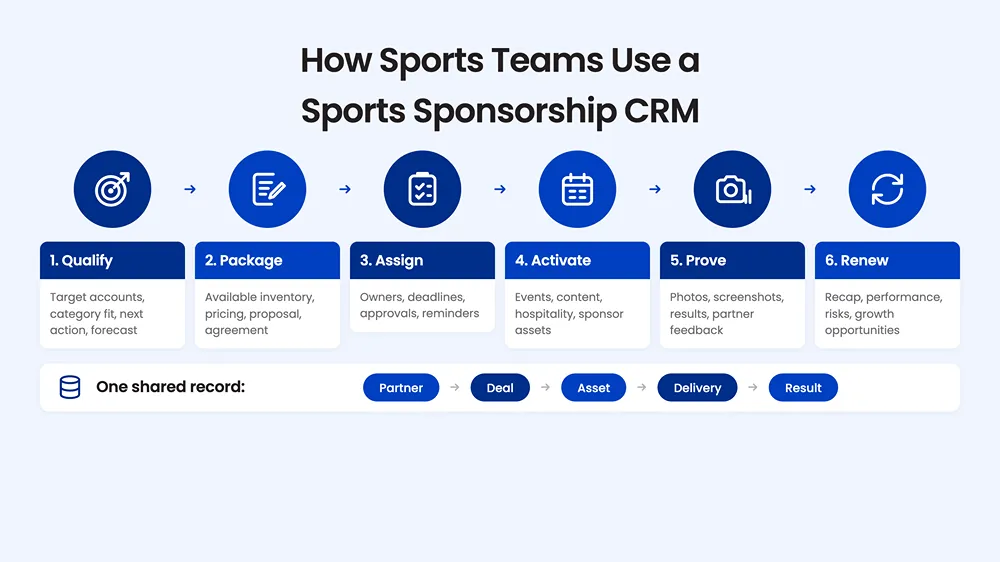
1. Build a qualified pipeline
Sales teams capture target accounts, decision-makers, category fit, prior conversations, proposal value, probability, next action, and expected close date. Clear stages make forecasting more credible and surface deals that have quietly stalled.
Strong partner management protects category strategy, too. Before a seller offers an asset, they should be able to see current exclusivities, available inventory, rate guidance, and competing proposals. That visibility cuts down on double-selling and helps the team build rights packages around what a sponsor is trying to accomplish.
2. Create proposals and agreements from live inventory
When inventory lives next to the pipeline, sellers can build an offer from assets that are genuinely available for the right season, venue, event, and channel. Once terms are approved, the agreement should hold onto the negotiated value including cash and in-kind components, billing schedule, renewal window, category protections, usage rights, and approval rules.
This is where a sponsorship strategy turns into something executable. A polished proposal gets a deal signed; the operating record underneath it is what every department downstream inherits.
Sporting JAX built sponsorship operations from the ground up.
Sporting JAX entered its first fall season with a small team and no established sponsorship infrastructure. SponsorCX became its sponsor management software, centralizing contacts, deals, inventory, and fulfillment. The system helped the team identify stalled opportunities, avoid overpromising assets, and catch difficult terms before renewal.
3. Turn commitments into owned work
A signed agreement should generate deliverables with owners, dates, dependencies, events, approval steps, and status, not just a file in a shared drive. A single digital-content obligation might involve the partnership manager, the creative team, a legal advisor, the sponsor contact, and social lead. All five need the same definition of completion.
Automating reminders, handoffs, and recurring tasks helps, but only once there's an agreed partner management process behind it. Automation on top of chaos just speeds up the chaos, especially during a dense home stand or tournament week.
4. Schedule and activate
Activation managers assign assets to games, programs, venues, channels, and audience segments, then track artwork, copy, talent, placement, hospitality guests, run-of-show timing, community partners, and contingency plans.
The same discipline shows up in nonprofit partner activations and fundraising event sponsorship. A youth tournament, charity run, alumni event, or athletic foundation gala often runs on a small staff and a lot of volunteers. Sponsor benefits are spread across registration, signage, hospitality, stage remarks, and follow-up content. A shared sponsorship tracker gives everyone the same handoff point to work from.
5. Capture proof as work happens
Teams use the sponsorship tracker to log photos, screenshots, links, attendance, impressions, scans, hospitality use, content performance, and sponsor feedback against the related asset. Ideally that happens at the event or shortly after, with a date, owner, and context attached.
Following that habit makes recaps far easier to build. It also gives managers enough lead time to catch a missed placement and offer a make-good before it becomes a partner complaint.
6. Report, learn, and renew
Partner reports should pull from the same records used to manage fulfillment. A recap can show contracted rights, delivery status, proof, agreed metrics, added value, and resolved issues, plus next-season opportunities, without anyone hunting through shared drives.
Renewal planning starts well before that final report goes out. Teams review utilization, partner priorities, inventory pressure, results, and service notes, then settle on a renewal strategy and a next meeting. That groundwork is what turns a renewal conversation into something specific. It also gives leadership a realistic read on retained and at-risk revenue.
What Partnership Information and Assets Should Teams Track?
Effective partner management needs a data model detailed enough to run the work and simple enough that people are willing to keep it current. Start from the decisions each role makes, then build out the fields that support those decisions.
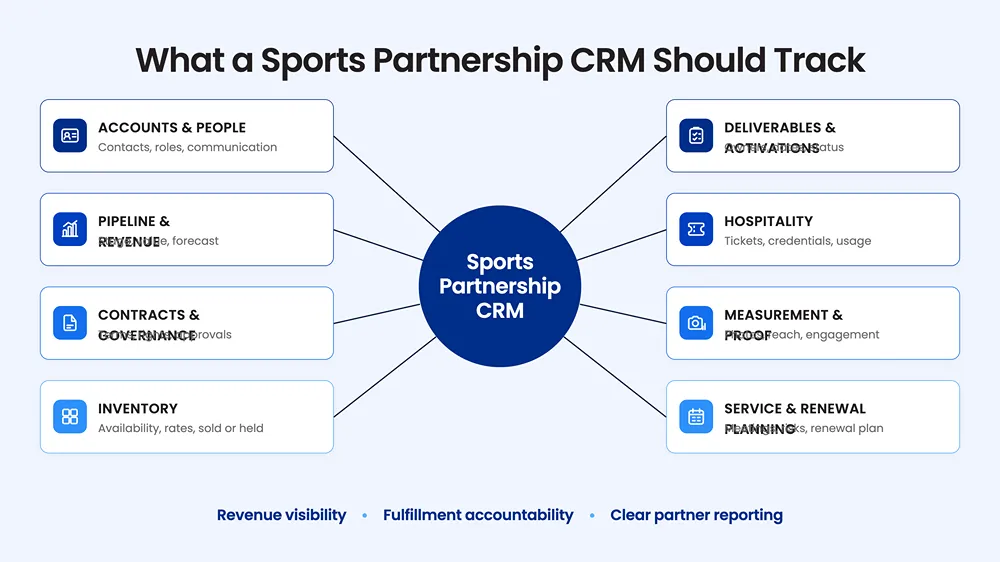
- Accounts and people: organization, category, contacts, roles, preferences, communication history, relationship owner, and key stakeholders
- Pipeline and revenue: stage, probability, proposal value, cash and value-in-kind, forecast period, close date, source, next step, invoice status, and renewal value
- Contracts and governance: term, rights, restrictions, category exclusivity, territory, marks, insurance, approvals, cancellation terms, payment schedule, renewal notice, and document versions
- Inventory: asset type, location, channel, event availability, quantity, rate, cost, sold status, hold status, sponsor, and package
- Deliverables and activations: owner, due date, event, dependencies, creative specifications, approval status, completion status, and make-good history
- Hospitality: tickets, suites, parking, credentials, guest lists, usage, transfers, and experience notes
- Measurement and proof: photos, screenshots, URLs, attendance, reach, impressions, engagement, leads, redemptions, media value where appropriate, survey results, and partner feedback
- Service and planning: meeting notes, open questions, risk flags, objectives, success measures, recap dates, renewal plan, and growth ideas
Tax-exempt sports properties should add fields that separate acknowledgment from advertising and record the fair market value of benefits. IRS guidance on qualified sponsorship payments notes that logo or name acknowledgment can qualify under specific conditions. Advertising, certain benefits, and exposure-contingent payments may be treated differently. Bring finance and tax counsel into that part of the data design.
Five Business Outcomes Sponsorship Management Software Can Improve
More dependable revenue
Sponsorship management software connects pipeline and inventory data, improving forecast quality, reducing conflicting offers, and making renewal timing visible. Payment schedules tied to agreements also help finance and partnership teams address unpaid balances earlier.
Stronger fulfillment and partner service
Owners and due dates reduce missed commitments. A sponsorship CRM with shared status also helps a manager answer sponsor questions quickly, coordinate a change, and document added value without relying on one person’s inbox.
Faster, clearer reporting
Reporting becomes a continuous output of the work instead of a separate end-of-season project. Executives can see revenue, inventory, fulfillment, risk, and renewal status; partners receive a credible record of delivery and outcomes.
Creating one source of truth for Bath Rugby
Bath Rugby replaced multiple sponsorship spreadsheets with one sports partnership CRM for inventory, pipeline, fulfillment, and reporting. The change improved accountability across its commercial team, gave leaders real-time information, and freed up hours each week for partnership development.
Better inventory yield
Teams can see which assets sell, which remain underused, where rates vary, and which rights are repeatedly added at no charge. Those insights support packaging, pricing, and new inventory decisions for the next cycle.
Operational resilience
A shared system preserves context when roles change, staff travel, or seasonal workers join. It also creates consistent processes across a league, venue portfolio, college department, event series, association, or governing body.
Try this with your own team. Review SponsorCX's sponsor management software workflow with sales, activation, finance, and operations leads, and ask each person where a handoff recently fell through the cracks. Schedule a focused demo around what you find.
How to Choose a Sports Partnership CRM
Start with how you operate. Look at team capacity, partner portfolio, and existing systems. When evaluating sports CRM software, test how the product handles your contracts and events, including the messy exceptions that create most of the work.
- Lifecycle coverage: Does it connect prospecting, inventory, agreements, fulfillment, proof, reporting, and renewal?
- Inventory control: Can users see available, proposed, held, and sold assets by event, season, venue, channel, and category?
- Workflow flexibility: Can your team set owners, recurring deliverables, dependencies, approvals, alerts, and make-goods without heavy administration?
- Reporting quality: Can leaders and partners trace a report back to the agreements, delivery records, evidence, and revenue behind it?
- Ease of adoption: Can sellers, coordinators, executives, and occasional users get their main tasks done without much training?
- Integration fit: Does data stay in sync with your enterprise CRM, email, calendar, accounting, e-signature, deck, and measurement tools? SponsorCX's integrations page lists what it currently connects to.
- Security and governance: Can administrators manage permissions, data ownership, audit needs, retention, and partner or agency access?
- Implementation support: Will the provider help migrate data, design fields, configure workflows, train roles, and set a usable reporting baseline?
A Practical Implementation Plan
Implementation works when the team supports the operating rules the sponsorship management software will reinforce. Keep the first release focused on the records and workflows needed to manage active revenue and current commitments.
- Map the current lifecycle. Document how a prospect becomes a contract, a contract becomes work, and work becomes a recap. Flag every duplicate entry, unclear owner, and manual handoff along the way.
- Define a minimum data standard. Choose required fields, naming conventions, stages, status definitions, asset categories, and ownership rules. Assign a data steward to own them.
- Clean and migrate active records. Prioritize current sponsors, open opportunities, live agreements, available inventory, upcoming deliverables, and renewal dates. Archive older data with a clear way to retrieve it later.
- Configure one end-to-end pilot. Pick a representative partnership or event and test inventory, agreement structure, assignments, approvals, evidence capture, reporting, and finance handoffs against it.
- Train by role and moment. Show sellers how to manage pipeline and inventory, activation teams how to update work, event staff how to capture proof, and leaders how to read dashboards.
- Set adoption measures. Track active-user coverage, required-field completion, overdue deliverables, proof attached, forecast accuracy, recap preparation time, and renewals started on schedule.
- Improve in short cycles. Run a monthly operations review, fix friction as it turns up, retire duplicate trackers, and only add automation once the underlying process is stable.
Nonprofit Sports Organizations Need a Slightly Different View
Sponsorship for nonprofit organizations usually gets categorized with donations, grants, memberships, and program funding. Keep those revenue types clearly labeled while still giving staff one view of the overall corporate relationship. A single sponsor might support a team, a clinic, and a fundraising event sponsorship in the same year, each with its own benefits and reporting expectations.
For nonprofit event sponsorship specifically, track the mission outcome right alongside the commercial deliverables. Included would be athletes served, scholarships funded, volunteer participation, community reach, or program access, plus whatever recognition and activation the sponsor agreed to. SponsorCX's nonprofit sponsorship management overview shows how sales, inventory, fulfillment, proof, and stakeholder reporting stay connected even for a lean team.
Done well, this gives the board a clear view of sponsorship value, gives finance cleaner documentation, and gives partners a balanced recap of audience value and community impact. It also makes nonprofit partner activations repeatable across fundraisers and seasons.
The Operating Model Behind Better Partnerships
Partner management technology gives a team one shared way to make commitments, complete work, and communicate value. Sellers see inventory, activation managers see promises, finance follows revenue, leaders monitor risk, and partners see what their investment produced.
SponsorCX's sports CRM software builds that model around four things:
- Centralize partnership details, assets, agreements, and contacts
- Automate tasks, timelines, reminders, and handoffs
- Track sales, inventory, fulfillment, proof, and renewal
- Report delivered value with records your team can stand behind
You lead the partnership. Your system should make that easier, not harder. Bring one active agreement and one executive reporting question to a SponsorCX demo and see how Centralize, Automate, Track, and Report hold up against your own process.
You make sponsorship happen. SponsorCX makes it simple.