Building Partnerships with Purpose
Corporate giving has grown 60 percent over the last five years, more than double the 29 percent growth in total charitable giving over the same period, according to Giving USA 2026: The Annual Report on Philanthropy for the Year 2025. Most of that growth is going to organizations that can show a sponsor a clear, well-run partnership.
Nonprofit event sponsorship is an exchange. A business provides financial or in-kind support for a nonprofit's event, and in return, the nonprofit delivers visibility, access, and association with its mission and audience. Both sides expect measurable benefit out of the deal.
A lot of organizations still treat sponsorship like a bigger version of a gift, something you thank a company for and move on from. That paradigm sells the model short, and it's usually why partnerships end after one cycle.
Companies weigh sponsorship against every other line in a marketing or CSR budget and ask what it returns. That expectation raises the bar for what counts as a compelling partnership, and it's why the gap between a good sponsorship program and a mediocre one shows up so clearly in renewal rates.
This guide explains how sponsorship for nonprofit organizations works, from prospecting and pricing through activation, fulfillment, and renewal.
What Defines Nonprofit Event Sponsorship?
A donor gives because it believes in your cause. A sponsor invests because the partnership promises to work for its business goals too. That could mean reaching new customers, showing up for employees, or supporting a community where it operates. Pitching a sponsor the way you'd pitch a donor, same tone, same ask, same follow-up, is one of the most common reasons sponsorship proposals get a polite no.
When the partnership is built thoughtfully, the benefit of sponsorship runs both ways. For the nonprofit, sponsorship dollars often come with fewer restrictions than grant funding. They can cover costs donors tend to avoid, like event production, staffing, and marketing. Sponsorship also brings in-kind support such as printing, catering, venue space, and volunteer hours.
For the sponsor, event sponsorship offers authentic association with a cause its customers and employees care about. It gives their marketing and CSR teams a real story: real photos, real attendance numbers, a real community presence. That's something an ad placement can't provide. In Double the Donation's Q4 2025 survey of more than 5,000 nonprofit professionals, over 62 percent of respondents said sponsorships produced the highest return on investment among corporate fundraising activities. That’s worth remembering the next time a sponsor hesitates over the price of a package.
Sponsors experience your event as a relationship, staffed and represented by whoever your team sends to manage it. Keep that in mind for nearly every decision downstream, from which benefits go into a package to how you follow up afterward. Understanding what sponsors are actually looking for, beyond logo placement, makes every later step of this process easier.
One clarification before moving on: sponsorship for nonprofit organizations isn't limited to galas and golf tournaments. Walks, runs, festivals, conferences, even recurring program events can carry sponsorship packages. The principles here apply across all of them, though the specific benefits, price points, and activation ideas will vary by format and audience size.
Finding Sponsors Who Fit Your Mission, Event, and Audience
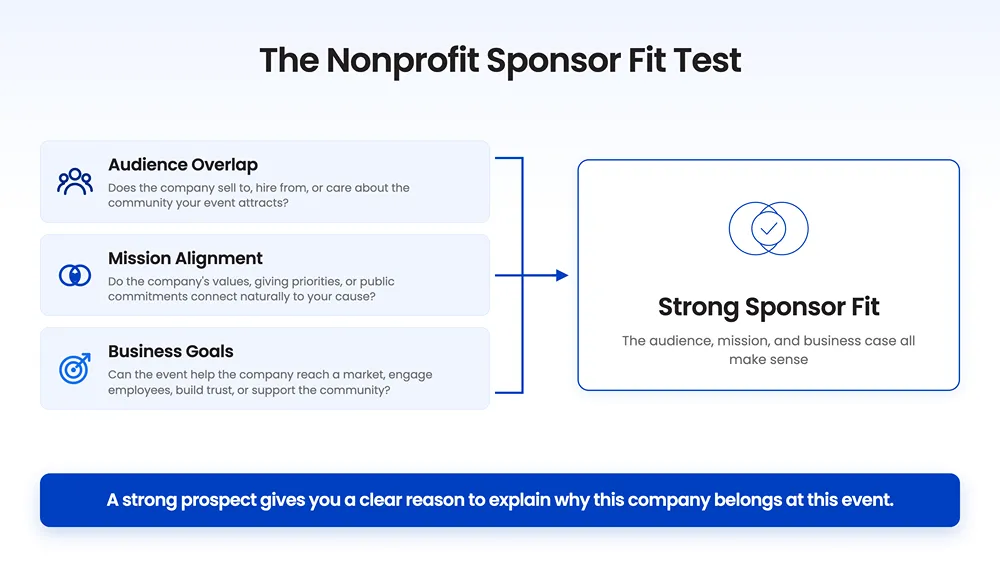
It's tempting to pitch every local business with a marketing budget. It's also a waste of time. A sponsorship strategy that starts with fit produces stronger proposals, faster decisions, and partnerships that actually last more than one cycle. Fit includes the sponsor's audience, values, and business goals overlap with your event in a way you could explain in a single sentence.
Three filters help narrow a long prospect list into a short one worth pursuing:
- Audience overlap: does the sponsor sell to, hire from, or care about the same community your event draws?
- Mission alignment: does their CSR focus, past giving, or public commitments connect naturally to your cause?
- Business goals: are they trying to enter a new market, reach a younger demographic, or rebuild their reputation, and does your event help with that?
Look at where a prospective sponsor has already shown up. Its past sponsorships, board memberships, and CSR reports tell you more than a cold pitch ever will. A regional grocery chain that's sponsored three youth sports leagues this year is a stronger prospect for a family-focused 5K than a national company with a massive budget but no local presence.
Don't skip your own network before reaching for a cold list. Board members, current donors, and past sponsors who work at other companies are often the fastest path to a warm introduction and a shorter sales cycle. A warm introduction carries more weight than a cold email, because it comes with a level of trust the sponsor doesn't have to build from scratch.
Cold outreach still has a place, particularly when you're trying to diversify beyond a small circle of familiar names. Treat it as a supplement to warm relationships, and be honest with your team about how much lower the conversion rate will be. Consistent sponsorship revenue usually comes from a mix of both, tracked and followed up on with the same discipline you'd apply to a sales pipeline.
Keep a simple record of why each prospect made your list. When you're managing a dozen or more sponsors across multiple events, that rationale is the difference between a scattershot pitch and one that explains why this specific company belongs at this specific event.
How to Approach, Pitch, and Secure Event Sponsors
Once you've identified a fit, the pitch should answer one question: what does this sponsor get, and how will they know it worked? Vague promises like “brand exposure” or “logo placement” don't hold up in a budget meeting on the sponsor's side. Specific numbers, past results, and a defined benefits list do.
Build your pitch around three components:
- A short case for fit: one or two sentences connecting their business to your mission and audience, based on the research from the previous step.
- A clear package with real numbers: attendance figures, past media reach, email list size, social following, and anything else that quantifies what they're buying.
- A defined ask and next step: a specific dollar amount or in-kind request, tied to a specific tier, with a clear date for a decision.
Most nonprofits find that tiered packages increase both the closing rate and the average sponsorship value. A prospect who can't commit to a $10,000 title sponsorship might say yes to a $2,500 supporting tier. Structuring those levels well takes thought about what's valuable at each tier.
The same 2026 study found that more than 37 percent of nonprofits were still building a formal strategy for workplace fundraising and volunteering. At the same time more than half described their approach as informal or ad hoc. Those numbers point to inconsistent pitches, missed follow-ups, and packages reinvented from scratch every year. A repeatable process, even a simple one, saves your team time and signals credibility to sponsors comparing your request against others. Set a follow-up pattern before you send the first pitch.
Timing matters more than most nonprofits imagine. Corporate marketing and CSR budgets are usually set months in advance, so a fundraising event sponsorship pitch sent eight weeks before your event is competing for whatever’s left over. Approach prospects four to six months ahead of the event date whenever possible, and treat that lead time as part of your strategy rather than an afterthought.
Expect negotiation, too. A sponsor might ask for a benefit that isn't in your standard package, or push back on price relative to what they've seen elsewhere. Decide in advance where you're willing to bend.
Price the Package Around Value and Capacity
Tier names and benefit lists aren't a pricing strategy. Before setting a price, inventory every asset the event can offer:
- Audience access
- Category exclusivity
- Digital reach
- Hospitality
- Speaking opportunities
- Content rights
- Employee engagement
- On-site interaction
Estimate what each asset is worth to the sponsor. A sound sponsorship strategy considers both the value offered to the sponsor and the nonprofit’s cost of delivering it.
Don't promise unlimited tickets, custom content, or labor-heavy activation support just to close the deal. A package can bring in revenue and still lose money if fulfillment costs get ignored. Build a delivery margin into every tier, save the most distinctive assets for higher-value partnerships, and price custom requests separately when they need extra production or staffing.
The agreement should also spell out the practical details:
- Payment dates
- Benefit deadlines
- Approval rights
- Category exclusivity
- Logo and trademark use
- Cancellation terms and contingencies
- Insurance obligations
If the sponsor will collect attendee information, specify who owns the data, how consent will be obtained, and what each party may do with it.
Sponsorship pitches get easier to track and follow up on when every prospect, conversation, and signed agreement lives in one place instead of scattered across spreadsheets and email threads.
See how SponsorCX keeps your pipeline organized from first contact through signed agreement.
Protect the Mission and Handle Sponsorship Correctly
A sponsor should fit more than just the audience profile. Review the company's public record, business practices, community reputation, and any potential conflicts with your mission before making an offer. Define categories your organization won't accept, and give leadership or the board a clear approval path for sensitive prospects. A large check isn't worth the reputational cost of a partnership your stakeholders can't understand or trust.
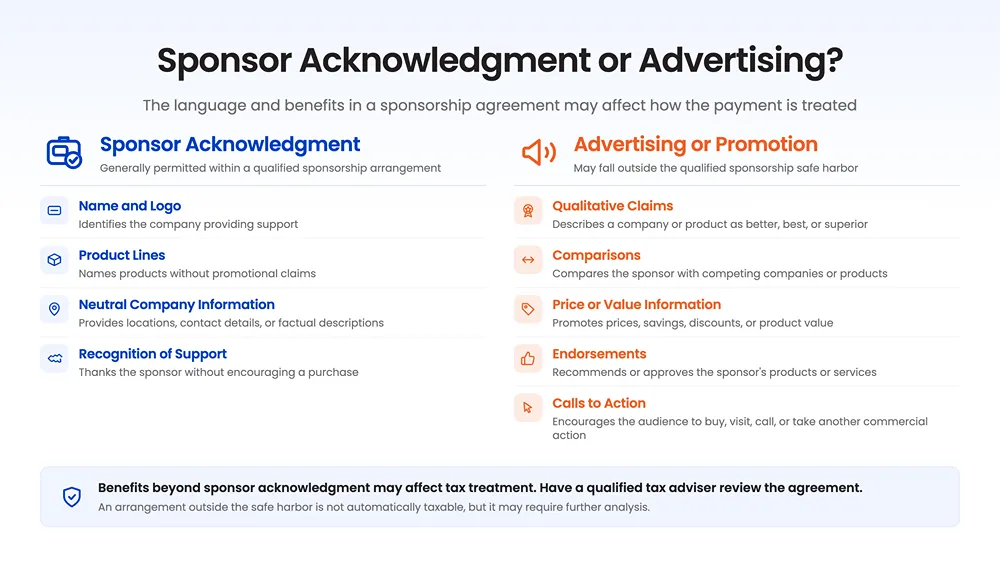
Nonprofits also need to distinguish sponsor acknowledgment from advertising. Under IRS rules on qualified sponsorship arrangements, a payment can generally be acknowledged with the sponsor's name, logo, or product lines without counting as unrelated business income. Promotional language, price information, endorsements, calls to action, or other substantial return benefits can move part or all of the arrangement outside that safe harbor.
Have your tax adviser review any package that includes advertising, exclusive-provider rights, valuable goods or services, or payments tied to attendance or exposure. Agreements should describe the benefits precisely enough that the nonprofit can value and account for each component correctly.
Activating the Partnership with Purpose
Signing the agreement is only the beginning of the relationship. Activation is where nonprofit partnerships either build trust for next year or lose a sponsor. It's what brings the sponsorship to life at the event and around it, in ways that feel authentic.
Good activation goes beyond a banner and a shoutout from the podium. Depending on the sponsor and the event, that might include:
- A branded activity or station where attendees interact directly with the sponsor's team
- Employee volunteer opportunities tied to the event
- Co-branded content published before, during, and after the event
- A speaking moment connecting the sponsor's values to your mission, not just their logo
The best nonprofit partner activations are built in collaboration with the sponsor. Ask what it’s hoping to get out of the day beyond visibility, whether that's employee engagement, lead generation, or content for its own marketing. A sponsor who feels like a genuine partner in the event is far more likely to renew and refer other companies.
Purpose matters. Sponsors increasingly want their support tied to outcomes they can point to, beyond the raw count of impressions or attendees. Frame every activation around a story. Answer these questions: what did this sponsor make possible, and who benefited from it?
That story becomes the backbone of your recap report and next year's pitch, so capture it as it happens. Waiting until afterward will blur important details. Assign someone specific to gather photos, quotes, and numbers during the event, separate from whoever is running logistics. From a renewal standpoint, an activation that goes undocumented is nearly as risky as one that never happened at all.
Fulfillment, Measurement, Reporting, and Renewal
Fulfillment is the unglamorous part of sponsorship, and it's where most partnerships fall apart. Every benefit you promised, from logo placement to speaking time to social mentions, needs to happen on time, and someone on your team needs to be able to prove it did. Even a small missed deliverable can cost you a renewal if the sponsor has to point it out first.
Build a simple fulfillment checklist for every sponsor as soon as the agreement is signed. List each benefit, who owns it, and the deadline, then track completion as the event approaches and unfolds. Photos, screenshots, and timestamps matter here; they become the raw material for your recap report and the proof that you delivered what you promised.
Measurement means connecting what you delivered to results the sponsor cares about. That could be impressions, foot traffic at their activation, email signups collected on-site, or media mentions, depending on what the sponsor identified during the pitch. Report these numbers within a few weeks of the event.
A strong recap report does three things:
- Shows what was delivered
- Connects that delivery to measurable outcomes
- Makes the case for renewal without directly asking for it yet
Send it before the sponsor asks what happened. That single habit, sending an unprompted recap, does more for renewal rates than almost any other step in this process.
Don't wait until the next event cycle to restart the relationship. Schedule the recap meeting while results are still fresh, ask what the sponsor would change, and agree on the next decision date. A short, year-round stewardship rhythm, relevant impact updates with no fundraising ask attached, keeps the partnership active and gives both sides time to shape a stronger renewal.
Organizations managing multiple sponsors across several events often find that fulfillment and reporting become the hardest parts to scale. That's because the details live across spreadsheets and inboxes, dependent on whether someone remembered to take photos that day. As sponsorship for nonprofit organizations grows past a handful of partners, informal tracking stops working, and small gaps start turning into missed renewals. A connected system built for nonprofit and government sponsorship management keeps that information in one place instead of scattered across your team's inboxes.
Renewal conversations get simpler when your fulfillment history and results are already documented instead of reconstructed from memory.
Request a SponsorCX demo to see how tracking stays current from signed agreement through renewal.
Building Partnerships That Last
Nonprofit event sponsorship works when both sides treat it as a real partnership:
- Researching fit before you pitch
- Building packages with real numbers
- Activating with purpose instead of just presence
- Following through on fulfillment
- Reporting without being asked
None of that happens by accident. It takes consistency and a system that keeps details from slipping through the cracks.
What Next?
You're the one building these relationships. You're the one sitting across the table from CFOs and marketing directors, making the case for why this partnership matters, and following through long after the signature. SponsorCX exists to support that work.
Our platform gives your team:
- One place to centralize sponsor and prospect data
- A seamless way to automate the tasks and timelines every agreement creates
- A way to track fulfillment as it happens
- Reporting sponsors can actually see
You make nonprofit sponsorship happen. SponsorCX makes it simple.
Request a demo today.