Question: if you removed every sponsor logo from your venue tomorrow, which partners would your fans miss?
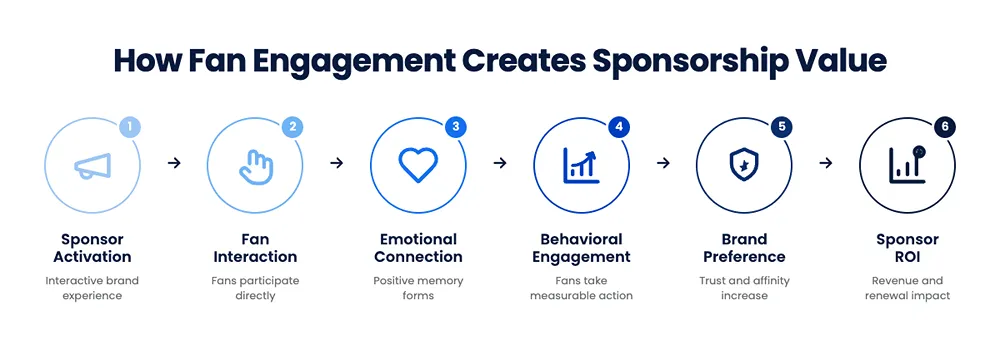
The honest answer is likely uncomfortable. Fans don't miss logos. They miss experiences: the halftime game where kids win gear, the app feature that lets them predict the lineup, the section where perks were hidden under the seats. Engagement turns a sponsor into a memory. Without it, the logo is background.
Fan engagement in sports describes the active relationship fans build with the teams, leagues, and brands woven into their experience. Sponsorship engagement is how deliberately a brand participates in that relationship. The gap between what sponsors invest in and what fans respond to is where renewal risk accumulates.
Exposure creates awareness. Engagement creates liking, and liking drives brand preference. Fans aware of a team's sponsors are 3x more likely to purchase from those brands and 2x more likely to recommend them, according to Navigate Research. That multiplier disappears when sponsors stay passive.
This article covers why fan engagement in sports drives sponsorship value, how to build the link deliberately, and what tools the most effective properties and brands use to sustain it.
What Fan Engagement Means Today
Fan engagement once meant showing up: a ticket, a jersey, a broadcast. Those behaviors still matter, but today's engaged fan participates across multiple touchpoints simultaneously and expects something in return.
Fans now interact through mobile apps, second-screen experiences, social platforms, loyalty programs, and in-venue activations. As of 2025, mobile devices account for approximately 74% of all digital fan engagement activity globally, up from 58% in 2020, per DataIntelo. That's not a trend. It's the new baseline.
Passive exposure no longer satisfies either party. A fan scrolling through highlights is not the same as one entering a sponsored sweepstakes, completing a trivia challenge, or scanning a QR code for a personalized offer. The difference is behavioral depth, and that's what sponsors now expect to measure.
Modern fan engagement looks like:
- Real-time interaction during live events through polls, predictions, and AR overlays
- Loyalty programs that reward repeat attendance, purchases, or social sharing
- Personalized content via app notifications or email based on fan preferences
- Experiential activations that invite participation, not just observation
- Community-building through fan clubs, digital forums, or ambassador programs
Properties and brands that understand this shift separate themselves from those still leading with banner space and logo placement.
Why Sponsors Care About Engagement More Than Impressions
Impressions are easy to generate. Sponsorship engagement is harder to build. That's why brand sponsors increasingly scrutinize engagement metrics before signing or renewing.
Traditional advertising can match sports' reach numbers, but it can't match the emotional intensity fans bring to a live event. Sports audiences don't just watch; they care. That investment is the core of what sponsors are buying. But it only converts into commercial value when it's activated.
The sports sponsorship market grew from $105.47 billion in 2023 to $114.41 billion in 2024 and is projected to reach $189.54 billion by 2030, per ResearchAndMarkets. That growth is driven by properties that can demonstrate behavioral outcomes: ticket purchases, app downloads, coupon redemptions, and brand recall.
As Deloitte's analysis of sports partnerships ROI notes, brands often struggle to connect exposure to conversion without adequate data. Properties that provide that data, tied directly to fan behavior, hold significantly more negotiating leverage.
The deeper reason sponsorship engagement outweighs impressions is longevity. An impression is a moment. Engaged fans buy from sponsors, advocate for them, and return season after season. That sustained behavior is what separates effective sports marketing from a media buy.
How Sponsorship Activations Increase Engagement
Sponsorship activation is where partnership value becomes something fans notice, remember, and act on. Without it, even the best-placed logo delivers minimal commercial impact. A well-designed sponsorship activation turns passive exposure into genuine fan participation.
Research from Navigate shows most sponsors spend roughly 20 cents on activation per rights dollar. Those who invest 50 cents tend to double their return. That ratio is a wake-up call for anyone still treating activation as optional.
Effective activations share a few common traits:
- They invite participation. Fans who do something with a brand form a stronger association than fans who see it.
- They fit the context. Native moments land. Interruptions don't.
- They create shareable moments. When fans post the experience, sponsor reach extends well beyond the venue.
- They connect to what fans already care about. The best sports marketing uses fan passion as the fuel.
AT&T's activation at NBA All-Star Weekend 2024 is a practical example. Rather than relying on signage, the brand created two digital games tied to the conference rivalry, a custom player avatar, in-person fan meetups, and a Snapchat AR filter for remote fans. The campaign generated over 400 million impressions, but more importantly, it gave fans something to do, not just something to see.
Format matters less than the underlying principle: fans need a reason to engage with the brand, not just awareness of it.
The Business Impact of Engaged Fans
Engaged fans are a commercial asset that shapes renewal rates, inventory pricing, partnership depth, and long-term revenue. Here's what that looks like across key outcomes:
1. Higher Sponsor Retention
Sponsors who see measurable fan engagement renew at significantly higher rates. When a brand can point to activation booth traffic, app interaction data, or social amplification from a campaign, the renewal case is strong.
2. Stronger Inventory Pricing
Properties with documented engagement data command higher rates. A naming right tied to a trackable fan experience is a fundamentally different product than one backed by attendance estimates. Pricing should reflect that difference.
3. Broader Partnership Opportunities
Strong fan engagement in sports attracts sponsors from new categories, expanding the range of viable sports partnerships. Financial services alone grew from 2% of Formula 1's sponsorship revenue in 2019 to 17% by 2024, largely because engagement data made the category investable.
4. Increased Fan Lifetime Value
Engaged fans spend more, attend more, and stay longer. Brands that integrate data from social media, website analytics, and in-venue interactions see a 47% higher ROI than those measuring each channel in isolation, according to Playbook Sports.
5. Competitive Differentiation
In a market where sponsors have choices across leagues, events, properties, and media platforms, sponsorship engagement is a differentiator. The property that walks into a sales conversation with a clearly articulated fan engagement strategy, backed by data, holds a distinct advantage over one selling logo placement and foot traffic counts.
| Ready to build a sponsorship program that demonstrates measurable fan value? Schedule a SponsorCX demo. |
Strategies for Building Links Between Sponsorship and Fan Engagement
The link between fan engagement in sports and sponsorship outcomes doesn't happen by accident. It requires deliberate strategy with the fan's experience at the center.
- Co-create activations, don't just approve them. When both the property and brand understand what fans value, they build experiences that serve everyone's goals.
- Anchor activations to fan passion points. Game-day rituals, rivalries, athlete stories, and community causes are emotional triggers fans already respond to.
- Build for multi-channel reach. Strategies operating across in-venue, broadcast, social, and digital are more durable and measurable than single-channel approaches.
- Integrate sponsorships into loyalty programs. When a sponsor is woven into the loyalty experience, fan engagement data becomes sponsor performance data.
- Use storytelling to deepen credibility. Sponsors integrated into authentic narratives through athlete partnerships, community programs, or behind-the-scenes access earn a different kind of attention.
- Align activation with the calendar. Season openers, rivalry weeks, and playoffs are natural windows for high-impact activations. Timing delivers more than a year-round static presence.
For more on building activations beyond visibility, see how properties are treating partner activation as an experience rather than a contractual obligation.
Metrics and Measurement Frameworks
You can't strengthen the link between sponsorship and fan engagement if you can't see it. Measurement is the foundation for every renewal conversation, every pricing decision, and every activation investment.

The metrics that matter fall into three categories:
Reach and Awareness
Baseline metrics, necessary but not sufficient:
- Total impressions across broadcast, social, and in-venue placements
- Branded content views and completion rates
- Media exposure value across platforms
Engagement and Behavior
This is where sponsorship value is built:
- Interaction rates with sponsored content, games, or features
- Foot traffic at activation zones
- Coupon redemptions and promo code usage tied to specific campaigns
- Loyalty program participation linked to sponsor touchpoints
- Social sharing volume from sponsored experiences
Commercial Outcomes
The highest-value metrics connect engagement to business results:
- Direct revenue attributed to sponsorship-driven promotions
- New customer acquisition linked to partnership campaigns
- Brand sentiment shifts measured pre- and post-activation
- Sponsor NPS among fans who interacted with the brand
A reliable framework maps each asset to at least one metric in each category. Properties that walk sponsors through layered reporting have a far stronger renewal conversation than those presenting a slide of logo placements.
The sponsorship reporting guide on SponsorCX offers a practical framework tied to real-world data collection.
Mistakes That Turn Sponsors Away
Not every fan engagement program strengthens sponsor relationships. Some approaches actively damage them.
Overloading Fans with Branded Interruptions
Sponsorship that feels intrusive backfires. Fans who feel exploited by excessive logo saturation or irrelevant messaging disengage. Authenticity isn't a soft concept; it's a commercial requirement.
Selling Reach Without Behavioral Proof
Presenting only impression-based metrics signals to sponsors that engagement is either not happening or not being tracked. Neither is a position of strength in a renewal conversation.
Treating Activation as the Sponsor's Job
The most successful sports partnerships are collaborative. Properties that deliver rights and step back leave sponsors to figure out fan engagement alone. Those sponsors rarely renew.
Failing to Close the Loop on Data
Engagement data collected but never shared with sponsors in an actionable format serves no one. Closed-loop reporting connects fan behavior to sponsor outcomes and is increasingly a baseline expectation, not a premium offering.
Ignoring the Non-Attending Fan
Digital and broadcast fans now outnumber in-venue attendees for most properties. Strategies that focus exclusively on the live event audience leave significant fan base segments, and significant sponsor value, unreached.
Future Trends in Sponsorship and Fan Engagement
The tools and formats of fan engagement are evolving quickly. Here are the shifts shaping the next five years:
- AI-driven personalization. Properties and sponsors are moving from broad segments to individualized experiences based on fan behavior patterns, not just demographics.
- Second-screen and real-time integration. As 5G expands, sponsored games, live stats, and AR overlays during broadcasts create measurable engagement touchpoints beyond the venue.
- Data portability across the fan journey. Unified fan profiles connecting ticketing, apps, loyalty, and social platforms give sponsors a complete picture of who they're reaching.
- Purpose-driven engagement. Younger fans respond more strongly to sponsors aligned with shared values: community initiatives, sustainability, and causes that matter to the base.
- Outcome-based contracts. More brands are linking sponsorship fees to defined engagement benchmarks. Properties that consistently deliver and document fan engagement in sports will command premium pricing, and this model is rapidly becoming the standard in sophisticated sports marketing.
See the full breakdown of AI-powered fan engagement tools already in use across professional sports.
A Real-World Case Study: Formula 1 and the Power of Fan Engagement
Few examples illustrate the connection between fan engagement and sponsorship growth as clearly as Formula 1's transformation under Liberty Media since 2017.
When Liberty acquired the sport, F1 had an aging fan base, minimal social media presence, and a culture that resisted fan access. Sponsorship revenues were stagnant. Liberty's response was not to sell more inventory; it was to rebuild fan engagement from the ground up.
The strategy centered on storytelling and digital access: a Netflix partnership producing Drive to Survive, an expanded social media operation, an esports series, and a fan voting system for race-day awards. Each was a deliberate investment in converting passive viewers into emotionally connected fans.
One in four people in a 2024 Nielsen study said they became an F1 fan specifically because of Drive to Survive. Approximately 43% of F1's fan base is now under 35, up by 51 million year over year, per TheStreet. That shift directly repositioned the sport's commercial appeal.
The sponsorship results followed. F1's revenue grew from roughly $1.8 billion in the mid-2010s to $3.65 billion in 2024, with flagship deals like Oracle-Red Bull and HP-Ferrari each valued at approximately $100 million annually. Financial services, nearly absent in 2019, now accounts for 17% of sponsorship revenue.
The lesson: fan engagement is the upstream driver of sponsorship value. Invest in the fan relationship first, and that relationship becomes the strongest sales tool in any sports marketing conversation.
How SponsorCX Reinforces the Link Between Sponsorship and Fan Engagement
When a sponsorship program involves a handful of partners, a spreadsheet might manage it. When it involves dozens of partners, hundreds of assets, multiple activation channels, and real-time reporting expectations, complexity compounds fast. That's where software becomes necessary.
SponsorCX gives sponsorship teams a centralized platform to manage every moving part: partner commitments, activation plans, engagement data, and reporting in one place.
Centralize
Every agreement, asset, activation deadline, and deliverable lives in one place. No more digging through email threads to confirm what was promised. Your team stays aligned, and sponsors see an organized operation.
Automate
Renewal reminders, fulfillment alerts, communication workflows, and reporting schedules run without manual follow-up, freeing your team to focus on activation quality and sponsor relationships.
Track
See which assets are being fulfilled, which sponsorship activations are underperforming, and where engagement opportunities are being missed. Real-time visibility lets you course-correct before a sponsor notices a gap.
Report
Turn fulfillment and engagement data into compelling reports that give sponsors proof of value, not just a summary of what was attempted. Properties using SponsorCX walk into renewal conversations with documentation that supports every line item.
For properties building a structured sponsorship management framework. or upgrading from manual processes, SponsorCX provides the infrastructure sports partnerships require.
The connection between fan engagement in sports and sponsorship value is real, measurable, and actionable. It requires intentional strategy, consistent execution, and the right tools to sustain it.
| You make fan engagement happen. SponsorCX makes it simple. Schedule your demo today. |