Somewhere in a brand's marketing budget meeting, someone compares your event to a Google Ads campaign. Not because they're the same thing, but because both compete for the same dollars. The Google campaign comes with click-through rates, cost-per-lead, and conversion data. Your event comes with an attendance estimate and a logo placement schedule.
You know which one is easier to approve. Event marketing techniques are how you close that gap. They give sponsors the documented audience quality, engagement data, and activation clarity they need to say yes, and the proof they need to justify it.
It's dangerous to believe that better sponsorship packages alone will close more deals. They help, but your sponsorship marketing strategy, your audience quality, and your track record are what sponsors are really evaluating. The package just names the price.
The numbers reinforce this. Global sponsorship spending is projected to approach $190 billion by 2030. That means brands are scrutinizing every dollar. They are comparing your event against digital ad campaigns, trade shows, and direct mail. If your marketing cannot hold up under that comparison, the deal goes nowhere.
This guide covers what sponsors look for, which event marketing techniques move them from interested to committed, how to structure packages that support commercial goals, and how to build post-event reporting that makes renewals the logical next step.
What Event Marketing Means for Sponsors
Event marketing, broadly defined, is the set of strategies, channels, and tactics used to promote an event: before, during, and after it takes place. Email campaigns, social content, influencer coverage, digital advertising, content partnerships, and on-site activation all fall under this umbrella.
For sponsors, the question is not what you are doing to market your event. The question is what all of that marketing activity does for them. They want to know whether your audience matches their customer profile, whether your reach extends beyond the room, and whether there is a system in place to measure and report results.
Successful event marketing, from a sponsor's perspective, is marketing that delivers a measurable return on their investment: not just impressions, but engagement, leads, and in some cases, direct revenue influence. That is the standard against which your program will be judged. It is a higher bar than most properties are prepared for. That's why those who clear it win more deals and keep partners longer.
Why Sponsors Care About Event Marketing Quality
It's not the event itself that sponsors are interested in. They want access to your audience in ways that favor their brand. The event is the vehicle that gets them there. Event marketing quality determines whether those conditions exist.
Here is what that looks like. A well-marketed event draws the right people: qualified, engaged, and predisposed to the brand categories your sponsors represent. A poorly marketed event draws whoever happened to see the invitation. The difference shows up in conversion rates, lead quality, and ultimately, the sponsor's willingness to renew.
Consider a few specific dynamics:
- Sponsors are consolidating budgets. Rather than spreading spend across many events, brands are focusing on fewer, higher-quality partnerships. That makes your event's marketing quality a direct factor in whether you even make the shortlist.
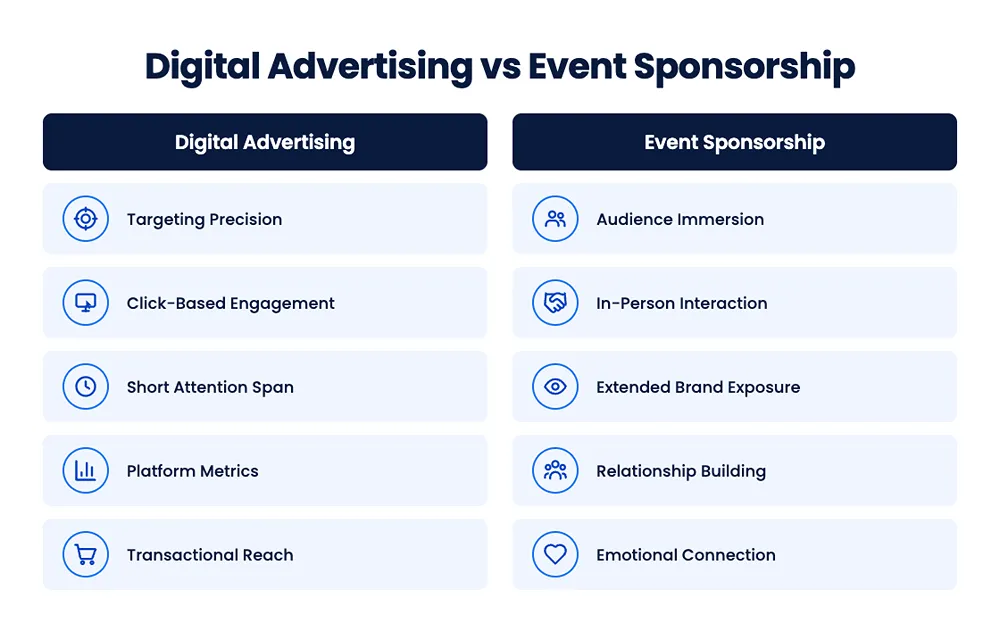
- Sponsors benchmark against digital advertising. A media buyer can generate precise targeting, cost-per-click data, and conversion reporting from a digital campaign. If your event cannot provide comparable clarity on results, it looks like a riskier investment, even if the audience value is higher.
- Long-term partners over one-time buyers. Sponsors with ongoing relationships report significantly higher satisfaction and are more likely to expand investment year over year. The foundation for that kind of relationship is consistent, professional event marketing that builds trust over time.
The point is not to compete with digital advertising on its own terms. It's to show that your event delivers something digital cannot: direct, in-person access to a motivated, assembled audience, and proof of that value in data.
What Sponsors Want from Modern Events
The list of what sponsors want has changed more in the past three years than in the previous decade. The shift away from passive logo placement and toward active, measurable engagement is nearly complete. Here is what matters now:
- Audience alignment vs. audience size. Demographic fit matters more than headcount. A sponsor selling financial planning software would rather reach 500 CFOs than 5,000 general consumers. Audience relevance drives sponsorship value.
- Interactive and experiential activations. Static displays, banner ads, and table drops no longer move the needle. Sponsors want activations that put their product or service directly in front of attendees: demos, co-branded experiences, exclusive lounges, gamified engagement. The closer the brand gets to the attendee, the better.
- Digital amplification beyond the room. Live coverage, recap content, social campaigns, and post-event reporting all extend a sponsor's presence beyond your venue. Events that only deliver in-room exposure are leaving value on the table.
- Clear deliverables and accountability. Sponsors want to know exactly what they are getting, when they will get it, and how it will be measured. Ambiguity in the proposal becomes distrust in the relationship.
- Post-event data and reporting. The end of the event is not the end of the sponsorship. Sponsors expect documented results: what ran, what engaged, what converted. Without this, renewal conversations become guesswork.
These expectations are not new ideas. They are the new baseline. Properties that meet them compete for the best partners. Those that don't tend to cycle through sponsors that leave after one year.
Event Marketing Techniques That Attract Sponsors
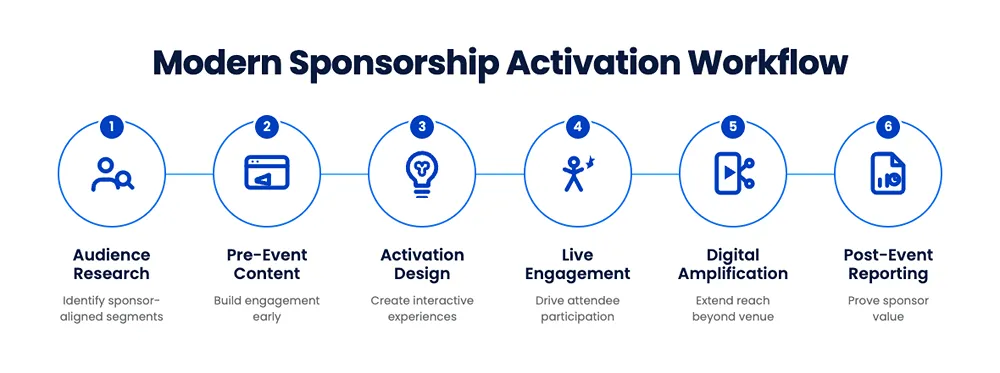
The following techniques are the ones that move sponsors from curious to committed. They're not theoretical; each one addresses a specific concern that sponsors raise when evaluating events.
1. Build a Pre-Event Content Strategy That Demonstrates Audience Quality
One of the most underused tools in sponsorship marketing is pre-event content. Blog posts, social series, video interviews, speaker previews, and email campaigns do two things simultaneously: they attract the right attendees, and they prove to sponsors that your audience is engaged before the event even happens.
When a sponsor sees that your event content generates thousands of email opens, social shares, and video views weeks in advance, they are looking at a live audience, not a projection. That is far more persuasive than historical attendance data. Use your pre-event campaign to tell a story about who your community is, what they care about, and why sponsors belong in that conversation.
2. Segment and Profile Your Audience with Real Data
Sponsors need to know they are reaching the right people. Audience segmentation is how you prove it. Go beyond age and zip code: pull purchase behavior, job function, income level, and interest categories from your registration and past-event data.
Build a one-page audience profile for each sponsorship category. A healthcare brand might see a different slice of your community than a financial services brand, and showing brands their specific audience segment is far more persuasive than presenting the full attendee population as if it applies equally to everyone.
This ties directly to your sponsorship marketing strategy. The tighter the match between sponsor objectives and audience profile, the easier the yes.
3. Design Event Sponsorship Packages Around Sponsor Goals, Not Yours
Most event sponsorship packages are built around what the property has to sell: logo placements, booth space, program ads, social mentions. That inventory-first approach creates packages that feel generic and force sponsors to cherry-pick from a menu.
A better approach is to build packages around what sponsors are trying to accomplish. If a brand wants to generate leads, package the activities that produce them: a speaking slot, a workshop sponsorship, a gated digital download, a booth with a lead capture mechanism.
If another brand wants brand awareness, package reach: prominent signage, digital amplification, sponsored content. Outcome-based package design replaces the tired Gold, Silver, Bronze structure with something that actually mirrors how sponsors think about return on investment.
4. Develop Activation Concepts Before the Proposal
Most sponsors need to see how a sponsorship will come to life before they can approve the budget. Activation ideas, even rough ones, do the work of making the sponsorship feel real. They also demonstrate that your team knows how to execute, which reduces perceived risk.
Concepts do not need to be commitments. They're proof of competence. A technology brand might be shown a charging lounge with AR-enhanced visuals. A food and beverage brand might see a branded tasting station with a product giveaway tied to social sharing. A financial services brand might be presented a breakout session where their team delivers content to a pre-qualified audience.
5. Extend Sponsorship Value Across Digital Channels
An event that only exists in one room is only as valuable as that room. The most attractive events for sponsors are ones that amplify the experience before, during, and after: through social media, email, video content, and digital campaigns.
Consider building digital amplification into every sponsorship tier. Live coverage on Instagram or LinkedIn, sponsor-branded recap videos, post-event blog features, email mention in your follow-up sequence. Each of these extends the sponsor's exposure beyond the attendee list and into the broader community you have built around the event.
This also gives you more to offer sponsors at different investment levels. Digital reach is scalable in a way that physical signage is not.
6. Create Exclusivity and Category Protection
Category exclusivity is one of the most valued, and most overlooked, assets in event sponsorship packages. When a brand knows they are the only financial services provider, the only insurance company, or the only technology sponsor at your event, the competitive dynamics shift dramatically in your favor.
Exclusivity is not just about limiting competitors. It is about creating a meaningful advantage that justifies premium pricing. A payment processor that is the only cashless payment option at a large event is not just a sponsor; they are infrastructure. The most effective exclusive sponsorships turn brand presence into a utility that attendees rely on.
7. Use Post-Event Reporting as a Sales Tool
The wrap report is one of the most powerful but consistently under-executed elements of event marketing. A professional, data-rich post-event report serves two purposes: it validates the current sponsorship to the decision-maker approving next year's budget, and it gives your sponsor's internal team the ammunition they need to sell the renewal internally.
Include audience reach metrics, engagement data, social impressions, activation performance, lead counts, and survey results. Package it visually, not as a spreadsheet dump. The report should answer the question every CFO eventually asks: "What did we get for what we spent?"
Properties that deliver thorough, timely post-event reporting are far more likely to retain sponsors and negotiate from a position of demonstrated performance.
Measuring Sponsor ROI
Sponsors are no longer satisfied with attendance counts and logo visibility. High-performing sponsorship packages generate 8 to 12 times the sponsor's investment, according to KORE Software's 2024 sponsorship analytics study. Reaching that level requires disciplined tracking and clear reporting.
The metrics that matter most to sponsors depend on their objectives. Here is a practical framework.
- Lead generation: qualified contacts collected during the event, follow-up meeting bookings, post-event conversions
- Audience reach: total attendees, social media impressions, video views, email list exposure
- Brand engagement: booth traffic, interaction time, product demos, social mentions and shares
- Media value: earned media, event press coverage, influencer amplification
- Pipeline influence: deals opened or advanced within 30 to 90 days of the event
The last point is often where the conversation gets complicated. Most B2B deals close weeks or months after the event. If your tracking ends on the day of the event, you are missing the part of the story that justifies the biggest sponsorship investments. Successful event marketing programs build attribution into the plan before the event begins, not after.
Work with sponsors to establish attribution models before the event begins. First-touch, last-touch, and weighted attribution all tell slightly different stories; what matters is that both sides agree on the framework before the data comes in. For a deeper look at the metrics that make renewal conversations easier, SponsorCX's ROI framework offers a practical starting point.
Mistakes That Turn Sponsors Away
Knowing the techniques that attract sponsors is only half the picture. Equally important is recognizing the patterns that quietly kill deals and renewals. These are the most common ones:
- Generic packages with no audience insight. Sending a templated tier deck with logo placement at three price points tells a sponsor you have not thought about their goals at all. It also signals that every other sponsor got the same deck. Event sponsorship packages built without sponsor objectives in mind rarely close at full value.
- Overpromising on deliverables. Sponsors can handle realistic projections. They cannot handle being told 5,000 attendees and seeing 900. Set conservative numbers and beat them.
- No post-event reporting. Silence after the event is one of the fastest ways to lose a sponsor. If they have to ask how things went, the relationship is already cooling.
- Slow response times during the sales process. Sponsors are evaluating your professionalism through every interaction. Long response times and disorganized follow-up signal that execution will be just as rough.
- Logo placement as the primary value. Logos on banners, websites, and programs are table stakes. Sponsors who are only getting logo visibility can get that cheaper elsewhere. Build packages that go deeper.
How to Turn Sponsors into Long-Term Partners
The most efficient sponsorship program is one where existing partners renew and expand year over year. Acquisition is expensive. Retention is leverage.
Long-term sponsor relationships are built on three things:
- Consistent execution
- Regular communication
- Proof of results
Consistent execution means that what was promised in the proposal matches what happened at the event. It sounds basic, but this is where most programs quietly fail. Deliverables get missed. Activation elements run late or not at all. The sponsor notices even when you hope they will not.
Regular communication means not going dark between events. Quarterly check-ins, post-event debriefs, and pre-renewal conversations all demonstrate that the relationship is active, not transactional. Ask sponsors what worked and what did not. Sponsors who feel heard are far more likely to come back.
Proof of results means showing your work before it is asked for. A sponsor who receives a detailed wrap report, a renewal proposal tied to measured outcomes, and a clear picture of what next year could look like is a sponsor who goes into renewal season with confidence, not hesitation. For a structured approach to keeping your best partners, the Sponsorship Lifecycle from Prospecting to Renewal lays out the process in detail.
One more dynamic worth understanding: multi-year deals change the economics on both sides. For the sponsor, they reduce the cost and effort of annual re-evaluation. For the property, they provide budget stability and deeper activation integration. If you want to pitch multi-year agreements, the evidence from your post-event reporting is your best negotiating asset.
A Real-World Example of Marketing Techniques That Work
Michelob Ultra's activation at the 2024 Copa America USA is one of the clearest recent examples of how event marketing techniques and sponsorship strategy work together.
As the official beer sponsor of the tournament, Michelob Ultra launched a summer-long campaign across all 14 host cities. The campaign included branded fan zones, pop-up bars, digital sweepstakes, limited-edition packaging tied to participating national teams, and a co-branded merchandise line with PUMA.
What made it work was not the budget. It was the architecture. The brand did not just buy signage inside stadiums; it built an experience that extended into cities, into retail, and into digital channels. Fans encountered the brand before, during, and after matches. The campaign gave organizers a clear story to tell: here is what activation with us looks like, here is the reach it generates, and here is how that engagement translates to measurable outcomes.
The lesson for event organizers is not to replicate the scale. It is to replicate the structure: build activation concepts early, integrate digital amplification into every touchpoint, and create enough documentation along the way that the data practically writes the post-event report for you.
That kind of systematic approach is what separates properties that negotiate from a position of strength from those that are always starting from scratch.
How SponsorCX Strengthens Your Marketing
When your sponsorship program is small, one or two partners, a single annual event, spreadsheets and email threads can hold things together. Add a second event, a third sponsor category, multiple activation timelines, and a cross-functional team, and the system collapses.
Deliverables get missed. Reports are assembled manually at the last minute. Renewal conversations happen without data.
That’s the inflection point where a platform like SponsorCX becomes essential: not a luxury, but a requirement for running a professional program.
SponsorCX is built around four capabilities:
- Centralize: Every contract, deliverable, activation timeline, and sponsor record lives in one place.
- Automate: Once a sponsorship is defined, SponsorCX generates tasks, timelines, and responsibilities automatically.
- Track: Real-time visibility into fulfillment and activation status across every partnership. You know what is complete, what is in progress, and what still needs attention.
- Report: Post-event reporting becomes a structured output, not a last-minute exercise.
The result is a sponsorship program that runs with consistency, earns sponsor confidence, and produces the data that makes renewals easier.
For teams managing marketing sponsorships across one or more events, the platform's impact is immediate. As one user put it: "Before SponsorCX, we were utilizing too many tools and spreadsheets to keep our sponsorships on track. Now, everything lives in one dynamic platform, and that has been a game changer."
The event marketing techniques covered in this guide require infrastructure to execute consistently. SponsorCX provides that infrastructure.
Ready to run a sponsorship program sponsors want to come back to? Schedule a demo with SponsorCX and see what a centralized, data-driven sponsorship program looks like in practice.
You make good marketing happen. SponsorCX makes it simple.