Consider a regional three-day festival that sold 11 partnerships in the spring but lost four by October. The packages were competitively priced, but when a beverage sponsor asked what its investment had produced, the festival could point only to a banner, a logo on the map, and four social posts. The sponsor was underwhelmed.
That gap between what gets sold and the sponsor’s desired results is the real problem in festival sponsorship.
A music festival sponsorship package is the organized set of rights, benefits, access, and activation opportunities a festival offers a brand in exchange for cash, product, or services. Strong event sponsorship packages sell a route to a business outcome, not a list of places a logo can appear.
The common oversimplification is that a package equals inventory. Inventory matters, but event sponsorship is closer to a service agreement than a media buy. You promise a defined audience interaction that gets documented and reported.
One sign that brand demand for live-music partnerships remains strong comes from Live Nation. The company reported $1.33 billion in sponsorship and advertising revenue for 2025, up 11 percent, with a 64 percent adjusted operating income margin. The results do not represent every festival, but they show that substantial sponsor money is still moving toward live entertainment properties that can deliver and document value.
This guide covers what belongs in a package, how to structure and price festival event sponsor levels, which creative music festival sponsorship ideas earn their cost, and how to measure results well enough to earn a renewal.
What Is a Music Festival Sponsorship Package?
Sponsorship buys association, access, and the right to build something inside an experience fans want to attend. Most festival sponsorship packages combine these elements:
- Visibility
- Hospitality
- Content
- Data
- Product presence
- Activation space
The mix is what makes a package feel custom-built.
Sponsorship Rights vs. Activation
Rights are what the sponsor is allowed to do. Activation is what the sponsor does with them. A brand may own a stage name, a category exclusive, and a footprint near the entrance, but none of it produces results until someone designs the space, staffs it, and gives fans a reason to stop.
Keeping the two separate clarifies responsibility and sets the expectation that a sponsor needs an activation budget on top of the rights fee. Programs that spend heavily on rights but invest too little in activation can underperform. Most often the festival absorbs the blame.
Why Every Package Should Support a Business Goal
Before you assign a price or a tier, write down the outcome the sponsor is buying. Awareness, trial, leads, hospitality, and community credibility each require a different asset mix. When the goal sits at the top of the package, every line below it either supports that goal or gets cut. Make a habit of getting rid of filler from festival sponsorship packages.
What Music Festival Sponsors Want from a Partnership
Sponsors do not always begin by clearly defining their objective. It helps to know the short list. Most festival sponsorship opportunities serve one or two of the following:
- Brand awareness among an audience that is hard to reach through paid media
- Audience engagement that lasts longer than a glance at a banner
- Product trial, especially for food, beverage, and personal care brands
- Lead generation through sampling, contests, sign-ups, or app activity
- Content creation the brand can use for months afterward
- Customer and client hospitality in a setting competitors cannot match
- Direct sales on site or through a promotion tied to the event
- Community connection for regional brands that need local credibility
- First-party audience insights, including opt-ins and behavioral data
An awareness sponsor needs scale and repetition. A lead generation sponsor needs a reason for fans to hand over an email address.
Ask these two questions early:
- What does success look like at the end of the festival?
- Who inside your company has to approve it?
The second answer tells you which numbers your reporting has to satisfy.
Common Music Festival Sponsorship Levels
Tiers can be useful. They make pricing legible and help brands self-select. The risk is defaulting to gold, silver, and bronze, which describes the size of a check but says nothing about what a sponsor gets to do. Naming your festival event sponsor levels after the role a partner plays makes the value clearer. Our guide to sponsorship levels and how benefits ladder between them goes deeper. Here are some possible package names:
· Title or Presenting Sponsor
The largest investment and the highest exclusivity. This partner sits in the festival name or presenting line, appears across paid and owned media, and holds broad category protection.
· Main Stage Sponsor
Strong visibility with a physical anchor. The stage name appears in schedules, signage, artist introductions, livestreams, and most fan photography. The investment typically sits below the title-sponsor level while still providing extensive visibility.
· Supporting or Category Sponsor
A mid-tier partner with a defined footprint and exclusivity inside a narrow category. Most brands land here, and package design matters most at this level.
· Official Supplier or Product Partner
A brand providing product, service, or infrastructure in exchange for rights and visibility. Compensation is often part cash and part in-kind. Document the fair market value of the contributed products or services in the agreement.
· Local Business and Community Partner
Smaller investments from regional brands that want proximity to the community. These partners often value a simple activation space, public recognition, and content they can share through their own channels.
What to Include in a Music Festival Sponsorship Package
Every benefit you list becomes a promise you must keep. Make sure each one is specific, measurable, and realistic for your current team to deliver.

· Brand Visibility and Signage
Name exact placements, quantities, sizes, and duration: banners, entry arches, wayfinding, fence scrim, wristbands, cups, screen rotations. "Prominent signage" is not a benefit. "Two 8-by-4-foot banners flanking the main stage for three days" is.
· Digital and Social Media Promotion
Specify post counts, platforms, formats, and timing. Share past performance ranges, not follower counts.
· On-Site Activation Space
Define footprint size, location, load-in windows, power, water, Wi-Fi, and staffing. Location drives results more than square footage, so map footprints against foot traffic first.
· Tickets and VIP Hospitality
List ticket quantities by type, parking passes, credential levels, and lounge or viewing access. Hospitality is underpriced at many festivals. Tickets, passes, and premium access are too often treated as courtesies rather than valuable inventory.
· Content and Media Rights
Cover what the sponsor may capture, what you will produce, and how long they can use it. Artist approvals are the constraint, so never promise likeness or interview access before it clears.
· Product Sampling and Sales
Define sampling volume, locations, and any exclusivity attached to sales rights. Confirm permits, health requirements, and vendor conflicts first.
· Category Exclusivity
Write the category definition in plain language and put its boundaries in the contract. Vague exclusivity is a common source of sponsor conflict in beverage, financial services, and telecom.
· Audience Data and Lead Generation
Explain what data the sponsor receives, how it is collected, how consent is handled, and how the information will be stored and protected.
· Post-Event Reporting
Include the report as a listed benefit with a delivery date. Naming it changes how your team treats documentation during the event.
If you build packages from shared inventory, SponsorCX puts every asset, its value, and its status in one view. Request a demo and see your full inventory at once.
How to Price Music Festival Sponsorship Packages
Pricing built only on attendance and logo size will be negotiated down, because sponsors can price impressions themselves. Set the price on the total value of what the partner receives and what it costs you to deliver. Here are common components:
- Attendance and audience profile, including age, income, travel distance, and spend
- Brand exposure across owned, earned, and paid channels
- Category exclusivity, worth more in crowded categories
- Activation footprint, weighted by location and traffic
- Digital reach, measured by engaged audience rather than raw followers
- Hospitality value, priced at what the equivalent experience would cost
- Content rights and the shelf life of the material produced
- Market demand, including how many brands want the same slot
- Production and fulfillment costs your team absorbs
- Comparable sponsorships at festivals of similar size and audience
Account for fulfillment costs before approving a price. A $40,000 partnership that costs $18,000 to deliver contributes only $22,000 before overhead and other expenses. Many festivals find that mid-tier partnerships produce their strongest margins.
Fixed Packages vs. Custom Proposals
Fixed packages move faster and protect margin on smaller deals. Custom proposals win larger deals because they respond to a specific objective. A hybrid approach usually works best: fixed tiers for local and supplier partners, followed by modular proposals for larger investments. A solid sponsorship tier package template makes the approach repeatable instead of improvised.
Creative Music Festival Sponsorship Ideas
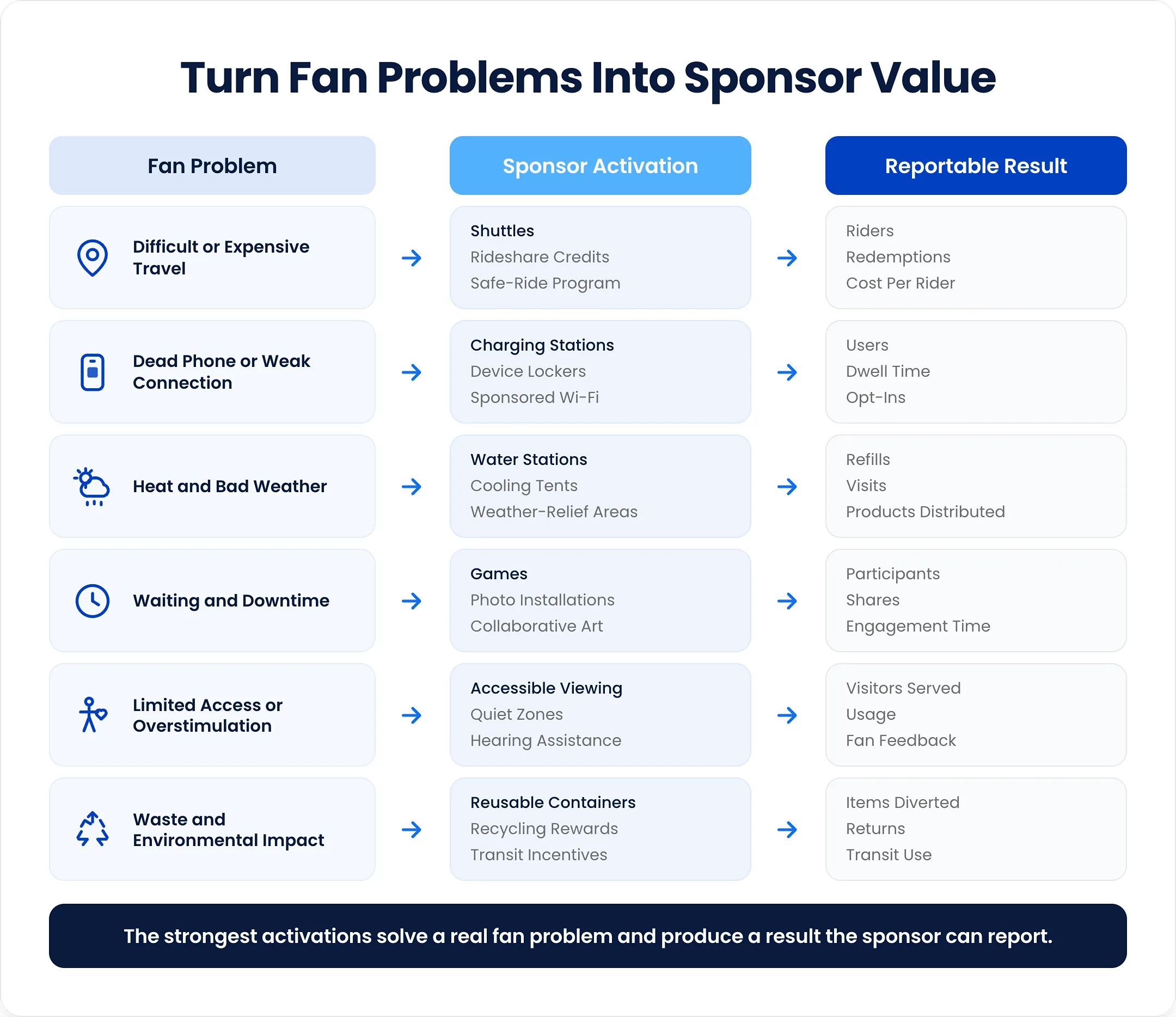
The best music festival sponsorship ideas start with a fan problem. Heat, distance, dead batteries, and long lines are all opportunities. Solving them creates gratitude the brand gets credit for.
· Sponsored Transportation and Safe-Ride Programs
Shuttles, rideshare credits, designated-driver check-ins, bike valet, and branded transportation hubs. These reach every attendee at the start and end of the day, the two moments people remember most.
· Charging Stations and Connectivity Lounges
Phone charging, device lockers, shaded seating, and reliable Wi-Fi. Dwell time is long and voluntary. Offer an optional charging reservation or notification and the space can also become a lead-generation asset, provided the data collection process is transparent.
· Hydration, Cooling, and Weather-Relief Stations
Free water and refill points, misting tents, sunscreen, fans, ponchos, and warming areas. These activations can generate lots of goodwill at outdoor festivals. They’re relatively easy to measure.
· Branded Festival Content
Artist interviews, backstage footage, livestream segments, curated playlists, and photo galleries. Content extends a three-day event into a three-month campaign. Secure content rights early and build the capture plan before gates open.
· Interactive Fan Activities
Photo installations, games, personalization stations, scavenger hunts, and collaborative art walls. The test is whether a fan would participate if the brand were not attached.
· Food and Beverage Partnerships
Signature drinks, tasting areas, chef collaborations, reusable cup programs, and sponsored dining zones. These convert directly and produce sales data, which makes them easier to renew and harder to execute.
· Wellness and Accessibility Programs
Quiet zones, sensory-friendly spaces, accessible viewing platforms, hearing assistance, and wellness tents. These serve fans who are often overlooked and give a sponsor a credible reason to be present.
· Sustainability Activations
Recycling rewards, reusable containers, solar charging, clean-up crews, and transit incentives. Sponsors want a defensible environmental story. Offer only what you can document.
· VIP and Artist Hospitality
Premium lounges, elevated viewing decks, gifting suites, and hosted meet-and-greet moments. Our breakdown of activation ideas that bring fans closer to the action applies directly to festivals.
The unique festival activations that get renewed share three traits:
- They solve something real
- They are easy to find
- They produce a number you can report
Sponsorship Ideas for Different Types of Brands
Category shapes what a sponsor can credibly do on site. These festival sponsorship ideas scale with your size and genre.
· Beverage and Food Brands
Sampling, signature menu items, refill programs, and hosted bars. Pair activation with sales rights where permitted, since trial plus purchase beats trial alone.
· Financial Services and Payment Brands
Cashless payment integration, fee-free ATMs, cardholder fast lanes, presale windows, and lounges. Payment integrations can produce measurable transaction data, subject to the agreement and applicable privacy controls.
· Automotive and Transportation Companies
Vehicle displays, test-drive sign-ups, ride programs, EV charging, and shuttle sponsorship. Registrations and ridership are clean, countable metrics.
· Technology and Telecommunications Brands
Connectivity, charging, app integrations, photo and video capture, and interactive installations. These brands can improve the festival's own infrastructure, so the partnership feels native.
· Health and Wellness Companies
Hydration, recovery zones, sun protection, quiet spaces, and sample distribution. Position these as care and the activation feels appropriate to the setting.
· Local Businesses and Regional Brands
Neighborhood vendor rows, community stages, volunteer programs, and shared promotions. Keep fulfillment simple, since local partners value proximity and recognition more than reach.
How to Customize Packages Around Sponsor Goals
Goal-based packages require a repeatable sequence you can finish in one meeting.
- Identify the sponsor's objective and the internal metric it is measured against.
- Match that objective to the audience moments where it can realistically happen.
- Select the rights and assets that support those moments, and remove the ones that do not.
- Build the activation plan, including staffing, cost, and what fans receive.
- Establish measurement before the festival: baselines, tracking method, and report format.
An awareness sponsor should end up with scale assets. A lead generation sponsor should end up with fewer placements and a better capture mechanism. If two sponsors with different goals get the same asset mix, the package came from your inventory instead of their objectives. The same discipline applies when you build the proposal itself.
How to Measure Music Festival Sponsorship ROI
Measurement decides renewals. Set benchmarks before the festival, assign someone to collect evidence during it, and tie every number back to the goal the sponsor named.
· Reach and Brand Exposure
Impressions from signage, stage mentions, livestream inclusion, and media coverage. Report methodology alongside the number.
· Fan Engagement
Activation visits, dwell time, participation counts, samples distributed, and social interactions tied to the sponsor.
· Leads and Conversions
Opt-ins collected, promo code redemptions, app downloads, and purchases traceable to the partnership.
· On-Site Participation
Footprint traffic by day and hour. This also improves next year's pricing, since it shows which locations perform.
· Content Performance
Views, completion rates, shares, and usable assets delivered to the sponsor.
· Brand Lift and Audience Sentiment
On-site intercept surveys and follow-up surveys sent to ticket buyers can provide a directional indication of brand lift.
· Sponsor Satisfaction and Renewal
A structured debrief within three weeks, before budget planning starts. Track fulfillment completion as its own metric because unfulfilled assets can jeopardize an otherwise successful partnership.
Photos, counts, and screenshots gathered during the festival are worth more than any estimate produced afterward. Our guide on how to measure sponsorship effectiveness covers baselines and attribution in detail.
Common Mistakes to Avoid When Building Sponsorship Packages
Most package problems trace back to one pressure: a deadline arrives, the package needs to look full, and filler gets added.
- Selling logo placement with no engagement mechanism attached
- Offering the same package to every sponsor regardless of objective
- Promising assets the festival cannot reliably deliver at scale
- Ignoring activation and fulfillment costs when setting price
- Overloading packages with low-value benefits to justify a number
- Leaving category exclusivity undefined in the agreement
- Waiting until after the festival to decide what gets measured
- Delivering reports that list activity without connecting it to the sponsor's goal
A shorter package built around three assets a sponsor will use beats a longer one built around eleven they will not.
Managing Festival Sponsorship Assets and Fulfillment
Selling the partnership is roughly a third of the work. The rest is inventory management, contracts, artwork approvals, production deadlines, activation coordination, proof of performance, and reporting. Festivals compress all of it into a few weeks across staff, seasonal hires, and vendors.
Spreadsheets hold up until they do not. The failure point is often a signage file approved in an email nobody forwarded, or a benefit sold twice from two versions of the inventory. Centralizing agreements, assets, deadlines, and evidence creates a record you can point to at renewal time.
Bring your inventory, contracts, and fulfillment tracking into one place before your next on-sale. Schedule a SponsorCX demo and see what your team stops chasing.
Build Festival Sponsorships That Benefit Fans and Brands
The festivals that keep partners year after year promise what they can deliver, deliver what they promised, and prove the results while the event is still fresh. The most effective music festival sponsorship packages connect sponsor goals with creative festival activations that solve problems for fans. You need a system that keeps the details from slipping while you handle the work that requires judgment.
SponsorCX helps you centralize inventory and agreements, automate approvals and deadlines, track fulfillment as it happens, and report results your sponsors can take to their leadership.
You make sponsorships happen. SponsorCX makes it simple. Schedule your demo.