Sponsorship Deck vs. Sponsorship Proposal: A Critical Distinction
Before diving deeper into what makes a winning sponsorship proposal, it’s important to clarify terminology. These terms are often used interchangeably, but they serve very different purposes.
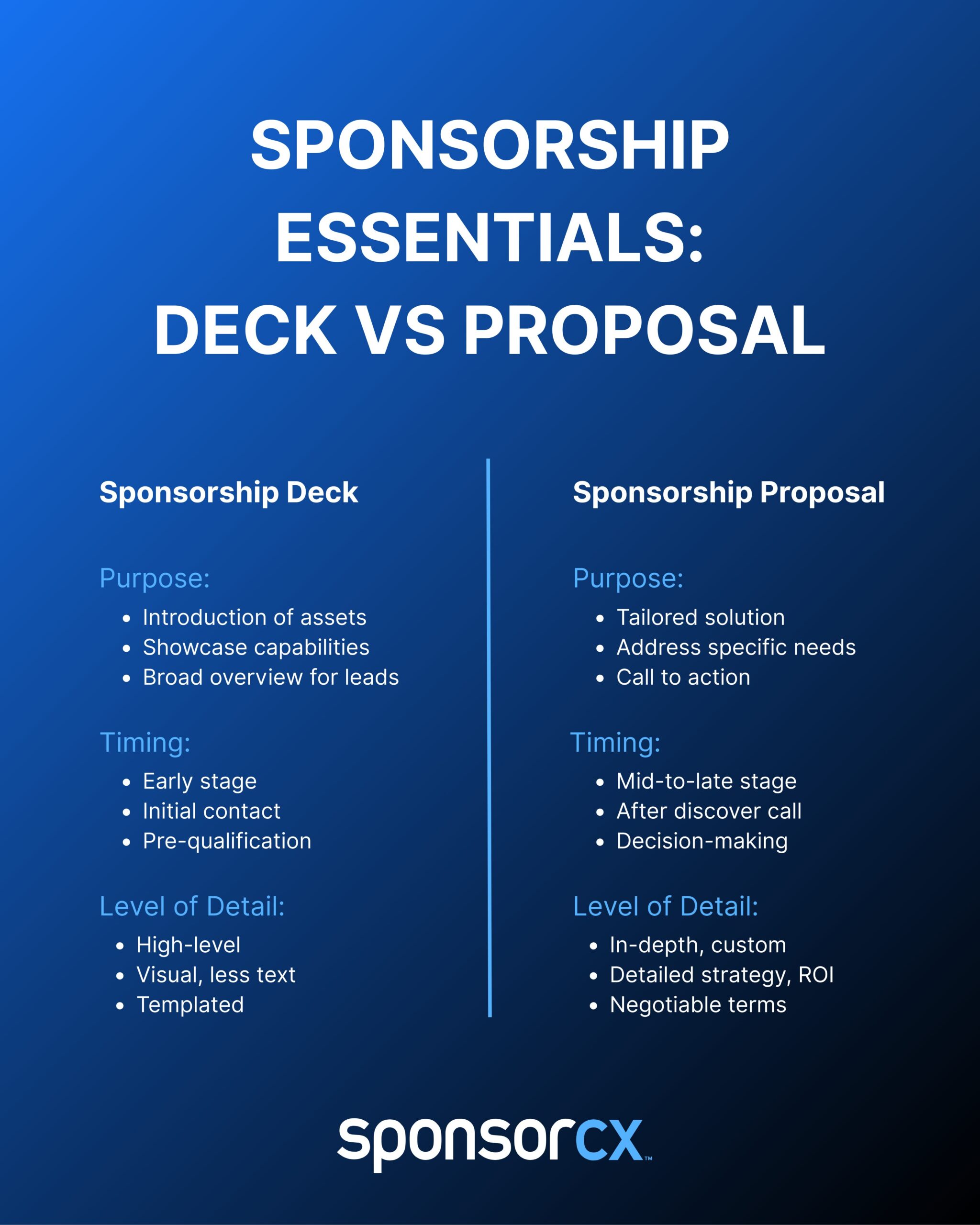
What a sponsorship deck is (and is not)
A sponsorship deck is:
- A high-level, strategic document
- Used early in the sales process
- Designed to earn the next meeting
A deck is not meant to:
- Lock in pricing
- Finalize deliverables
- Answer every possible question
Instead, a strong sponsorship deck should:
- Establish relevance
- Demonstrate fit
- Signal professionalism and credibility
- Make the opportunity easy to explain internally
In practical terms, a sponsorship deck should help a sponsor say:
“This looks aligned with what we’re trying to do. We should explore this further.”
What a sponsorship proposal is meant to do
A sponsorship proposal comes later.
- It’s more detailed
- It’s customized
- It’s more specific
A sponsorship proposal typically includes:
- Defined packages or scopes
- Pricing and timelines
- Detailed deliverables
- Measurement frameworks
- Reporting expectations
Once signed, the proposal often becomes a working reference for fulfillment and reporting. That’s why sending a proposal too early can actually slow deals down. Without alignment, detail creates friction instead of confidence.

Why confusing decks and proposals hurts conversion
When properties combine these two documents, several problems emerge:
- Decks become bloated and hard to scan
- Sponsors struggle to summarize the opportunity internally
- Too many decisions are introduced too early
- The conversation jumps to pricing before fit is established
Top-tier teams avoid this by respecting sequencing.
A strong sponsorship proposal structure follows this progression:
- Deck: Establish fit and relevance
- Conversation: Clarify objectives, constraints, and priorities
- Proposal: Confirm scope, value, and execution
This sequencing reduces friction, shortens sales cycles, and increases the likelihood that sponsorship leads turn into real conversations instead of dead ends.
Why This Matters More Than Ever
As sponsorship organizations grow more complex, decks are no longer evaluated by a single decision-maker. They are shared, forwarded, summarized, and questioned internally.
A sponsorship deck that:
- Is easy to understand
- Is easy to explain
- Clearly frames value
has a much higher chance of surviving that internal process. That’s what separates top-tier decks from the rest—and it starts with clarity, not creativity.
Anatomy of a Winning Sponsorship Deck

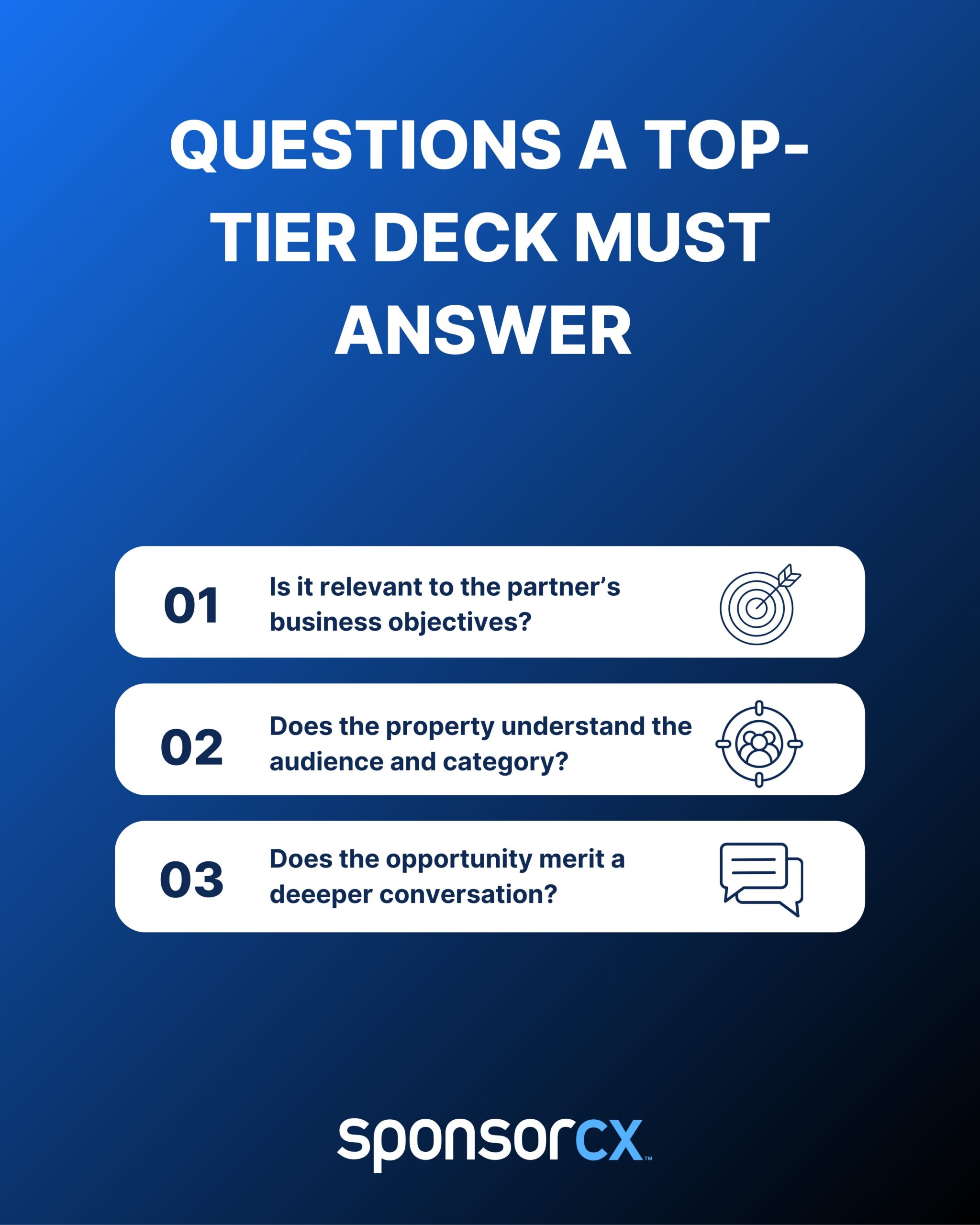
Once a sponsorship deck earns initial attention, the next question sponsors are quietly asking is simple: Does this hold up under scrutiny?
This is where average decks and top-tier decks go their separate ways. Strong decks are not just persuasive on the surface. They’re structurally sound. They anticipate questions. They guide interpretation. And they help sponsors connect dots internally without extra effort.
Below is the practical anatomy of a winning sponsorship deck—what it must include, how each section should function, and what “great” looks like in practice.
- Start With the Sponsor’s Objective, Not Your Offering
Top-tier decks don’t start with assets. They start with intent. A strong opening section clearly frames:
- The type of business objective being supported
- The category context the sponsor operates in
- The role the partnership could play in that strategy
This does not mean trying to guess the sponsor’s goals. It means anchoring the opportunity in commonly understood objectives such as:
- Brand awareness in a specific market
- Consideration among a defined audience segment
- Engagement tied to experiences or content
- Community impact or brand purpose
When this framing is clear, every slide that follows feels connected instead of random.
- Proving Fit by Using Real Audience Data (Not Generic Demographics)
This is where many sponsorship decks lose credibility. Demographics alone are not insight. Age, gender, and income describe who an audience is, but they don’t explain why that audience matters to a sponsor.
Top-tier decks use audience data to explain behavior. Even at the highest level, modern partnerships are increasingly built around data-driven experiences and insights (see IBM’s long-running work on the Wimbledon digital platform. Effective audience sections include these four elements:
Participation patterns
- How often people attend, watch, or engage
- Seasonality or frequency trends
Engagement behavior
- What content drives interaction
- When attention peaks
Context
- Where the audience spends time
- How and when brands are experienced
Category relevance
- Categories that already perform well
- Purchasing or brand affinity indicators where available
Just as important, top-tier decks interpret the data. Instead of presenting charts and leaving sponsors to draw conclusions, winning sponsorship proposals explain:
- Why this data matters
- What opportunity it creates
- How it informs activation and asset selection
This translation step is what turns data into proof of fit.
- Present Assets in Context, Not as an Inventory List. Sponsors don’t buy assets. They buy outcomes.

Weak decks list deliverables:
- Logos
- Signage
- Posts
- Impressions
Top-tier decks organize assets by purpose. Group assets into categories such as:
- Awareness drivers
- Engagement moments
- Conversion or data-capture opportunities
- Relationship-building or hospitality elements
This does two important things:
- It helps sponsors understand why each asset exists
- It shows that assets are part of a system, not isolated tactics
Context transforms inventory into strategy.
- Frame Benefits, Activation, and Measurement as an ROI Case.
Sponsors evaluate sponsorships as investments, not creative ideas. Leaders want return-on-marketing investment clarity, not activity reports. Top-tier decks consistently frame benefits through an ROI lens by answering three questions:
- What business outcome is being supported?
- How does this partnership contribute to that outcome?
- How will progress be measured?
Move from features to outcomes.
Instead of:
- “Ten social posts”
Frame:
- Sustained reach during high-engagement windows aligned to campaign timing
Instead of:
- “On-site signage”
Frame:
- High-attention brand exposure during dwell-time-rich moments
This language mirrors how sponsors discuss sponsorship internally. It makes approval easier.
Show how activation supports measurement. Winning sponsorship proposals make measurement feel intentional, not tacked on.
Strong decks:
- Define success upfront
- Align KPIs to sponsor objectives
- Clarify reporting cadence and accountability
Examples of clear measurement framing include:
- Awareness measured through reach and frequency
- Engagement measured through interaction or participation
- Conversion signals tied to clicks, opt-ins, or qualified leads
- Reporting delivered on a predictable schedule with insights, not just numbers
Measurement clarity reduces perceived risk and builds confidence.
- Use Activation Concepts to Demonstrate Thinking, Not Lock in Ideas. Activation concepts are not commitments. They are proof of competence.
Top-tier decks typically include:
- One to three sample activation concepts
- Clear alignment to sponsor objectives
- Practical execution logic
These concepts help sponsors answer an unspoken question: “If we move forward, do these people know how to bring this to life?”
Strong activation sections:
- Show creativity without overpromising
- Demonstrate operational awareness
- Reinforce that the property has done this before
Even simple concepts, when well explained, increase trust.
- Common Sponsorship Deck Mistakes That Kill Momentum. Even experienced properties fall into predictable traps.

Mistake: One-size-fits-all decks
- Signals low effort and low relevance
Top-tier alternative:
Modular decks that allow customization by category, objective, or audience segment.
Mistake: Too much detail too early
- Overwhelms sponsors
- Introduces friction before alignment exists
Top-tier alternative:
Progressive disclosure—high-level clarity first, detail after discovery.
Mistake: Asset-first thinking
- Makes sponsorship feel commoditized
Top-tier alternative:
Outcome-first framing that explains why assets matter.
Mistake: Vague measurement language
- Creates uncertainty and skepticism
Top-tier alternative:
Clear examples of what will be measured, how often, and why.
Mistake: No clear next step
- Leaves momentum to chance
Top-tier alternative:
A guided next step that explains what happens after the deck.
- Winning Sponsorship Proposals Require Process, Not Heroics. One of the biggest differences between average and top-tier sponsorship teams has nothing to do with creativity.
It’s process.
Top-performing properties:
- Track sponsor objectives consistently
- Maintain alignment between sales and fulfillment
- Reduce gaps between what’s promised and what’s delivered
- Create repeatable standards for decks and proposals
This matters because sponsorship proposals don’t live in isolation. They influence:
- Activation planning
- Fulfillment workload
- Reporting expectations
- Renewal conversations
When decks are built without process, they create downstream risk. When they’re built with structure and discipline, they support long-term relationships.
This is where sponsorship management software becomes an advantage. To understand how proposal quality enables success, see our breakdown of the sponsorship lifecycle and how every stage builds on clarity and alignment.
Proposals process callout
Why This Anatomy Works
Top-tier sponsorship decks:
- Make relevance obvious
- Prove fit with real data
- Frame value as outcomes
- Reduce internal decision friction
- Set realistic expectations from the start
That’s what allows them to convert sponsorship leads into productive conversations instead of silent hesitation.

Final Thought: Great Sponsorship Proposals Aren’t Built to Impress. They Clarify.
The most effective sponsorship proposals don’t win because they are flashy or exhaustive. They win because they reduce uncertainty.
Top-tier sponsorship decks:
- Make relevance immediately clear
- Prove fit with real audience insight
- Frame benefits as business outcomes
- Define success before activation begins
- Set realistic expectations that carry through delivery and renewal
When those elements are in place, sponsorship decisions become easier. Conversations move forward faster. And sponsorship leads are far more likely to convert into long-term partnerships.
That’s the difference between a deck that gets skimmed and a proposal that gets internal buy-in.
You’re already responsible for making sponsorship work—from the first pitch to the final report.
SponsorCX acts as your guide, providing the systems, visibility, and structure you need to build stronger sponsorship proposals, deliver consistently, and prove value over time.
If you’re ready to bring clarity and confidence to every sponsorship conversation, see how SponsorCX supports winning sponsorship proposals from pitch to renewal.