
What leading properties call their partnerships, what those levels unlock, and what smaller teams can learn
When the subject of sponsorship levels comes up, we’re bound to hear about the usual suspects: Coca-Cola and the Olympic Games, Red Bull and extreme sports, and maybe a NASCAR deal that no one knows how to explain. What we don’t hear much about is why a sponsor chose a specific level and what went into the decision-making process.
In today’s sponsorship environment, the most useful examples of sponsorship levels rarely look like Gold, Silver, and Bronze. Leading sports and event properties use levels to define a partner's role. Often, they include title partner, presenting partner, corporate champion, official technology partner, category partner, or supplier. While the level name may point to a level of status, the real value lies in the rights, access, obligations and activation platform that underpin it all.
This isn’t another guide focusing on how to build sponsorship tiers, although you will find some of that. We’re going to look behind the curtain at what a well-thought-out level looks like once it’s matched with money, rights, and brand strategy.
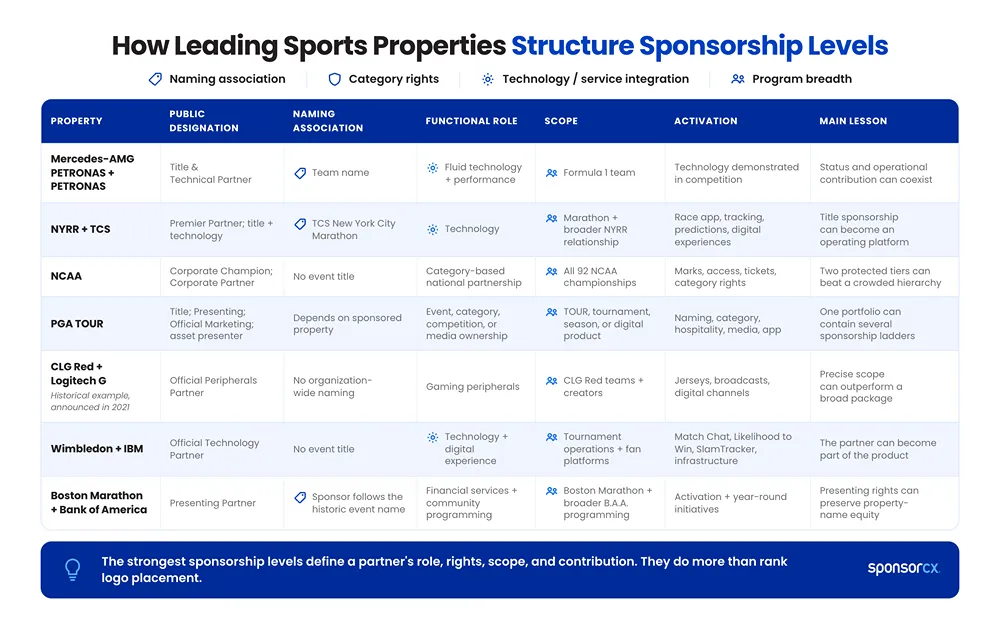
Six Real-world Sponsorship Level Examples
Mercedes-AMG PETRONAS: Levels Based on Strategic Role
The Mercedes-AMG PETRONAS F1 Team has divided its partner structure into Title Partner, Principal Partners, Team Partners, and Team Suppliers. PETRONAS is at the top as Title and Technical Partner. INEOS sits below PETRONAS as a Principal Partner and equal shareholder.
Each one describes its role as a partner of the team. Title Partner ties PETRONAS to the naming of the team. Technical qualifies its contribution of fluids and technology created for racing purposes. Principal Partner signifies value to the strategic partnership without bumping PETRONAS out of the title slot. Supplier allows for companies that produce goods or services that support the team but aren’t afforded title rights.
Partner tiers work when you separate status from function. Lower tiers can feel important when their names tell you why they’re a partner. Official Mobility Partner. Official Recovery Partner. Production Supplier all make sense for a team, tournament, or festival.
TCS and the New York City Marathon: A Title Tier That Becomes a Platform
Tata Consultancy Services is the New York Road Runners' (NYRR) Premier Partner and title and technology partner of the TCS New York City Marathon. NYRR categorizes relationships with its other marathon partners in 2025 as Foundation Partners, Strategic Partners, Contributing Partners, broadcast partners, community partners, fundraising partners, and license partners.
The upper echelon symbolizes more than a logo hung above the starting line. NYRR and TCS signed an extension through 2029 of their title and technology deal in 2021. Official race app services, real-time runner tracking, digital cheer tools, finishing-time prediction, and augmented reality experiences have been products of the relationship.
Each tier implies a certain level of involvement. Foundation implies ongoing institutional significance. Strategic implies a brand that fills a specific event or runner role. Contributing allows brands room to sponsor more narrow activations. Broadcast, community, fundraising and license are broken out because they require separate rights and deliverables.
A title level is like a stage for activations. TCS can demonstrate its technology tailored to what athletes and spectators require. The activation reinforces the sponsor and elevates the event.
The NCAA: A Deliberately Narrow Two-Tier National Program
The NCAA Corporate Champion and Corporate Partner Program only features two levels. The higher level is Corporate Champion and the lower level is Corporate Partner. The program covers all 92 NCAA championships and benefits include category exclusivity, usage of NCAA marks and designations and championship tickets.
The two-tier approach makes a lot of sense because there’s lots of real estate below program level. The NCAA sells access to an entire national championship program. With only two tiers of Champions sponsors can still deliver on a sense of exclusivity. There are still plenty of partners to activate year-round.
More levels don’t automatically equal more sellable inventory. If levels offer the same rankings, access and category rights, graduated hierarchy is nothing more than an illusion. Reduce the number of levels and protect and define the ones that remain. It will make selling and renewing that much easier.
PGA TOUR: One Ecosystem, Several Kinds of Ownership
Look at a list of PGA TOUR marketing partners. Numerous partners sell and activate property rights at the same time. WM is a PGA TOUR Sustainability Partner and title sponsor of the WM Phoenix Open. Mastercard is the presenting sponsor of the Arnold Palmer Invitational and activates its business on TOUR through a payment category partnership. Michelob ULTRA is the Official Beer of the PGA TOUR and PGA TOUR Champions.
The TOUR even sells sponsorships at the product level. The point is that sponsorship levels should be built around what’s being sponsored. Event title, presenting rights, league category, season- long competition, broadcast elements, and digital products can all sell together, if the rights and categories are mutually exclusive.
CLG Red and Logitech G: A Category Partnership Scoped to the Right Audience
CLG and Logitech G announced a multi-year partnership in 2021 establishing Logitech G as the Official Peripherals Partner of CLG Red. Included in this were jersey-side sponsorships, streams of competition, and other digital platforms. CLG was merged into NRG in 2023.
It’s interesting to look at because of the its sheer size. Logitech G didn’t need to attach an official, enterprise-wide tier name. “Official Peripherals Partner of CLG Red” only applied to CLG Red, its women counterparts, and competitors. Through competition and content creation, it created a relationship between an otherwise unrelated category and those utilizing the product.
The takeaway is that a smaller segment can have more meaning behind its title than a broad logo package. A sports-based organization with multiple teams, programs, or consumer groups, can create a partnership around one of those niches specifically.
Wimbledon and IBM: The Partner is Part of the Product
IBM has served as Wimbledon’s Official Technology Partner for over 30 years. Wimbledon calls out fan features like Match Chat, Likelihood to win, SlamTracker as IBM powered products, and runs the digital operation on infrastructure capable of supporting intense AI workloads.
These are two separate program benefits positioned side-by-side. It’s what can happen when an official recognition status sits adjacent to “generic”. The Partner gets recognition on a visible service. And you get a bona fide story of innovation. Tech, medical, sustainability, logistics and equipment tiers tend to shine here since you can point to verified performance.
Boston Marathon and Bank of America: Presenting Rights that Protect the Property Name
Starting in 2024, Bank of America became the presenting partner of the Boston Marathon. This is a 10-year agreement. Positioned after the event name is the proper treatment: the Boston Marathon presented by Bank of America.
The partnership includes Boston Athletic Association (B.A.A.) events and programming on non-race days as well. The position is strategic. It provides the sponsor top-tier positioning while leaving intact an event name that has more than 100 years of brand equity. Properties often think they need title sponsorship for the top tier. If protecting the core brand is a priority, presenting can be a better choice.
What These Real-World Sponsorship Tiers Have in Common
Take a look at these tiers from different sponsorship programs. They don’t share even one common naming convention. But they all practice some similar principles:
- The label describes the relationship. Title, technology, peripherals, sustainability, supplier, and presenting are distinguished by different expectations.
- The highest status is limited. A top level suffers from diluted meaning when oversold.
- Category rights are defined. Official designations become more valuable when the category, territory, term, and conflicts are defined.
- Activation is linked to fan behavior. Following a marathoner, leveraging match stats, attending a slam or watching your favorite team compete lets the sponsor play naturally
- Multiple ladders are fine. Organization-wide, event-level, program-level, media, supplier, and community partnerships can coexist.
- The name is only a label. Delivery still depends on assets, dates, owners, approvals, evidence, and reporting.
Here’s a test of operational capability: Before a proposal is sent, can your team see what rights are available? SponsorCX for properties manages inventory, agreements, activation, proof, and reporting in one place so a robust partner structure can live there too.
A Guide to Creating Sponsorship Levels After Studying the Examples
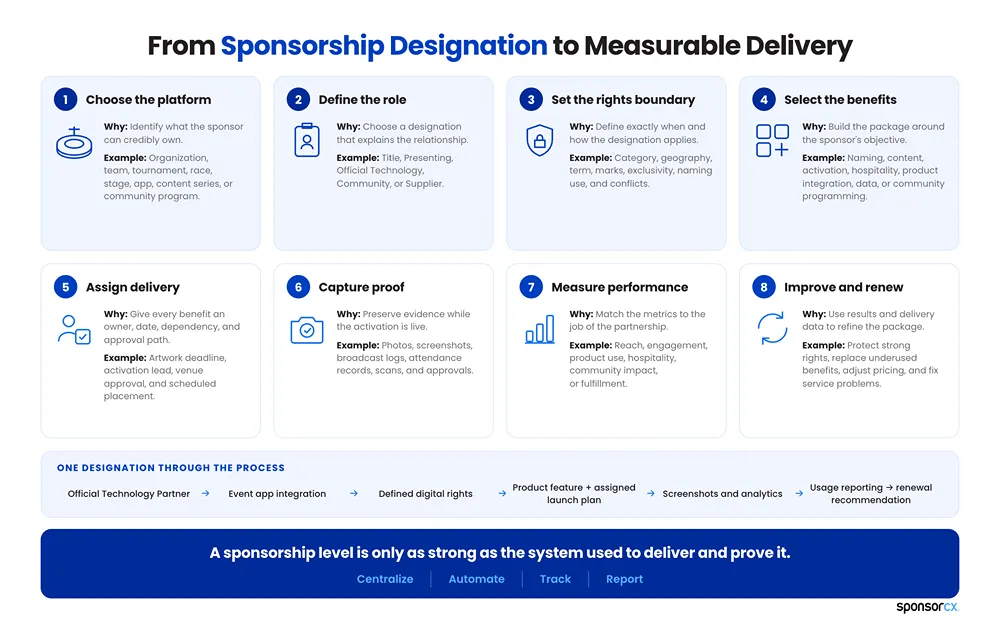
1. Choose a platform before packages. List tangible things your partner would own. Ideas include company name, team name, event name, stage name, attendee product/service name, community initiative, content series name, broadcast name, online product name. Avoid dumping all ideas into one tier dropdown.
2. Choose the role each level represents. Decide if a tier conveys status, purpose, or both. Presented by conveys status. Official Technology Partner/Official Vehicle conveys purpose. Supplier conveys a non-official type of contribution. Community Partner could include purpose driven initiatives. Pick tier names that a buyer and an internal employee can understand the same way.
3. Set the rights boundary. Category, geography, term, trademarks, naming rights, exclusivity, sublicense and conflicts. For every level or tier make sure property actually owns all rights it promises. College, facility, broadcast, league, talent and third-party rights may be owned by someone else.
4. Build benefits around the job of the partnership. Anchor with the sponsor’s desired outcome, then choose sponsorship benefits. Your technology partner might need product integration and a case study. Your presenting partner could require event naming, media mentions, hospitality and community programming. A supplier might want product use, credentials and approved opportunities for recognition. More benefits don’t necessarily mean more value.
5. Make the levels visibly different. Ideally each step will change the platform, exclusivity, logo use, audience access, activation type, hospitality, content ownership, or reporting. There should be recognizable differences in between levels.
6. Specify every deliverable
- Right or asset: Designation, placement, experience, content, ticket, data access or service
- Scope: Event, team, channel, market, category, dates, and quantity
- Owner: Person responsible for production, approval, delivery, and proof
- Inputs: Sponsor artwork, copy, product, guest list, legal approval, or technical integration
- Evidence: Photo, screenshot, traffic log, attendance record, scan count, broadcast log, or survey
- Contingency: Approved replacement if weather, schedule, production, or availability changes
How to Price Levels Without Copying Another Property
The examples we’ve looked at clearly show structure. Price is dictated by other factors. Don’t rely on someone else’s fee structure. Every property or event is unique. The mix of your audience, location, circulation of media, strength of your brand, scarcity of inventory and length of sponsorship, along with cost to activate and sponsor goals all factor into value.
Begin by pricing out the individual assets and rights. Evaluate the bundle vs cost, competitive inventory, demand and capacity. The SponsorCX sponsorship valuation guide provides a useful framework for defining asset value.
- Establish a base price for production, hospitality, staffing, tech and servicing costs.
- Charge a premium for exclusive rights like naming, category entry, location exclusivity, and access privileges.
- Track rate-card value, cash paid, value of in-kind discount, and added value separately.
- Take into account the costs of custom content, integrations, data handling, approvals, and talent access.
- Use a multi-year structure when the sponsor needs time to build a platform.
Levels should command a price difference that’s commensurate with the gap in rights. A sponsor pays more for the next level because it provides a greater value. It shouldn’t pay more just to get a longer list of deliverables.
Deliver, Measure, and Improve the Package After It Is Sold
A partnership level becomes active upon signature. Each benefit should include a scheduled deliverable, owner, due date, dependency, approval path and proof of performance. Block out hard to get inventory immediately so the rights committed to in one agreement do not appear in a different proposal.
| Partnership job | Measures that can fit | Proof to retain |
| Brand association | Reach, frequency, share of voice, awareness or recall when studied | Media logs, placement photos, third-party research |
| Fan or participant utility | Users, sessions, feature adoption, dwell time, satisfaction | Platform analytics, service records, surveys |
| Engagement or trial | Visits, interactions, samples, entries, scans, opt-ins | Activation counts, tagged links, consent records |
| Hospitality | Invitations, acceptance, attendance, guest feedback | Credential and check-in records, survey results |
| Community impact | People served, participation, hours, funds, products or outcomes | Program records and beneficiary reporting |
| Fulfillment | Delivered, pending, changed, missed, and added-value assets | Asset status, approvals, proof, exception record |
Apply uniform campaign tags across digital activations and agree on measurement prior to launch. Google Analytics' guide to custom campaign URLs outlines how campaign parameters differentiate traffic sources. Review the FTC guidance on endorsements and material connections for sponsored content, and seek guidance on any particular activation.
At renewal time, review your levels holistically. What were the drivers behind the sponsor's performance? What resources went untapped? What was expensive to maintain? Where did rationalizations/excuses/docs fall short? The answers here can lead to changes in your package/pricing/workflow/measurement plan. Clarify assumptions.
Build a Hierarchy That Makes Sense
Examples of real sponsorship tiers demonstrate that the strongest hierarchies are built around things prospective sponsors care about: meaningful roles, protected rights and experiences the sponsor can elevate. Think about how Mercedes-AMG PETRONAS defines its strategic status and technical contribution, or how The Challenge (TCS) creates a technology platform from title sponsorship or how the NCAA maintains national rights in a program that by design stays intentionally narrow. Or how the PGA TOUR builds levels of ownership at the event, category and product levels. Real world examples like CLG Red, Wimbledon and The Boston Marathon highlight the value of finely tuned scope, functional designations and judicious brand preservation.
Look at how those concepts might apply to your organization. Even a minor league team, college program, race, fair, festival or conference can have limited assets but should still strive to design sponsorship tiers that define who the partner is, what it has, what it offers and how it can be successful.
SponsorCX supports that process through four connected capabilities:
- Centralize agreements, partner details, inventory, pricing, and contacts in one shared system.
- Automate tasks, timelines, reminders, approvals, and handoffs after the sale.
- Track available and sold assets, delivery status, proof of performance, and exceptions.
- Report what was delivered, what it produced, and what should guide renewal.
See how SponsorCX simplifies sponsorship management for sports properties and event teams, or review how sports teams use a sponsorship CRM from prospecting through renewal. Ask for a no-obligation demo today.
You make sponsorships happen. SponsorCX makes it simple.