The Metrics and Analytics That Prove ROI
A practical guide to sports sponsorship measurement, including the metrics, KPIs, and analytics that prove ROI and tie results to real objectives.
Somewhere, a finance director is asking what the company’s $400,000 sponsorship deal produced. She’s not interested in impressions or reach. She wants to know how the company benefited from its investment.
If the answer is a few anecdotes and a folder full of screenshots, the sponsorship is probably not the problem. How it’s being measured is.
Sports sponsorship measurement tracks, quantifies, and reports the business impact of a sponsorship investment, from awareness through generated revenue. Measurement done right arms leadership with clear proof that the sponsorship was worth the investment. Done haphazardly, or not at all, it turns every renewal effort into a crapshoot.
The all-too-prevalent problem is counting impressions and calling it measurement. That ignores what the deal was supposed to accomplish.
Only 19% of sponsorship professionals are confident that they can measure the real business value of a sponsorship. Just one-third of organizations have a standardized process for measuring that value, according to Kantar research.
This guide will walk you through sports sponsorship analytics from start to finish. We’ll cover what to measure (and why), how to plan for measurement when building a sponsorship from the ground up, when to use ROI, when ROO is a better metric, and how to use your results to create cleaner reporting AND stronger renewals.
Match Every Metric to a Sponsorship Objective
The road to sponsorship measurement misery is usually paved well before a dashboard is opened. The deal gets signed, assets get slotted on a calendar, and no one ever defines what success looks like.
Teams track signage views, broadcast mentions, and social impressions because those numbers are easily accessible. The issue is that they might not correlate with the question management is sure to ask.
The danger lies in approaching sponsorship analytics as if there is just one kind of report. One sponsorship intended to drive awareness in a new market is vastly different from another designed to boost season-ticket renewals.
Here’s the remedy. Start well before the first activation is executed. Define the sponsorship’s objectives in specific, measurable terms. A clearly articulated partner activation strategy connects those objectives to the experiences, content, and deliverables the audience will see and experience.
Everything downstream (tracking, reporting, renewal planning) flows from getting this step right. Sponsorship objectives fall into five categories. Each requires a unique measurement strategy. The sponsorship performance metrics below are helpful but will fall short if they are not tied to the objective of the sponsorship.
| Objective | Core metrics | What the metrics show | Key limitation |
| Awareness | Reach, impressions, media-equivalency value, brand mentions, aided and unaided recall | Potential exposure and changes in awareness | Exposure alone does not prove that people noticed or remembered the brand |
| Engagement | Social interactions, video completion, time spent, app use, activation participation | Whether and how deeply people interacted | High volume can reflect low-effort actions rather than meaningful connection |
| Consideration and preference | Brand lift, preference, purchase intent, sentiment, exposed-versus-control studies | Changes in attitude or intent | Studies can be costly, slow, and sensitive to sample design |
| Sales and leads | Promo-code use, tracked traffic, qualified leads, conversion, incremental revenue or profit | Commercial outcomes associated with the sponsorship | Other marketing and market conditions complicate attribution |
| Retention and loyalty | Repeat engagement, renewal, churn, repeat purchase, customer lifetime value | Longer-term behavior among acquired or exposed audiences | Results mature slowly and require sustained tracking |
Awareness
Awareness objectives call for:
- Reach
- Impressions
- Media-equivalency value
- Brand-mention volume
- Brand recall across broadcast, digital, and in-venue placements
These metrics answer how many people were likely exposed to the brand and what comparable exposure might have cost in paid media.
What they don't prove is whether people saw or recalled the brand. A logo can flash across 10,000 frames and go unseen if it's too small, too fast, or hidden behind another sign. If awareness is the goal, combine reach measures with regular brand-recall surveys.
Engagement
Engagement metrics include:
- Social interactions
- Video views and completion rates
- Time spent with branded content
- App usage
- Participation in on-site activations
They show whether people did something with the sponsorship beyond seeing it.
Volume can be deceptive. A campaign that racks up thousands of lazy likes may tell you less about your audience’s affinity for your brand than several hundred individuals signing up for your loyalty program or hospitality list. Focus more on the quality of the action rather than the quantity.
Consideration and Preference
Consideration and preference objectives require:
- Brand-lift studies
- Sentiment analysis
- Pre- and post-sponsorship surveys
Reliable studies measure well-matched exposed and unexposed audiences. This is where we start to see measurement make the connection between exposure and a discernible shift in attitude.
The downside is cost and frequency. Brand-lift studies can be costly and slow. Many companies only run them a couple of times a season. They’re good for looking at the big picture but don't help with in-season tweaks.
Sales and Leads
Sales objectives call for:
- Promo-code redemptions
- Dedicated landing-page traffic
- Lead capture
- Conversion rates
- Attribution tied to sponsorship campaigns
These are typically the numbers finance cares most about because they tie directly to commercial results. Attribution is challenging. Sponsorship rarely stands alone, so a sale during the sponsorship period is not necessarily a sale directly linked to sponsorship. Control groups, matched-market comparisons, time-series analysis, and dedicated tracking links are among the ways to roughly quantify the incremental lift from the sponsorship.
Retention and Loyalty
Retention and loyalty objectives are common in nonprofit and community sponsorships as well as commercial ones. Useful metrics include:
- Repeat engagement
- Membership or subscription renewal
- Churn
- Repeat purchases
- Volunteer participation
- Long-term customer value among sponsorship-acquired audiences
These measures take time to develop, and they can be easy to neglect. Leave room for a longer measurement window in your plan as you begin.
For a more comprehensive view of how these measures work together, the SponsorCX guide to measuring sponsorship success covers brand exposure, engagement, sales, loyalty, ROI, and ROO.
Build Measurement In Before the Sponsorship Starts
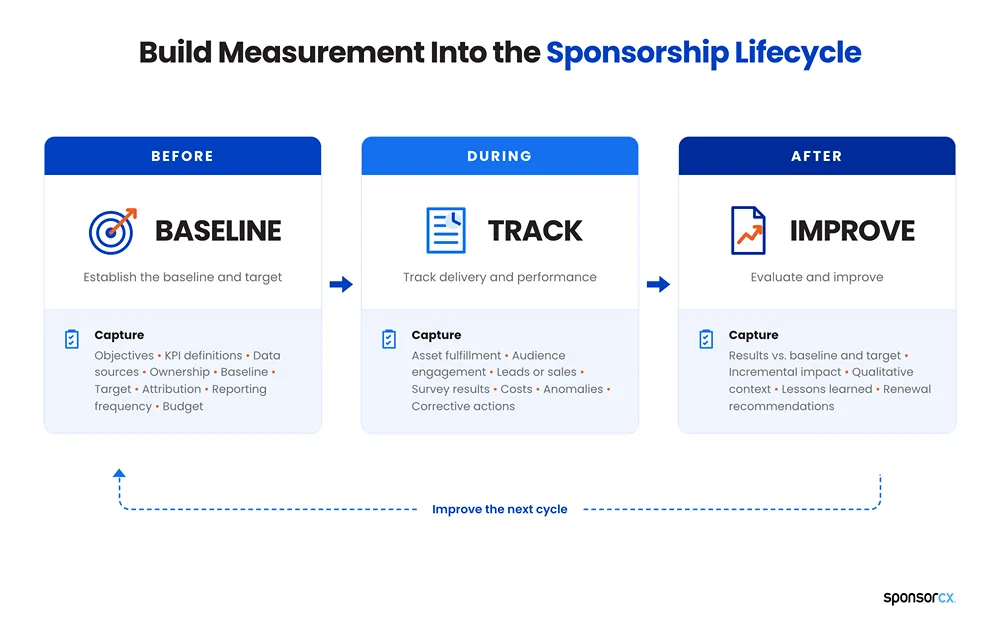
Measuring a sponsorship after it has concluded is little more than an educated guess. Organizations that create defensible results put their measurement plan in place before the agreement is signed.
Before the Sponsorship
Define baselines for each metric you’re reporting. That could include current brand awareness in your target market, existing social engagement, or current sales by category or geography. “We drove 40,000 impressions” means nothing without a baseline. Was that better or worse? Did you hit your goal? Was performance flat?
Write down the objective, metric definition, baseline, target, data source, measurement owner, reporting cadence, and attribution model. Include that somewhere in the agreement or in a separate internal measurement plan tied to the agreement. Allocate separate budgets for measurement and activation. Don't let one crowd out the other when priorities change.
During the Sponsorship
Monitor the sponsorship throughout the season. Maintain fulfillment records that prove each promised asset was executed. Gather social and digital performance metrics on a regular basis. Consider conducting an in-season brand study if your budget permits. Extract sales or lead information in time to react to what you discover.
Continuous tracking has two advantages. It discovers a skipped placement early enough to fix it or negotiate a make-good. It also provides both partners with hard data for a midseason discussion rather than a nebulous promise that “we're okay.”
Keep your measurement plan connected. SponsorCX brings objectives, deliverables, proof, and reporting into one shared system, so the recap builds as the work happens. Request a demo to see how it works.
After the Sponsorship
Put a wrap on sponsorship effectiveness by comparing final results with your baseline, target, and original objective. Hard numbers only tell part of the story.
If you’re measuring sales and leads, include attribution analysis (and describe how you attributed). Make note of external influences that could have affected performance positively or negatively. Did you have a winning season? Did a competitor drop out of the market? Is demand up across the board?
Qualitative data can be captured at this stage as well. Solicit partner interviews, gather activation photos, and collect anecdotal wins to help flesh out the story. Just remember that they’re supporting characters, not the heroes of your story.
Sponsorship ROI and ROO
Sponsorship ROI and ROO answer different questions. Using the wrong measure is a fast way to lose credibility.
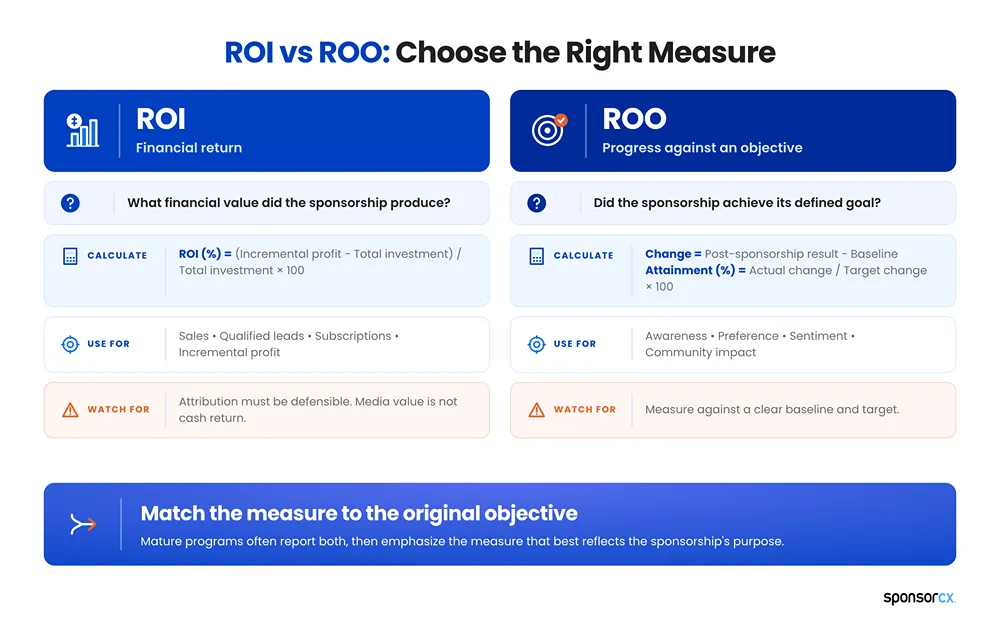
Understanding how to measure sports sponsorship ROI starts with separating financial return from progress against nonfinancial objectives.
ROI Measures Financial Return
Sponsorship ROI is the net financial return derived from the sponsorship relative to the total amount invested. The standard formula is:
Include the rights fee plus applicable activation, production, staffing, and measurement expenses when calculating your total sponsorship investment. Use incremental profit (when data is available) rather than gross revenue in the numerator of your equation.
For instance, if a company spends $150,000 on a naming-rights package, including activation expenses, and that sponsorship helps generate $260,000 in attributable incremental gross profit before sponsorship expenses are deducted, then ROI would be 73%.
The math is easy. Calculating the attributable profit is not. The SponsorCX article on calculating sponsorship ROI explores the data, goals, valuation choices, and reporting practices that help you arrive at a reliable calculation.
Do not inflate sales or profit with media-equivalency value and call the sum “ROI.” Media value can be a valuable exposure diagnostic. But it does not represent hard cash returned. Report it as such unless you have a validated model that translates the incremental brand lift into financial value without double counting.
Use ROI when the sponsorship objective is explicitly commercial, such as sales, qualified leads, subscriptions, or incremental profit, and when you can defend the financial result with real data.
ROO Measures Progress Against an Objective
ROO (return on objective) measures whether a sponsorship was successful at meeting a predetermined nonfinancial objective. This could be brand awareness, preference, sentiment, community impact, or any number of other attitudinal and behavioral objectives.
The Marketing Accountability Standards Board identifies brand preference as the highest-order sponsorship ROO metric because of its strong relationship with market share and price premiums.
The formula for the change in an objective metric is:
If the team set a numeric target, it can also report objective attainment:
For measures such as brand preference, show the change both in percentage points and as a percentage change. This will prevent readers from confusing the two measures.
Use ROO when the primary goal of the sponsorship was not short-term sales. Examples include brand building, community relationships, and long-term positioning. Coercing an ROI calculation on a brand-awareness sponsorship will result in a neat-looking number, but that number won't answer the question the program was intended to answer.
ROI and ROO are both commonly reported by mature sponsorship programs. However, more weight is given to the metric that reflects the intent of the deal when it was made.
Turn Measurement into Better Decisions and Renewals
Sponsorship measurement is worthless unless it guides future actions. If data gets filed away and forgotten, then the report is a wasted effort.
Provide leadership with a concise, standardized report in a rhythm that aligns with meaningful decisions. Monthly performance reports might be necessary throughout a season. Quarterly executive summaries might suffice for oversight purposes. Lead with the goal and the outcome that answers the goal, then provide the detailed data.
External benchmarks can provide helpful context, including industry averages and competitor spending versus reach. They’re less powerful as the primary driver of a decision because no two properties are exactly alike. The same goes for deal structures.
Past performance can help guide you. Was this year’s engagement rate better or worse than last year’s for a comparable activation? Why was there a difference? What should the team do differently moving forward?
The true value of sponsorship measurement should point to next steps.
Utilization data tells you what assets were used by a partner. Fulfillment data tells you what contracted assets were provided. Performance data tells you what assets moved the goal forward. Discuss all three in contract renewal, and discuss why there are gaps.
Connect the Data Behind Every Partnership
All of this assumes you have data, that it’s using the same definitions, and that it ties to the proper agreement and deliverables. This is often the hardest part.
Too often, fulfillment is found in one spreadsheet. Social metrics are in another export. Sales data lives with someone else’s team. Trying to build one recap means talking to four people before you even start reporting.
A sports partnership CRM bridges that gap. SponsorCX links the objective defined at signing to the deliverables scheduled against it and the proof captured as it’s happening.
Each metric can roll up to an agreement instead of an estimate. That means measuring sponsorship activity isn’t a frantic exercise every time someone wants to know what a deal produced.
Bring one sponsorship you are struggling to report on to a SponsorCX demo and see how Centralize, Automate, Track, and Report can simplify the recap process.
You make sponsorships happen. SponsorCX makes it simple.