The event is over. The sponsor showed up. The assets were delivered as promised. But no one is able to prove it worked.
Execution is where so many partner activations fall apart.
Partner activation brings a sponsorship to life through planned experiences, interactions, and content that engages a target audience and delivers measurable results. It’s what you do with the rights you’ve purchased. Without it, even a good sponsorship deal is just a line item on the P&L.
Sponsorship by itself is just the asset: naming rights, signage, title association. Activation is the plan for using those assets to create audience engagement. Sponsorship buys access. Activation commands attention.

According to a 2024 Forrester survey, 76% of U.S. consumer marketers who invested in sports sponsorships said they struggle to calculate ROI. That’s not a data problem. It’s an activation problem. When experiences aren’t planned, good data isn’t captured, and results aren’t defined, there is simply nothing to measure.
This guide covers what partner activation is, how it works, the types that matter most, how to build a strategy, and how to measure whether it’s working for properties and brand sponsors alike.
What Is Partner Activation?
Partner activation is the execution layer of a sponsorship. It encompasses the campaigns, the experiences, and the touchpoints a brand deploys to make its partnership visible, relevant, and valuable to target audiences.
Rights are what you buy; activation is how you use them. Purchasing a sponsorship without a plan to activate it is like leasing a billboard and never putting anything on it. The space exists. The opportunity exists. The message isn’t communicated.
Effective sponsorship activation benefits both sides of the partnership. Properties that help sponsors activate see higher engagement during events, stronger sponsor satisfaction, and better renewal rates. Brands that activate consistently produce measurable outcomes rather than vague exposure claims they can’t defend in a budget review.
Activation only works when both sides are aligned. The property must understand what the sponsor is trying to achieve. The sponsor must understand who the property’s audience is and what moves them. That alignment is what separates a forgettable booth from a program that generates leads, captures data, and earns a second cycle.
How Partner Activation Works
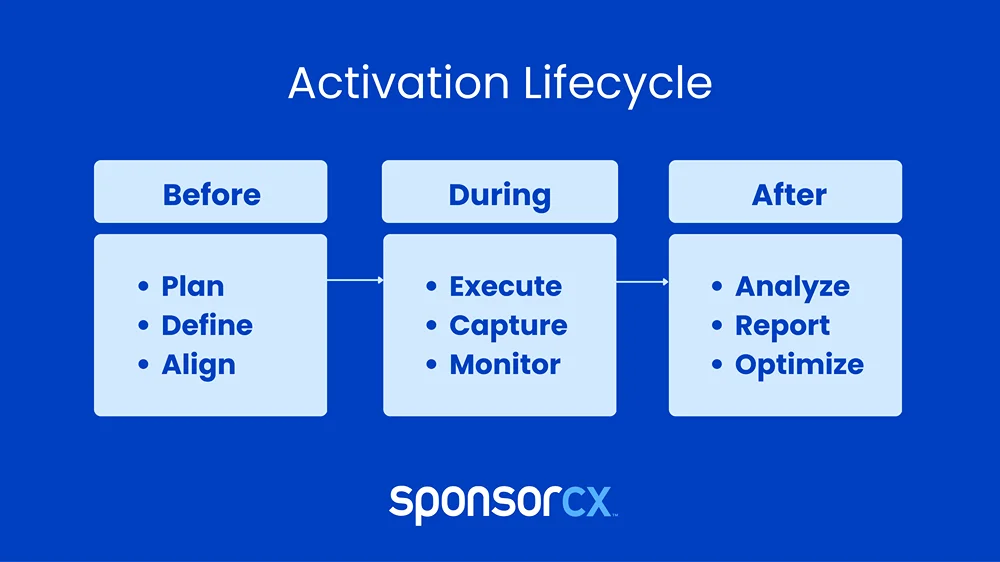
Activation is a three-phase process. Properties and sponsors that treat it as a day-of responsibility consistently underperform. Those who see it as a marketing strategy will see compounding results.
Before: Define, Plan, and Brief
This is where the work is done. Both parties agree on:
- Objectives
- Audience segments
- Activation formats
- Creative direction
- Budget
- Measurement criteria
Assets get assigned to owners. Deadlines get set. If the measurement plan isn’t finalized before the event starts, the most valuable data will never exist.
During: Execute, Document, and Monitor
On-site or in-channel execution is only part of the during phase. Documentation runs parallel:
- Photos
- Scan counts
- Lead captures
- Attendance figures
- Social posts
Everything captured during the event becomes the raw material for proof-of-performance reporting.
After: Analyze, Report, and Build Forward
This is where most programs fall apart. Results go unanalyzed, reports never get produced, and the sponsor receives nothing but a thank-you note. Properties that deliver structured post-event reports, with clear performance data tied to agreed objectives, are the ones sponsors renew with. The “after” phase is not a courtesy. It is the foundation of the next deal.
What This Looks Like at Scale
At the Chase Center, home of the Golden State Warriors, dozens of sponsors activate simultaneously across physical, digital, and mobile channels. Each partner has defined assets, activation plans, and reporting tied to performance.
This is not a collection of logos. It is a coordinated system.
Without centralized management, this level of activation breaks down into missed deliverables, overlapping categories, and weak reporting. With it, the organization turns a complex sponsor portfolio into a measurable, repeatable program.
What Partner Activation Can Achieve
When executed well, event sponsorship activation delivers results that passive sponsorship cannot. Here is what it can accomplish:
- Brand visibility that converts. Moving beyond impressions to interactions that influence behavior. A fan who interacts with a brand’s activation is different from one who walks past and glances at a banner.
- First-party data capture. Contests, sign-up forms, QR scans, and demo requests are activation tools that generate audience data that sponsors use long after the event ends.
- Sponsor retention. Properties that invest in sponsor activation support see higher renewal rates. Value is easier to demonstrate when there is a record of what was done and what it produced.
- Community connection. Authentic activations build goodwill with audiences in ways paid advertising cannot replicate. The brand becomes part of the experience rather than an interruption of it.
- A documented case for renewal. Activation results give both sides something concrete to discuss when contract conversations begin. Without them, renewal negotiations are based on gut feel.
According to IEG, tent-pole activations deliver up to 35% higher ROI than season-long, always-on programs. That’s a strong indicator that focused, well-planned activation consistently outperforms passive presence.
Types of Partner Activation
Not all activations work the same way or serve the same goals. Choosing the right format depends on the sponsor’s objectives, the property’s audience, and the available budget. These are the categories that show up most often. They’re what properties should be thinking about when they build their sponsorship packages.
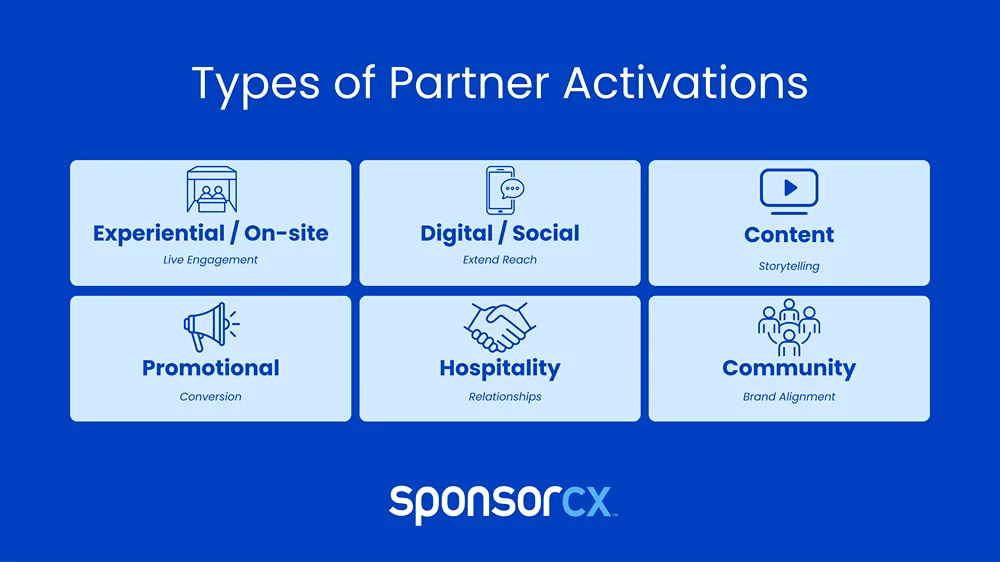
Experiential and On-Site Activations
On-site activations create direct, physical contact between attendees and a sponsor’s brand. Common formats include:
- Interactive booths
- Branded lounges
- Product demos
- Charging stations
- Photo installations
This is where brand activation ideas have the most immediate impact, because the audience is captive and the experience is real.
Digital and Social Activations
Digital activations extend reach beyond the venue and generate shareable user content. Common formats include:
- Branded hashtags
- Social contests
- Event-specific landing pages
- Digital filters
- Live-streamed content
These activations keep the sponsorship visible before and after the event, not just during it.
Content-Driven Activations
Content activations build a narrative around the partnership and give the brand something to distribute across its own channels. Common formats include:
- Co-branded video
- Behind-the-scenes coverage
- Email features
- Influencer collaborations
This approach keeps the sponsorship visible over time, not just during the event itself.
Promotional and Sampling Activations
Promotional activations give the audience a reason to engage and create a trackable path to conversion. Common formats include:
- Promo codes
- Exclusive discounts
- Product trials
- Giveaways
These are some of the cleanest activation types for measurement because the call to action is specific and the response is quantifiable.
Hospitality and Relationship Activations
Hospitality activations are often underused by smaller properties but are among the most valued by B2B-focused sponsors. Common formats include:
- VIP experiences
- Private receptions
- Sponsor-hosted events
When the goal is building client relationships, not just brand awareness, hospitality is the activation type that delivers.
Community and Cause-Based Activations
Community activations are growing in relevance, particularly with younger audiences and brand-conscious sponsors who care about cultural alignment. Common formats include:
- Social impact partnerships
- Sustainability initiatives
- Local community programs
These activations position the sponsor as a genuine partner in the community rather than a transactional presence.
How to Build a Partner Activation Strategy
A structured activation strategy is what separates programs that renew from programs that do not. Here is how to build one that works.
Step 1: Start with Shared Goals
Before any creative conversation, both sides need to agree on what success looks like. The property needs to understand the sponsor’s marketing objectives. The sponsor needs to understand the property’s audience and event context. Misaligned goals produce misaligned activations.
Step 2: Know Both Audiences
Properties must know their attendees well enough to explain them to a sponsor in a compelling way: demographics, interests, spending behavior, how they engage. Sponsors then map that audience to their target customer profile for alignment. The more specific this alignment is, the better the activation will perform. Generic activations targeting “event attendees” consistently underperform compared to those built around a defined segment. For more on building a program that connects, see Sponsorship Success Guide.
Step 3: Match the Format to the Objective
Brand awareness calls for experiential or social activations. Lead generation calls for promotional or digital. Relationship building calls for hospitality. Client retention calls for a different mix than new customer acquisition. Map the activation format to the stated goal before committing to a creative direction.
Step 4: Build the Asset Mix and Timeline
Determine which rights and assets will be activated. Assign a timeline to signage, digital placements, stage time, email inclusions, social posts. This is where the sponsorship package becomes a working plan. For frameworks that help with this, see the SponsorCX Sponsorship Activation Guide.
Step 5: Assign Ownership and Budget
Every activation element needs a specific owner and a line item. Properties should be clear about what they are responsible for delivering. Sponsors should be clear about what they are funding beyond the rights fee. Underfunded activation budgets are a primary reason for weak execution. A general benchmark: plan to spend 50 to 100 percent of the rights fee on activation.
Step 6: Define Measurement Before You Execute
Set KPIs, establish baseline metrics, and confirm how data will be captured before the event begins. Waiting until afterward to figure out measurement means the most valuable data never gets collected. Measurement planning is not a post-event task. It is a pre-event requirement.
Execution: Where Results Are Made
The best strategy still fails if execution is disorganized. Clarity is essential: who is doing what, where assets are staged, and what data is being captured in real time.
Execution quality affects how a sponsor perceives the property as a partner. A flawless setup signals professionalism and attention to detail. A disorganized one raises questions about what the relationship is worth. For properties, this is a defining moment.
Documentation runs in parallel with execution. The photos, scan counts, attendance tallies, social mentions, and lead captures that happen during the event are the raw material for everything that comes after. If data is not captured during the event, it cannot be reported. If it cannot be reported, the activation might as well not have happened from the sponsor’s perspective.
For sponsors, the execution phase is also when real-time adjustments matter. Monitor what is generating engagement and what is not. If a digital activation is underperforming by midday, shift resources to what is working. The data is available in real time; use it.
How to Measure Partner Activation ROI
Measurement is where programs either justify themselves or lose the next budget cycle. The goal is not a perfect attribution model. The goal is consistent, honest measurement against defined objectives.
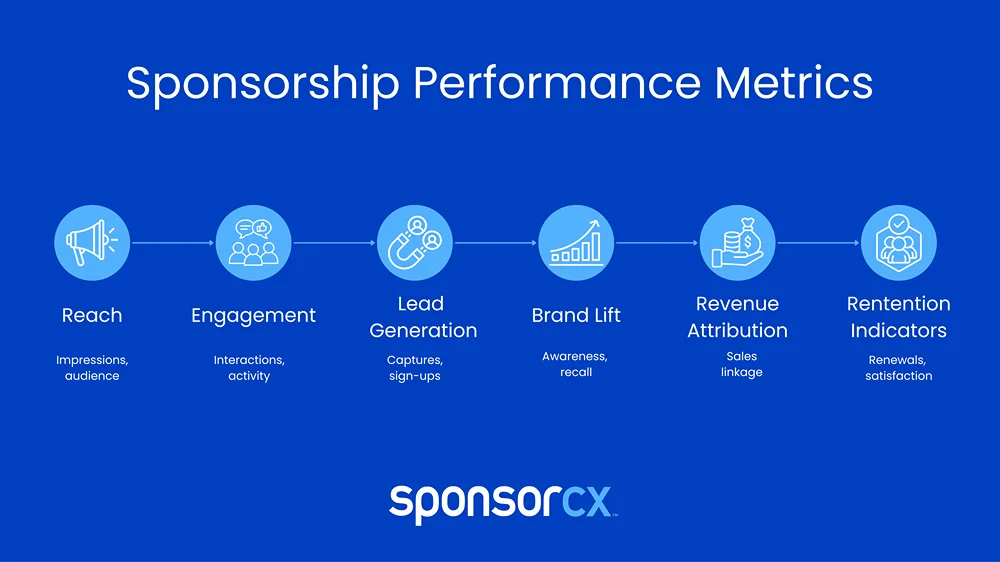
Six Key Metrics
Organize metrics by what they measure:
- Reach: Attendance, total impressions, and media exposure value.
- Engagement: QR scans, contest entries, booth interactions, social mentions, and dwell time.
- Lead generation: Form fills, email captures, and promo code redemptions.
- Brand lift: Aided and unaided awareness measured via pre/post surveys.
- Revenue attribution: Sales linked to activation through unique codes, dedicated URLs, or CRM tracking.
- Retention indicators: Sponsor renewal rates and satisfaction scores.
Not every metric applies to every activation. Choose five or six KPIs that map directly to the stated objectives and track those consistently. More metrics without a focus produce data without insight.
The ROI Formula
The standard formula: ROI = (Net Profit ÷ Total Cost) × 100. Net profit includes revenue directly attributable to the sponsorship. Total cost includes rights fees, activation expenses, creative production, and staffing. A positive ROI indicates the investment returned value. A negative ROI is information, not failure. It tells you where and what to adjust.
Attribution is rarely clean. A brand interaction at an event may influence a purchase made three weeks later. The best programs acknowledge this complexity and build measurement systems that capture touchpoints across the full customer journey, not just the event itself.
Tools for Measurement and Reporting
Effective measurement requires the right infrastructure. A sponsorship management platform serves as the central system of record for agreements, deliverables, and performance data.
- CRM integration connects activation activities to lead-to-revenue tracking.
- Social listening tools handle reach and sentiment.
- Post-event surveys capture brand lift.
The more fragmented the toolset, the harder reporting becomes. Properties managing multiple partners across multiple events without a centralized platform are almost always underreporting the value they deliver. For a framework on ROI reporting, see Calculating Sponsorship ROI.
Common Activation Mistakes
These are not theoretical missteps. They are the patterns that show up repeatedly in underperforming programs, across property types and budget levels.
- Activating too late. Treating activation as a day-of responsibility instead of a months-long strategy produces rushed creative, missed opportunities, and weak data capture.
- Misaligned activation formats. Deploying experiential activations when the goal is lead generation, or building a sampling campaign for a B2B sponsor focused on relationships, produces work that looks good but does not perform.
- Skipping the measurement plan. Agreeing on deliverables but not on how success will be defined or tracked leaves both sides unable to evaluate what happened.
- Underfunding activation. Spending heavily on rights fees and leaving too little for execution is one of the most common reasons for disappointing results. The rights are just the entry point.
- One-size-fits-all activation. Applying the same approach to every sponsor regardless of their goals, audience, or category undervalues the relationship and produces generic results.
- No post-event follow-through. Failing to produce a proof-of-performance report makes renewal harder and signals to sponsors that their investment is not being taken seriously.
- Treating activation as the sponsor’s problem. Properties that do not proactively help sponsors think through activation get fewer renewals and lower-value deals. Activation support is a competitive differentiator for properties.
- Going dark after the event. Most audience recall and content performance happen in the days following the event. Brands that stop communicating immediately leave measurable value behind.
How SponsorCX Strengthens Your Activation Program
As programs grow, the complexity compounds. More sponsors, more activation types, more deliverables, and more ways for things to slip. Tracking what was promised, what was delivered, what performed, and what is due for renewal becomes unmanageable without the right system in place.
SponsorCX is built around four capabilities that address exactly this:
- Centralize brings your sales CRM and inventory into one shared system, so every sponsor agreement, asset, and activation plan lives in the same place.
- Automate connects inventory directly to fulfillment, reducing manual handoffs and keeping execution on track without constant follow-up.
- Track gives you scheduling and fulfillment visibility across every sponsor and event, so nothing gets missed and no one has to chase status updates.
- Report pulls from sales, inventory, and fulfillment data to generate reporting that is accurate, current, and easy to share — with sponsors, with leadership, and in renewal conversations.
You show up for your sponsors. You manage assets, coordinate activations, and do the work that makes partnerships run. The last thing you need is a system that slows you down.
You make activations happen. We make it simple.