

The end-of-season review is never fun when the numbers don't add up. You executed the activation, the logo ran, fans showed up, but when someone asks what the sponsorship produced in leads, awareness, or dollars, you're trying to pull data from a spreadsheet that hasn't been updated since Q2. You know it worked. You just can't prove it.
That's the problem with sponsorship ROI: measuring sponsorship effectiveness and return on investment is genuinely difficult. It's not a skill issue. It's a system issue.
Sponsorship ROI is often misunderstood as a simple revenue equation: spend X, earn Y. It spans brand visibility, audience engagement, partner satisfaction, and long-term business outcomes that play out over months, not just event weekends. ROI measurement concerns affect more than half of all sponsorships in a global market projected to nearly double by 2034. Brands are spending significant budget on partnerships they can't fully measure.
This guide covers what sponsorship effectiveness means, how to set up measurement before a deal begins, which metrics matter most, how to calculate and communicate ROI, and how a centralized platform makes all of it more manageable.
What Sponsorship Effectiveness Means

Sponsorship effectiveness is the degree to which a partnership achieves the goals both sides agreed on before it launched. Most deals never define those goals upfront. That's exactly why effectiveness is so hard to evaluate later.
Effectiveness is a layered picture that includes:
- Delivery: Were all contracted assets and activations fulfilled as promised?
- Exposure: How many people encountered the brand through this partnership?
- Engagement: Did audiences interact meaningfully, beyond passive exposure?
- Perception: Did the brand's image improve, stay neutral, or take a hit?
- Business outcomes: Did the sponsorship generate leads, drive sales, or contribute to long-term revenue?
The mistake is treating these as a hierarchy, as if outcomes are the only layer that matters. A sponsorship can deliver strong engagement and brand lift without producing a traceable sale within the same quarter. That makes it a brand investment, not a failure. Brand investments deserve a different measurement lens than direct-response campaigns.
For properties, effectiveness means executing every deliverable and keeping the sponsor satisfied enough to renew. For brands, it means whether the partnership moved the metrics tied to their business goals. Both require data. Both require agreement before the season starts.
Understanding Sponsorship ROI: More Than Revenue
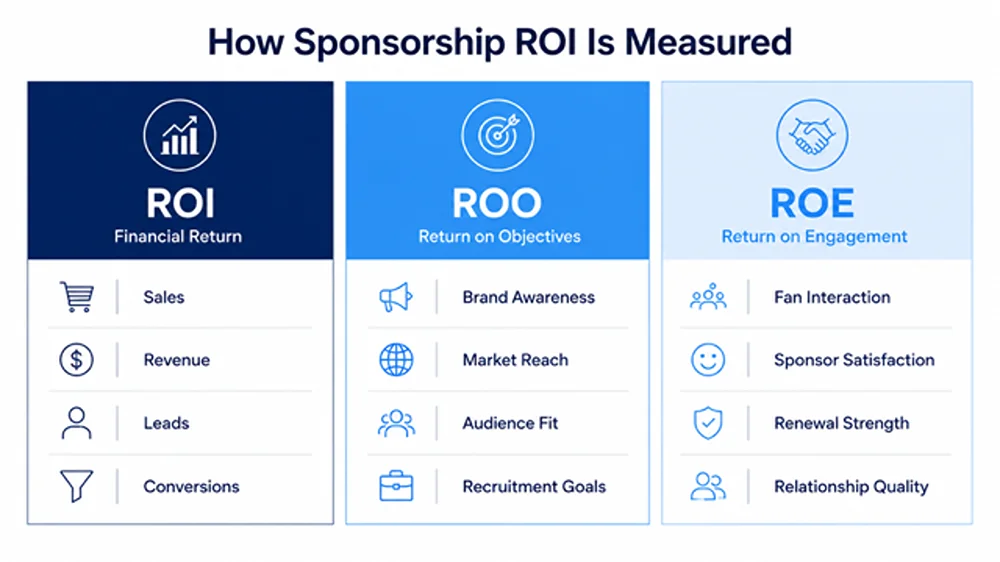
Sponsorship professionals measure three related returns:
ROI (Return on Investment)
The financial-based return: direct revenue tied to the partnership. Sales from promo codes, leads generated, purchases attributed to activation. ROI is the clearest language for executives. It's also the hardest to attribute cleanly, because sponsorships rarely operate in isolation from other marketing channels.
ROO (Return on Objectives)
The goal-based return. Sponsors enter partnerships with specific objectives: enter a new market, reach a demographic their product doesn't typically index well with, recruit employees. ROO measures how well the sponsorship moved those needles. Modest direct sales alongside major gains in brand consideration among a target audience. That's ROO doing its job.
ROE (Return on Engagement)
The relationship-based return: how fans engaged with the brand, how satisfied the sponsor felt about the property's communication, how "sticky" the partnership feels going into renewal. ROE is often overlooked, but it's one of the strongest predictors of whether a sponsor re-signs.
A complete picture of sponsorship ROI requires all three. Organizations that master measurement retain sponsors at nearly double the rate of those that don't. The goal isn't to pick one lens — it's to balance all three.
How to Set Measurable Goals Before a Sponsorship Begins
The single biggest predictor of whether you'll be able to measure effectiveness is whether you agreed on specific, measurable goals at the start. Measurement doesn't begin at the end of the season. It begins in the proposal meeting.
Step 1: Identify What the Sponsor Needs
Don't assume the objective. Ask directly. Brand awareness and lead generation require completely different measurement approaches. Getting this clarity upfront determines everything downstream.
Step 2: Tie Goals to Specific Outcomes
"Increase brand awareness" is not a goal, it's a category. "Increase unaided brand recall among 18–34 sports fans in the Denver market by 10% over the season" is a goal. Specificity makes measurement possible and reporting credible.
Step 3: Establish Baselines Before Activation
Capture baselines before anything goes live: brand awareness scores, website traffic, social following, lead volume. Without a starting point, you can't quantify movement. "Things got better" doesn't hold up in a boardroom.
Step 4: Agree on KPIs and Reporting Cadence
Both sides should sign off on which metrics will be tracked, how often they'll be reported, and who's responsible. A shared measurement framework turns renewals into conversations about shared data, not debates about what the numbers mean.
Step 5: Document Everything in One Place
Goals, baselines, agreed KPIs, and reporting timelines should live in a system both sides can access. Email threads and disconnected spreadsheets make this nearly impossible to maintain over a full season. The Sponsorship Measurement Guide on SponsorCX maps the marketing funnel to specific KPIs at each stage.
Key Metrics for Measuring Sponsorship Effectiveness
Reach and Impressions
How many people encountered the brand through broadcast viewership, in-venue attendance, social reach, and digital ad impressions. Impressions are a starting place, not a destination. High reach with low engagement tells you something; high reach with high engagement tells you more.
Brand Awareness and Recall
Pre- and post-season surveys measure whether people in the target audience recognize the brand's connection to the property and can recall it without prompting. This is one of the best ways to quantify the brand-building return on a sponsorship investment.
Audience Engagement
Social interactions (likes, comments, shares, saves), contest entries, app downloads, in-venue interaction rates, and digital click-throughs. Engagement metrics show whether audiences connected with the sponsorship or simply ignored it.
Lead Generation and Conversion
For sponsors with direct-response objectives: how many leads did the partnership generate, and how many converted? Promo codes, dedicated landing pages, and QR codes at activations help attribute lead volume directly. Conversion rate matters more than raw lead count.
Media Value
Equivalent media value translates brand exposure into a dollar figure based on what comparable advertising placements would cost. It's a useful benchmarking tool, not a revenue figure. Accurate sponsorship valuation goes beyond media exposure — it accounts for audience quality, activation depth, and business outcomes. Use media value to support valuation conversations, not replace outcome measurement. See the Sponsorship Valuation guide for how to apply it.
Fulfillment Rate
What percentage of contracted deliverables were fulfilled? If a sponsor paid for 12 in-venue activations and only 9 ran, the renewal conversation is already at risk. Clean fulfillment documentation protects the property and gives sponsors a reason to re-sign.
Sponsor Satisfaction
Post-season surveys or structured check-ins give properties a qualitative read on the relationship's health. A sponsor who renews out of obligation is a liability. Satisfaction data helps you tell the difference before renewal season.
Customer Lifetime Value (CLV)
Customers acquired through sponsorship activations may have different retention rates and spending patterns than those from other channels. Tracking CLV gives sponsorship a seat at the long-term revenue conversation.
Ready to stop guessing and start proving value? See how SponsorCX centralizes your metrics and makes reporting simple. → Schedule a Demo at sponsorcx.com
How to Build a Sponsorship Measurement Strategy
Most programs underperform on measurement because it wasn't built in from the beginning. It's retrofitted after the fact and that's when the gaps appear.
Start With Business Goals, Not Marketing Metrics
Impressions, clicks, and social engagement are indicators, not outcomes. Your strategy needs to connect those indicators back to the business goals the sponsorship was designed to serve. If a metric won't influence a specific decision, it probably shouldn't be your primary focus.
Build Measurement Infrastructure Before Launch
Survey links, tracking codes, and analytics dashboards need to be in place before activations go live. Attribution is hard enough under ideal conditions. Reconstructing it after the campaign ends is nearly impossible.
Use a Consistent Reporting Template
If every report looks different, uses different metrics, or covers different time windows, you can't draw conclusions across a portfolio. A standardized template reduces confusion and builds credibility with sponsors over time.
Tie Measurement to Renewal Conversations
When both sides look at the same data and agree on what was delivered, renewal isn't a negotiation. It's a natural next step. Build reports with renewal in mind: highlight fulfillment, show movement on agreed KPIs, include a clear summary of value delivered.
Review and Refine Every Cycle
After each season, ask: what data was useful, what was missing, what took too much effort to collect? The best measurement programs improve incrementally. Refinement is the point.
Execution: Where Measurement Either Happens or Doesn't
During a live sponsorship, measurement looks like this:
- Activation documentation: Photos, attendance counts, and engagement data captured at every event, not just the big ones.
- Real-time digital tracking: Social metrics, website traffic from sponsorship-linked campaigns, and app engagement tracked throughout the term.
- In-season audience surveys: Mid-season awareness checks give you early indicators of whether brand perception is shifting.
- Fulfillment logs: Every contracted asset's delivery documented as it happens, with confirmation: photo proof, broadcast clip, or screen capture.
- Communication logs: Notes from sponsor check-ins and changes to activation plans. These become critical context in renewal conversations.
Most teams fail because they lack a system. When data lives in email threads and disconnected spreadsheets, it doesn't get collected consistently. Gaps appear and reports become estimates.
How to Calculate and Report Sponsorship ROI

The Standard Formula
ROI = (Total Value Generated − Total Sponsorship Cost) ÷ Total Sponsorship Cost × 100
A sponsor that invested $20,000 and generated $35,000 in attributable value produced a 75% ROI. The challenge is defining "total value generated."
Attribution: The Honest Conversation
A consumer who sees a logo on a jersey, encounters a social ad, then makes a purchase, which touchpoint gets credit? All of them, to varying degrees. Practical approaches:
- Promo codes and dedicated URLs: unique identifiers per partnership to track what sponsorship channels directly drive
- Pre/post surveys: brand awareness shifts attributed to the sponsorship window
- Comparable media benchmarks: exposure translated to equivalent ad placement costs
- Customer source tracking: ask new customers how they heard of the brand
No model is perfect. Show your methodology, acknowledge its limitations, and let the data speak within that context. Sponsors that receive clear, consistent reporting are far more likely to renew and increase their investment.
What to Include in a Sponsorship ROI Report
- Executive summary: key metrics, major wins, and any gaps with context
- Fulfillment summary: every contracted asset, delivery status, and documentation
- Reach and impressions: broken down by channel
- Engagement metrics: social, digital, and in-venue
- Brand awareness and recall: pre/post comparison if surveys were conducted
- Lead and sales data: attributed to the partnership with methodology clearly documented
- Media value summary: supporting context for overall investment value
- Sponsor satisfaction score: if gathered through survey
- Recommendations: what worked, what to adjust, what would improve next cycle
Tools for Sponsorship Measurement and Analytics
The right sponsorship analytics tools reduce manual effort and keep data consistent across a full season. Depending on what you're measuring, the stack may include:
- Sponsorship management platforms (like SponsorCX): centralized fulfillment, tracking, and reporting across your portfolio
- Social media analytics (Sprout Social, Hootsuite): engagement and reach data
- Survey platforms (SurveyMonkey, Qualtrics): brand awareness and recall measurement
- Web analytics (Google Analytics): sponsorship-linked traffic and conversions
- Media monitoring (Nielsen, Kantar): broadcast exposure and earned media value
Managing multiple partners across a season? SponsorCX gives you real-time tracking and one-click reporting — so your next review is built on data, not memory. → https://www.sponsorcx.com
Common Sponsorship Measurement Mistakes
1. Setting Goals After the Activation Launches
When goals are defined retroactively, teams cherry-pick favorable metrics to justify the investment. Goal-setting happens in the proposal phase or it doesn't happen at all.
2. Confusing Impressions with Impact
Impressions tell you how many people could have seen the brand. They don't tell you whether anyone noticed, felt anything, or acted. Layer in engagement, awareness shifts, and outcome data to give impressions context.
3. Tracking Too Many Metrics Without Prioritizing
The trap is collecting everything and analyzing nothing. The most effective teams identify five to eight KPIs tied directly to their sponsorship objectives and focus there. Volume of data doesn't produce insight.
4. Failing to Document Fulfillment as It Happens
When a sponsor questions whether an activation ran and you're searching email threads from six months ago, confidence in the relationship suffers. Fulfillment documentation happens in real time, at each activation, throughout the term — or it barely happens at all.
5. Presenting Equivalent Media Value as Revenue
EMV is a benchmarking tool, not revenue. When teams present it as a return on investment, they set expectations that business outcomes can rarely meet. Use it to support valuation; don't let it replace outcome measurement.
6. Skipping Mid-Season Check-Ins
Mid-season is where you catch problems before they become deal-breakers: underperforming activations, quietly building sponsor dissatisfaction, or audience data suggesting a pivot. Regular check-ins turn measurement into a management tool, not just a reporting artifact.
7. Measuring Properties and Brands Against the Same Framework
A property's core metrics are fulfillment rate, sponsor satisfaction, and renewal probability. A brand's are awareness, engagement, and business outcomes. Forcing the same framework on both sides produces reports that feel generic to everyone.
8. Never Updating the Measurement Framework
At the end of every season, ask: what data was useful, what was missing, what took too long to collect? The teams that improve their measurement system year over year compound that advantage over time.
A Real-World Example: What Good Measurement Looks Like
A regional sports property with eight active sponsors heads into a new season. The team is organized and sponsor relationships are solid, but every post-season report looks different: different metrics, formats, timelines. Renewal conversations are harder than they should be.
In the off-season, they restructure their approach:
- They meet with each sponsor before the season to define specific KPIs: two sponsors focus on brand awareness, three on lead generation, two on hospitality ROI, one on community engagement.
- Pre-season surveys establish brand awareness baselines for the awareness-focused sponsors.
- Unique promo codes and landing pages are set up for the lead generation sponsors.
- Every activation is logged as it runs — photo documentation, attendance estimates, social metrics — in a centralized platform.
- At mid-season, a brief satisfaction check-in flags one relationship showing early signs of friction.
- At season end, each sponsor receives a tailored report: awareness sponsors see pre/post survey comparisons; lead sponsors see attributed lead volume and conversion rates; hospitality sponsors see event participation data.
Result: seven of eight sponsors renew, including one that increases their investment based on the data. The eighth leaves due to a budget cut unrelated to performance — and the property has documentation for a replacement conversation.
That wasn't luck. It was a measurement strategy that ran throughout the year, not at the end of it. The Top 10 Sponsorship KPIs for Brands and Properties breaks down what each side should be tracking and why.
How SponsorCX Strengthens Your Measurement Program

Sponsorship measurement at scale is a data management problem as much as a strategy problem. When teams manage multiple partners, dozens of assets, and full-season activation calendars across spreadsheets, email, and shared drives, measurement becomes reactive and incomplete.
SponsorCX changes the workflow: rather than chasing data at season's end, you're collecting it continuously, and reporting is built from what actually happened.
Centralize
Every sponsor, asset, agreement, and activation lives in one platform. Both sides work from the same system of record. No reconciling conflicting spreadsheets, no searching email threads for proof of delivery.
Automate
Once an agreement is defined, tasks, timelines, and responsibilities are created automatically. Fulfillment workflows don't depend on anyone remembering to update a shared document. Manual coordination drops away and teams focus on relationships again.
Track
Real-time visibility into what's complete, in progress, and still needs attention across every partnership and asset. That visibility makes mid-season reviews productive and protects against discovering unfulfilled deliverables too late to fix them.
Report
SponsorCX brings fulfillment data and sponsorship valuation together in reports that reflect how partnerships actually operated. When it's renewal time, you're presenting clear, documented evidence, not estimates. That clarity builds trust, and trust drives renewals.
For a broader look at how connected tools outperform disconnected ones, the Sponsorship Tech Ecosystem guide is worth reading.
Final Thoughts
Measuring sponsorship effectiveness and ROI is hard. The data is scattered, attribution is imperfect, and timelines are long. The teams that consistently do it well, with real data tied to real goals, have a meaningful advantage when it comes to renewing partners, securing budget, and growing their programs.
Start with clear goals. Establish baselines before anything goes live. Track fulfillment in real time. Report against what you agreed on. Review the system every cycle and make it better.
The sponsors who see clear evidence of value don't just renew, they expand.
You make sponsorships happen. SponsorCX makes it simple.
See how SponsorCX helps you track every deliverable, measure every result, and report with confidence. → Request a Free Demo at sponsorcx.com