Exploring how consumers navigate trust, skepticism, and authenticity across influencer marketing, online reviews, AI content, and brand partnerships.
Consumers have never had more information available when making a purchase decision. Reviews, influencer endorsements, sponsored posts, AI-generated recommendations, and brand partnerships shape every online shopping experience. But instead of making consumers feel more informed, this flood of content has created widespread skepticism about what — and who — can actually be trusted online.
To learn more about how Americans navigate trust in the modern digital marketplace, SponsorCX surveyed 1,000 U.S. adults about influencer marketing, online reviews, AI-generated content, user-generated media, and brand partnerships. The results reveal a major shift in consumer behavior: people are becoming more skeptical of paid endorsements and algorithm-driven recommendations while placing greater value on personal relationships, authentic user experiences, and values-driven partnerships.
Key Takeaways
- 82% of consumers say AI-generated content makes it harder to tell what is genuine online, and over half (51%) have already replaced traditional research with AI tools at least once.
- Nearly two-thirds (65%) of consumers agree that brands overuse the word "authentic" without backing it up, and 76% say marketing today feels more performative than genuine.
- More than half (55%) have avoided a brand due to suspicious and AI-generated reviews, followed by endorsements that feel fake (49%), AI-generated content (39%), and too many ads (34%). Yet 95% still use reviews, making review integrity a make-or-break issue.
- Only 16% trust influencer recommendations very or completely, and just 1 in 100 consumers report they will actually purchase after seeing an influencer promotion.
- Nearly 1 in 5 consumers have already replaced traditional research with AI. 17% use AI tools like ChatGPT regularly instead of reading reviews, and another 34% do so occasionally. Among Gen Z, 70% have done so at least once.
- Friends and family crush every other trust source, with 70% of consumers strongly or completely trust recommendations from people they know.
- Partnerships with organizations or causes increase trust for 46% of consumers, the single most trust-positive partnership type. Celebrity and influencer partnerships, by contrast, actively decrease trust for roughly 25% of consumers each.
The More Brands Push “Authenticity,” the Less Consumers Believe It
Marketing buzzwords change quickly — and the latest one is “authentic”. Consumers want to buy from a brand that’s the real deal, and companies responded by putting an “authentic” label on their products or services. But consumers are savvy, and brands overusing this tactic led to a lack of trust in authenticity marketing on the whole.
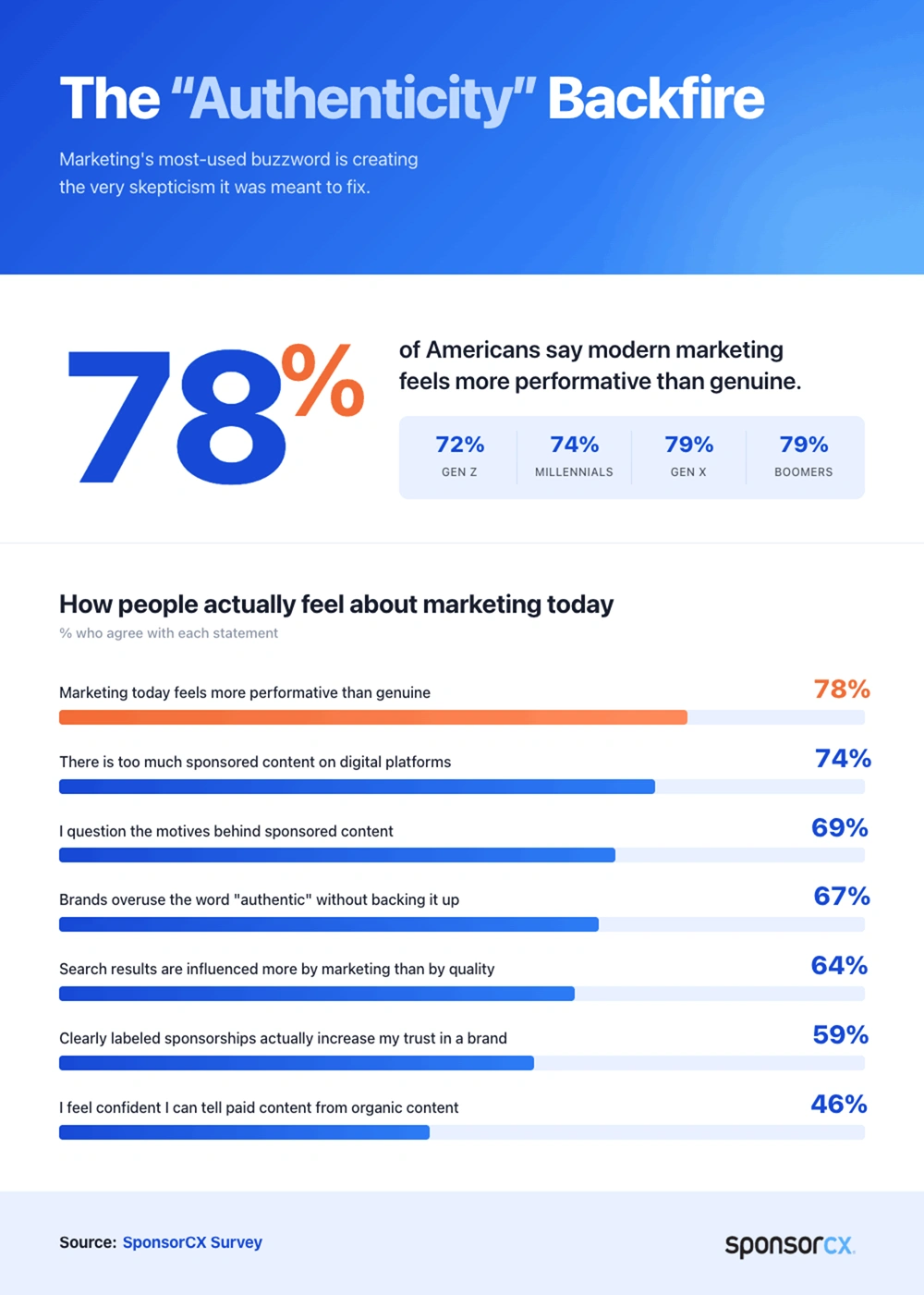
Over three-quarters of Americans (78%) agree: modern marketing feels performative. Surprisingly, this sentiment was consistent between generations: 72% of Gen Z, 74% of millennials, 79% of Gen X, and 79% of boomers all think that today’s ads come across as fake. Brands tried to combat this widespread skepticism by emphasizing their authenticity, but this backfired — 67% of consumers agreed that brands overuse the word "authentic” in their marketing materials. Many of those who do use this terminology don’t back it up with their business practices. Audiences know the difference between a philosophy and a marketing tactic, and aren’t likely to support a brand they think is jumping on a bandwagon.
Beyond this level of skepticism, there is also widespread fatigue at the sheer number of ads that consumers take in each day. Almost three-quarters (74%) of respondents said that there’s too much sponsored content on digital platforms, clogging their feeds and making it more difficult to figure out what products are actually worth it. Another 64% said that search engine results were influenced more by marketing than by the quality of the webpage.
This has led a majority of respondents (69%) to question the motives behind sponsored content, rising to 70% among women. However, 59% said that clearly labeled sponsorships actually increase their trust, proving that most consumers are just looking for open communication. But “clearly labeled” is the key here, as only 46% of respondents feel confident in their ability to distinguish between paid and organic content. As marketing becomes more and more subtle, consumers are doing their best to stay ahead of brands and make truly informed purchases.
Online Reviews Are Less Reliable Than Ever
Reviews used to be the internet’s version of the Roman Agora: everyone could come together to discuss the pros and cons of a product, warning or encouraging fellow consumers. But in the age of bot comments and review-bombs, a five-star rating doesn’t mean what it used to.
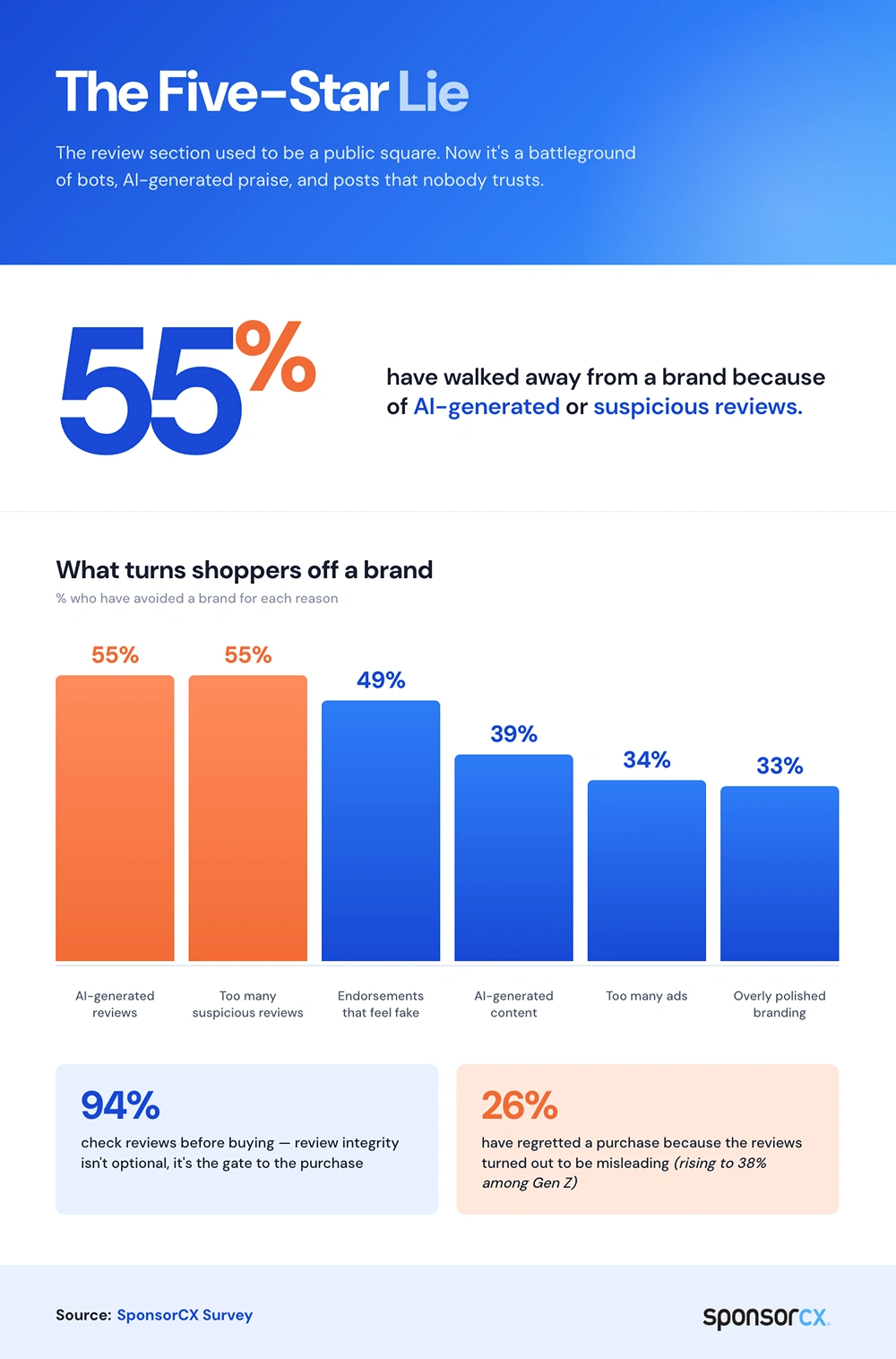
Nearly all (94%) Americans check the reviews before buying a product. But, paradoxically, too many good reviews can lead to less trust in the brand. New technology has made the review section less valuable–so much so that 82% of Americans said AI-generated content makes it harder to trust any online reviews. Instead of trusting the input from their peers, consumers have to decipher what’s real and what’s just a marketing ploy.
Other review red flags that turn customers away from a brand include:
- AI-generated reviews (55%);
- Too many suspicious reviews (55%);
- Endorsements that seem fake or untrustworthy (49%);
- AI-generated content (39%);
- Too many ads (34%);
- Overly polished branding (33%).
Despite these red flags, even savvy shoppers can get duped. Over a quarter (26%) of respondents have regretted a purchase because the reviews or content turned out to be misleading. This rose to 38% among Gen Z, suggesting that the youngest generation is more willing to take risks, but also more likely to succumb to a scam.
Interestingly, women sought answers from the review section far more than American men. Over half (55%) of women said they frequently read reviews before making a purchase, compared to 43% of men. Perhaps due to this, women’s standards are higher: 42% of women avoid brands that utilize AI-generated content vs. 35% of men. Because women are responsible for up to 80% of all American financial decisions, their decisions and purchasing power can significantly differentiate the success of businesses that do and don’t use AI.
Why 99% of Consumers Are Not Buying What Influencers Are Selling
For years, we’ve heard that influencer marketing is the future: followers are more likely to buy something endorsed by their favorite online personality, and brands will benefit. However, the oversaturation of brand partnerships and influencer marketing has had the opposite effect. While consumers may get initial recommendations from an influencer, they rarely lead to a direct purchase.
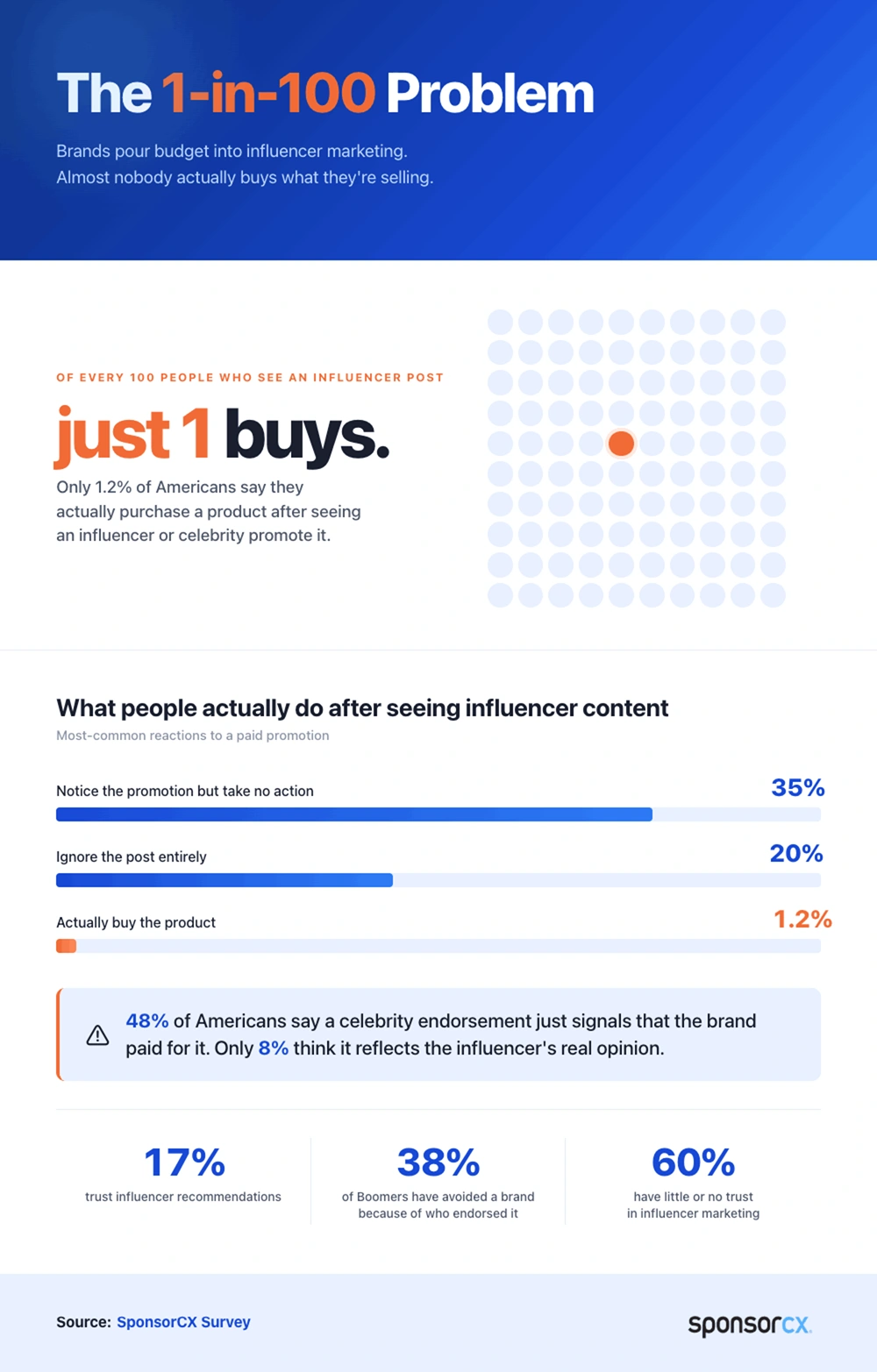
Nearly half (48%) of Americans said they often encounter paid influencer content online. But despite this constant exposure, only 17% of consumers said they actually trust influencer recommendations. This was highest amongst Gen Z, though, as 37% of Zoomers trust influencer recommendations–nearly double the national average.
Despite that, only 1% of consumers said they’ll purchase something based on an influencer's recommendation, demonstrating how untrustworthy the market has become. Even Gen Z, the generation most receptive to influencers, showed surprisingly low conversion rates: just 3% said they had actually purchased a product after seeing it promoted online. Most consumers simply absorb the content without taking action, with 35% saying they notice influencer promotions but move on, and another 20% ignore them entirely.
Consumers know how influencer marketing works, and they’re over it. Nearly half (48%) of Americans said celebrity or influencer endorsements just communicate that the brand paid for the promotion, and only 8% believe the endorsement reflects the influencer’s genuine opinion. Another 27% said influencer partnerships signal that the company has a large marketing budget — not that the product itself is worth buying.
This oversaturation is starting to backfire. Three out of five Americans (60%) say they have little to no trust in influencer recommendations, rising to a surprising 80% among baby boomers. The oldest generation lived a long time before influencers came on the scene; they’re not letting a YouTuber in athleisure convince them to buy something. In fact, influencer marketing may be driving older consumers away: 38% of boomers have avoided a brand specifically because of the influencer they partnered with. This was higher than any other generation, including Gen Z (28%). Modern brands need to be selective about their partnerships — choosing influencers that truly tie into the brand values instead of who has the most followers.
Consumers Don’t Trust AI Content — But They Still Use AI to Shop
We’re neck-deep in AI — so much so that AI bot activity now outnumbers human activity on the internet. Consumers are tired of reading “slop” and are looking for ways to distinguish the human-written from the procedurally generated. Ironically, the best tool they have to do so? More AI.
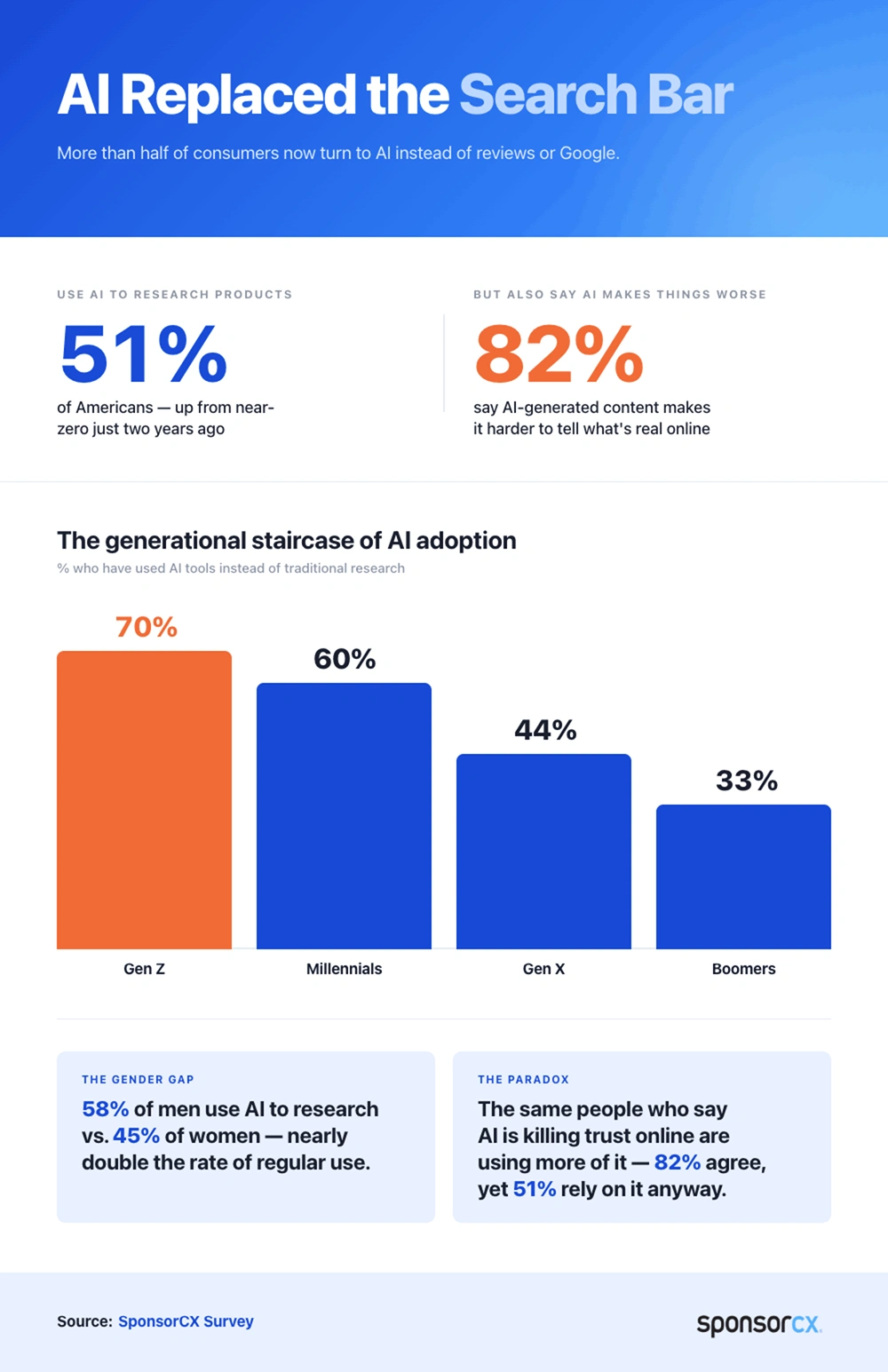
More than half (51%) of Americans use AI tools like ChatGPT to research a product, instead of traditional reviews or search results. This rose to 70% among Gen Z, with 35% doing so regularly. Millennials weren’t far behind at 60%, though usage dropped to 44% among Gen X and just 33% among baby boomers. Younger generations are more open to using AI as a tool for making smart purchases.
What makes this trend especially interesting is that AI has become both the problem and the solution. More than four in five Americans (82%) agreed that AI-generated content makes it harder to tell what’s genuine online. Likewise, 82% specifically said AI-generated content makes online reviews harder to trust. But it’s getting more and more convincing, and consumers need AI assistance to sort through the slop.
These tools are expediting the work people have to do to find trustworthy products: only 18% of Americans said they primarily rely on reviews and recommendations when researching a product. In comparison, 31% now cross-reference multiple sources before making a purchase. AI tools allow people to cross-reference these sources in an instant, gaining valuable insight.
Men were significantly more likely than women to replace traditional research methods with AI, with 58% of men saying they’ve used AI tools for product research compared to 45% of women. Men were also nearly twice as likely to use AI regularly for research purposes, at 21% versus 13% of women. This may reflect broader differences in trust toward emerging technology: only 12% of women said they strongly trust AI-generated recommendations or information, compared to 23% of men. There is a clear hesitation toward AI technology among women, particularly as concerns around misinformation, deepfakes, scams, and manipulated online content continue to grow.
Word-of-Mouth Is Winning the Trust War
If you can’t trust internet strangers, who can you trust? Turns out, people are going back to the old methods of getting information: asking people IRL. No algorithm can replace the trust people have in their friends and family.
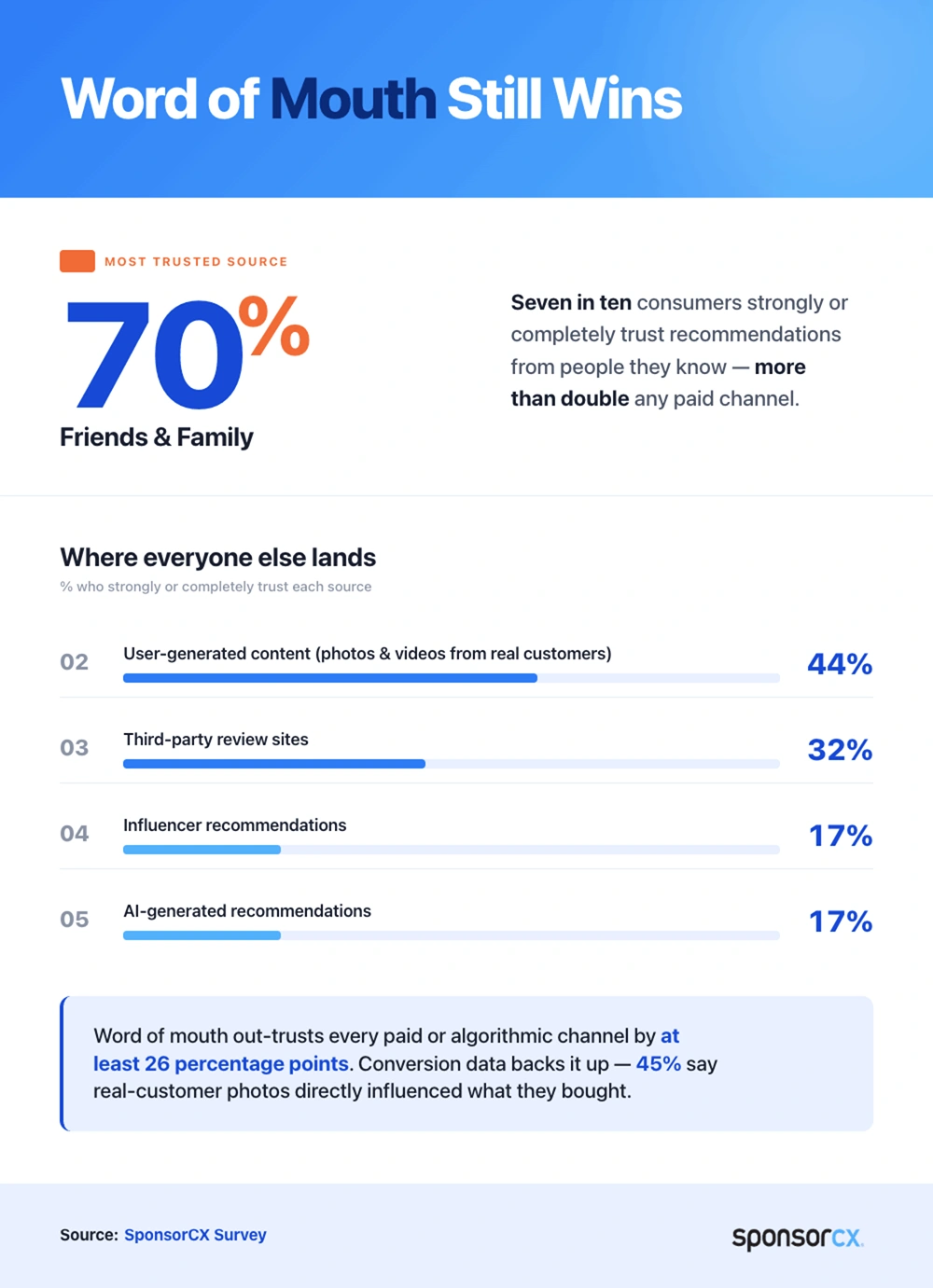
Across every source we listed, recommendations from friends and family ranked highest by an overwhelming margin. Seven in ten Americans (70%) said they trust recommendations from people they know personally — more than double the trust levels associated with influencers, sponsored content, or AI-generated recommendations. That trust held steady across virtually every demographic group. Men and women both reported identical trust levels at 70%, and every generation — including Gen Z — ranked friends and family as their most trusted source for purchase decisions.
However, that doesn’t mean they aren’t turning to online recommendations some of the time. User-generated content (UGC) earned strong trust from 44% of Americans, nearly three times the trust level associated with influencers (17%). UGC can also drive real conversions, with 45% of respondents saying customer-submitted photos or videos were influential in whether they ultimately bought a product.
Third-party review sites still retained some credibility, with 32% of Americans saying they strongly or completely trust them. But even those platforms lagged far behind direct personal recommendations. Consumers increasingly appear to treat reviews as one data point among many rather than a definitive source of truth. As AI-generated content and paid partnerships continue to flood the internet, consumers are placing more value on information that is difficult to fake.
Consumers Respond Better to Purpose Than Popularity
Consumer trust looks different nowadays. People are more interested in buying from a brand that aligns with their philosophical beliefs, not just one that comes highly recommended by influencers.
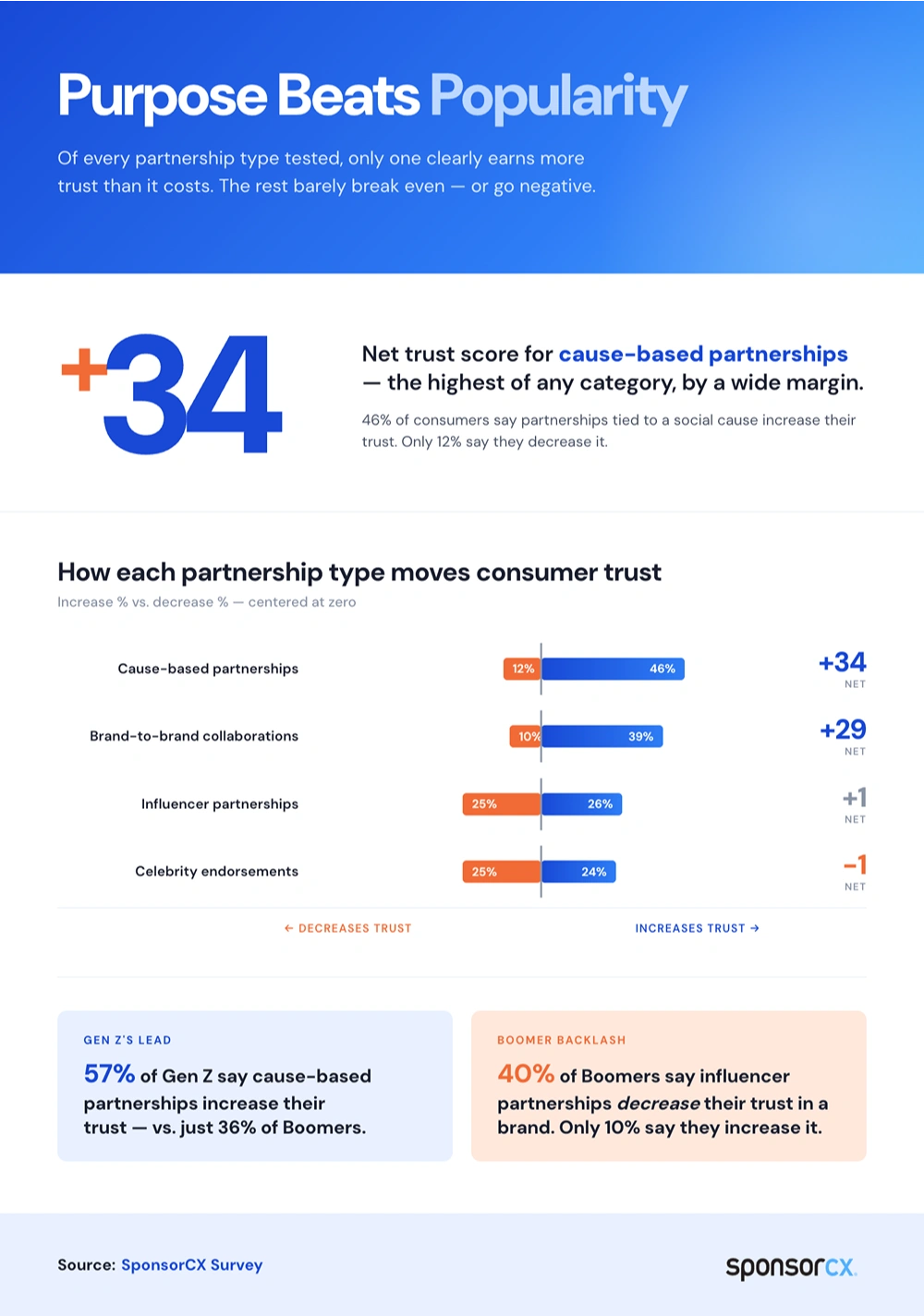
Nearly half (46%) of Americans said partnerships tied to charitable causes or meaningful social impact increase their trust in a company. In comparison, only 12% said those partnerships decrease trust, giving cause-based sponsorships a net trust score of +34 points. No other partnership category came close.
That trust boost was consistent across every generation, though it was especially strong among younger consumers. A majority of Gen Z respondents (57%) said cause-based partnerships increase their trust in a brand, compared to 36% of boomers. Even in a highly skeptical marketing environment, consumers respond well to partnerships that are community-oriented.
Traditional brand-to-brand collaborations also performed relatively well, earning the second-highest trust score overall. Thirty-nine percent of Americans said collaborations between brands increase trust, while only 10% said they decrease it, resulting in a net trust score of +29 points. By contrast, influencer collaborations were effectively net-neutral, with 26% of consumers saying they increase trust and 25% saying they decrease it. Among boomers, influencer marketing was actively harmful: 40% said influencer partnerships decrease their trust in a brand, while just 10% said they increase it.
The broader pattern across the data is clear: consumers are no longer automatically impressed by visibility, fame, or sponsorship scale. The partnerships that build trust are the ones that are genuinely aligned with the brand itself.
Consumers Trust What Feels Human
The findings throughout this report point to a growing crisis of trust in digital marketing. Consumers are overwhelmed by sponsored content, increasingly skeptical of influencer endorsements, and struggling to distinguish genuine recommendations from AI-generated noise. Traditional trust signals that once drove online purchasing behavior–reviews, celebrity partnerships, and polished branding–no longer carry the same authority they once did.
At the same time, the data also points toward what consumers still value. Consumers are not rejecting marketing entirely — they are rejecting marketing that feels manufactured, performative, or disconnected from reality.
This shift will likely reshape how brands build trust over the next decade. As AI-generated content becomes more sophisticated and online skepticism continues to rise, companies may need to rely less on mass visibility tactics and more on genuine community alignment, customer advocacy, and transparent partnerships. The brands that succeed moving forward will likely be the ones that feel hardest to fake.
Methodology
SponsorCX commissioned an online survey of 1,000 U.S. adults conducted via Pollfish. The survey examined consumer trust in social proof mechanisms, including influencer and celebrity endorsements, online reviews, user-generated content, AI-generated recommendations, and brand partnerships.
Results were stratified and analyzed across demographic segments, including generation (Gen Z, Millennials, Gen X, and Baby Boomers) and gender. Gen Z findings (n=84) should be considered directional. Percentages reflect self-reported data, and responses to multi-select questions may total more than 100%.
About SponsorCX
SponsorCX helps brands create, manage, and measure sponsorship and partnership programs that build meaningful audience connections. Its unified platform brings together sponsorship workflows, activation tracking, and relationship management into a single system of record, giving teams a clearer view of performance and impact. With AI-driven insights and modernized reporting, SponsorCX helps organizations develop partnerships that drive both engagement and long-term brand trust.
Fair Use Statement
The information in this article may be used for non-commercial purposes only. If shared, please provide proper attribution to SponsorCX and include a link to the original research.