The marketing director of a mid-major athletic department sends the same email to 40,000 fans every Tuesday. It has the same subject line, the same offer, the same content, regardless of whether the recipient drove three hours to the last game or hasn't opened a message in two seasons.
The email goes out. The results are mixed. A real opportunity gets left on the table every week.
Every untargeted message is a missed conversion and a missed retention opportunity.
This is the problem AI-powered fan engagement tools were built to address. Fan engagement in sports has always been about building connections between a property and its audience. While the goal is the same, AI changes your ability to act on what fans are telling you, at a scale that no marketing team can manage on its own.
The numbers are hard to ignore. According to Stats Perform's 2026 Sports Fan Engagement, Content Monetisation and AI Trends Report, 81% of sports media executives expanded their use of AI in the past year. Organizations that got there early are three times as likely to find it easier to monetize their content than those still on the sideline. That gap compounds over time.
This article walks through what these tools actually are, how they work, what they can realistically achieve, how to build a strategy around them, what good measurement looks like, and where most programs quietly go wrong.
What Are AI-Powered Fan Engagement Tools?
Start with the basics. Fan engagement tools are the systems sports organizations use to reach and connect with their audiences:
- Ticketing platforms
- CRM
- Mobile apps
- Social media
- Loyalty programs
- Analytics
AI-powered versions of these don't replace them; they make them smarter.
Traditional tools are descriptive. They tell you what happened. AI-powered tools are predictive. They tell you what's likely to happen next, and they help you do something about it before the moment passes.
Take a basic example. A standard CRM tells you a fan attended three games last season. An AI-powered platform takes that same data point and combines it with purchase history, app activity, email behavior, and social engagement to estimate whether that fan will renew, identify which message is most likely to move them, and send it automatically at the right time. Same fan, same data. Very different outcome.
How AI Fan Engagement Works
The foundation is a unified fan profile. That means pulling together everything you know about a fan, their ticket purchases, merchandise orders, app activity, social behavior, in-venue habits, into a single record the system can use. Without that, AI has nothing to work with. Fragmented data is why many organizations invest in engagement technology and then wonder why it isn't performing.
Once the data is unified, AI finds patterns at scale. Which behaviors show up consistently before a renewal? Which content formats keep fans on the app longest? Which offers convert in week three of the season versus week ten? No analyst can discover these patterns across tens of thousands of fans manually. The platform can, and it updates those findings continuously as behavior shifts.
From there, those patterns drive personalized delivery. The right offer to the right fan on the right channel at the right time. Fans showing churn signals get proactive outreach before they've made a decision to leave. And all of that activity rolls up into dashboards that connect fan behavior to the outcomes your sponsor partners are actually asking about, which makes the whole reporting conversation much easier.
What Fan Engagement Tools Can Achieve

Properties come to these tools from different starting points. It helps to think through what they deliver across three areas.
On the audience side, the biggest wins are retention-related. Predictive churn models flag at-risk fans before they go quiet, giving your team a window to intervene. Personalization keeps fans spending more time on your owned platforms. Gamification, polls, predictions, rewards, and leaderboards give fans reasons to stay connected between seasons, not just during games.
On the revenue side, AI recommendation engines improve merchandise conversion by revealing the right product at the right moment. Dynamic pricing tools squeeze more value out of ticket inventory without manual adjustments. Loyalty programs tied to behavioral data generate premium upgrades at rates that generic promotions rarely match.
The third area is sponsorship value and reporting. It’s the one most directly tied to sponsorship health. Properties that can show how their audience responded to a campaign, not just how many people saw it, have more profitable conversations with brand partners.
| Industry Insight 81% of sports media executives expanded their use of AI in the past year. Early adopters are three times as likely to find it easier to commercialize their content, and 70% of sponsors now demand more digital content as part of partnerships. (Stats Perform, 2026 Fan Engagement Report) |
Types of AI Fan Engagement Tools
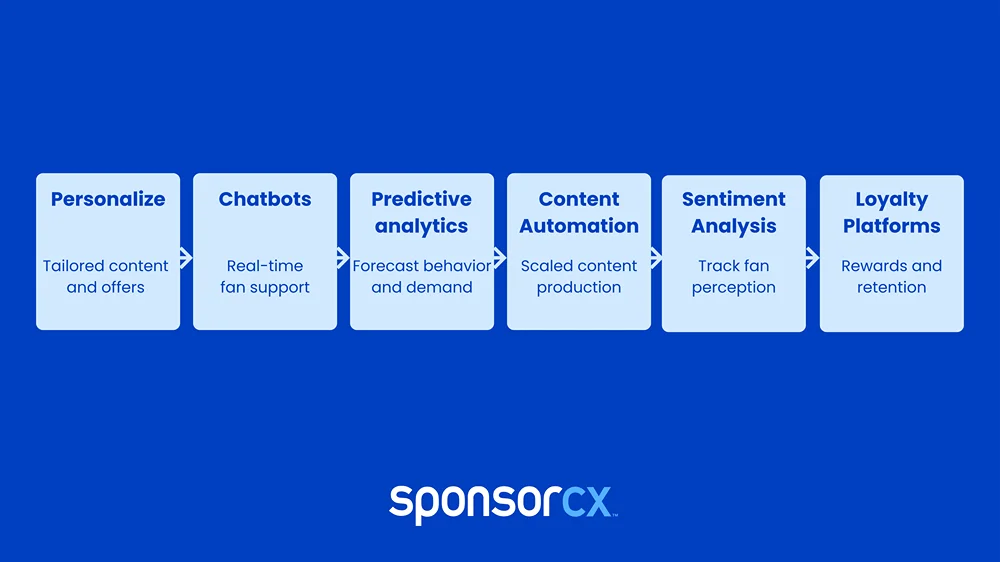
Fan engagement platforms vary widely in what they focus on and what problems they solve best. Choosing the right fan engagement platform starts with understanding what each category is designed to do. Here’s an overview:
Personalization Engines
These tools analyze fan behavior across every channel, purchases, clicks, app activity, email opens, and use that data to serve each fan a tailored experience. For properties with large, digitally active fanbases, this is where manual segmentation stops working and a real platform becomes necessary.
AI Chatbots and Conversational Tools
Chatbots handle around-the-clock fan questions on websites, apps, and messaging platforms, covering tickets, schedules, merchandise, and routing anything complex to staff. For sponsors, chatbots are worth paying attention to because they create trackable, branded touchpoints that show up in reporting.
Predictive Analytics Platforms
These platforms are built for forecasting: renewal probability, expected attendance, merchandise purchase likelihood, churn risk. If your program is managing a large season-ticket base or a multi-tier membership structure, predictive analytics is often the difference between reaching fans while you still can and scrambling to win them back after they've already moved on.
AI Content Generation and Distribution
Generative AI tools produce match summaries, social captions, highlight reels, and post-game recaps faster than any editorial team can. For properties, this is a meaningful force multiplier. For sponsors, it opens up new inventory: branded clip packages, personalized recaps, stat overlays, at volumes that would otherwise require production budgets most properties don't have.
Sentiment Analysis Tools
Sentiment tools scan social media, forums, and in-app behavior to surface how fans feel about campaigns, activations, players, and brand partners. The value is real: you can show a partner how your audience responded to their presence, not just how many people were in the building.
Fan Engagement Platforms and Loyalty Apps
Integrated platforms, mobile apps, loyalty hubs, and community tools, bring multiple capabilities into a single owned environment where fans earn rewards, engage with content, and connect with each other. Research consistently shows that owned platforms generate twice the revenue of social media for properties that use them well. The reason is straightforward: the property controls the relationship and keeps the data.
In-Venue AI Tools
AI is showing up inside the stadium too:
- Streamlined entry through facial recognition
- Location-based push notifications for concession offers
- Staffing models that adjust to real-time attendance patterns
- Dynamic digital signage that responds to audience segment and game situation
These tools generate behavioral data that rounds out the fan profile in ways that digital-only engagement never can.
A Real-World Example
The San Francisco 49ers faced a problem familiar to most properties: fan data was fragmented across social, email, and ticketing, with no unified way to understand or act on fan behavior. In 2025, the organization partnered with PwC as its Official Digital Consulting Partner to address it directly.
The result was a new mobile app that uses AI to personalize the fan experience from onboarding forward. Fans select favorite players and team eras, and the app builds a tailored content feed from those inputs. Gamification features, including collectible badges tied to app activity, drive consistent engagement between seasons. The app also includes Sourdough Sam AI, a generative AI chatbot, along with full Levi's Stadium integration: ticketing, parking, payment, and concessions.
The broader goal is year-round relationship building with three million global fans, turning fragmented touchpoints into a single, data-powered ecosystem. The 49ers sequence maps directly to the strategy framework in the next section: unify the data, build a personalized owned platform, deploy AI on top of it, and connect everything to commercial outcomes.
How to Build a Fan Engagement Strategy Around AI

Most fan engagement programs underperform because the strategy upstream of those tools is vague. Organizations buy platforms before they know what problem they're solving, deploy personalization without the data to power it, and then measure how busy the team was rather than what changed. The sequence below is designed to fix that.
Step 1: Audit Your Current Fan Data
Before you evaluate a single tool, map what fan data you have, where it lives, and whether your systems can share it. Ticketing in one platform, CRM in another, and merchandise in a third is an extremely common setup, and it guarantees that any AI engine you drop on top will underperform. Answer three questions:
- What do we actually know about each fan?
- Where does that data live?
- Can our systems talk to each other?
Step 2: Define the Business Problem You Are Solving
"Better fan engagement" is not a strategy. "Increase season-ticket renewal rates among fans who attended fewer than five games last season" is. The more precisely you can name the problem, the clearer your tool selection becomes.
Step 3: Unify Your Fan Data Before Deploying AI
This step is listed separately because organizations consistently skip it. Deploying a personalization tool before the underlying data is connected is the most expensive mistake in fan engagement technology. Unifying fan data, connecting ticketing, CRM, merchandise, and digital behavior, is the foundation. Everything else depends on it.
Step 4: Prioritize One High-Impact Use Case First
Pick the application with the clearest line to a measurable outcome you already care about. Renewal pressure? Start with predictive analytics. Sponsor reporting gap? Start with engagement dashboards and sentiment analysis. Content bottleneck? Start with AI generation. Getting one use case right builds the confidence and the data infrastructure to expand from there.
Step 5: Connect Engagement Data to Sponsorship Reporting
Fan engagement data only becomes a commercial asset when it's organized, tracked, and presented in a way sponsors can understand and act on. Activation performance, audience response, and fulfillment status all need to live in one place, not across three systems and a shared spreadsheet that someone updates manually before every meeting.
| If you're in the strategy phase and want to see how centralized sponsorship management connects to your engagement data, → request a SponsorCX demo. |
Step 6: Build the Reporting Infrastructure Before You Need It
Sponsors want data. The time to build your reporting structure is before that conversation happens. Decide in advance what you're tracking, how you're presenting it, and what benchmarks you're measuring against.
Execution: Where Results Are Made
Strategy orients you. Execution is where programs succeed or stall, usually for operational reasons that don't show up until you're already in the middle of it.
Personalization only works if your content pipeline can keep up. AI can identify that a segment responds to behind-the-scenes content on Tuesday mornings, but if your team can't produce it consistently, the infrastructure sits idle. Audit your production capacity before you deploy segmentation at scale.
Automation needs clear, often reviewed rules. Someone has to define what triggers what, which segments get which messages, and where the guardrails are to prevent over-contact. Fan behavior shifts across seasons and roster moves. The rules that made sense in September may not serve you well in February.
Sponsor activation is its own layer. Connecting engagement data to sponsor deliverables, reporting which activations drove real fan response, which branded content moved the needle, which offers converted, requires a defined workflow, not just a data feed. Platforms that integrate directly with your sponsorship management system eliminate the manual transfer step and give your commercial team live visibility into how things are tracking.
How to Measure Fan Engagement ROI
Key Metrics
Fan engagement measurement falls into four categories:
- Audience metrics: total fan base size, active user rate, app downloads, email subscribers, social following growth
- Engagement metrics: open rates, click-through rates, average session duration, content interaction rate, game-day app activity
- Commercial metrics: ticket renewal rate, merchandise conversion rate, average revenue per fan, loyalty program participation, upsell rate
- Sponsor metrics: activation impression delivery, branded content engagement rate, fan sentiment toward sponsor, sponsor-linked conversion rate
ROI Formula
ROI = (Revenue Attributable to Engagement Initiative − Cost of Initiative) / Cost of Initiative × 100
Attribution is where this gets tricky. Fan behavior is shaped by multiple variables, and isolating the impact of one AI campaign from a concurrent promotion is hard. Use control groups where you can, track how similar groups of fans behave over time rather than chasing campaign-by-campaign attribution, and be upfront with sponsors about your methodology. How you report matters as much as what the numbers say.
Tools for Measurement and Reporting
- Fan engagement platforms with built-in analytics (renewal dashboards, content performance, churn scoring)
- CRM reporting for tracking fan behavior and segment movement over time
- Sponsorship management platforms for activation fulfillment, delivery reporting, and sponsor-facing ROI summaries
- Social analytics tools for sentiment tracking and organic reach measurement
- Survey and NPS tools for qualitative data that the numbers alone can't capture
| When you're ready to move from tracking data in spreadsheets to reporting it clearly to sponsors, → see how SponsorCX automates the reporting process. |
Common Mistakes in Fan Engagement
These show up regularly, across all program sizes and budget levels.
- Buying the platform before defining the problem. AI tools execute strategy; they do not create it. Without a clear problem statement, you end up with sophisticated tools generating outputs no one knows how to act on.
- Treating fan engagement as a marketing function rather than a commercial one. Fan engagement data is a sponsorship asset. Keeping marketing and sales in separate silos means missing the direct connection between engagement performance and sponsor renewals.
- Using static segmentation in a dynamic system. Building a segment once and applying it indefinitely ignores how fan behavior shifts across seasons and roster changes. Teams that do not use dynamic segmentation pay for a tool they use like a spreadsheet.
- Over-communicating to the most engaged fans. High-engagement fans are easy to identify, and easy to over-contact. Frequency should be tied to behavioral signals, not volume targets.
- Measuring inputs instead of outcomes. Emails sent and impressions delivered are activity metrics. What matters is what fans did as a result: renewed, purchased, engaged with a sponsor's offer. Optimize for outcomes, not activity.
- Failing to connect in-venue and digital fan engagement data. Treating attendees and digital fans as separate audiences leaves a significant personalization gap. Unifying both data streams produces more accurate profiles and deeper sponsor reporting.
- Launching loyalty programs without a clear value exchange. Points programs fail when fans cannot clearly answer: "What do I get for this?" Participation value needs to be tangible and proportionate to the behavioral change being asked.
- Reporting sponsor impressions instead of sponsor impact. Sponsors can buy impressions anywhere. What they cannot get elsewhere is how their brand activated within your fanbase: response rates, sentiment shifts, conversion data. Properties that report impact command stronger renewals.
How SponsorCX Strengthens Your Fan Engagement Program
Managing fan engagement data, sponsorship assets, activation tracking, and reporting across disconnected systems eventually stops being an inconvenience and becomes the constraint. A centralized platform removes the friction that costs you time, accuracy, and credibility with partners.
SponsorCX is built for sports properties and brand sponsors managing the full sponsorship lifecycle in one place. For properties investing in AI fan engagement tools, it connects that engagement data to the commercial workflow where it matters most:
- Centralize: Consolidate sponsorship assets, activation records, partner communications, and performance data in a single platform. This eliminates the version-control problems that come with managing complex programs across email threads and shared spreadsheets.
- Automate: Reporting workflows, fulfillment tracking, and sponsor communications can run automatically, so your team spends more time on the relationship work that moves renewals forward and less time assembling decks.
- Track: Every activation, deliverable, and fan engagement metric tied to a sponsor's investment is tracked in real time. Your commercial team can see where things stand before a gap becomes a conversation.
- Report: Sponsor-facing reporting is where fan engagement data becomes commercial leverage. SponsorCX generates clear, professional reports that connect activation delivery to real audience response, the kind of reporting sponsors bring up when renewal discussions start.
Properties that win the next sponsorship cycle won't just have good stories to tell. They'll have the data to back them up. For more on how leading properties approach this work, check out Partnership or Sponsorship: What’s the Difference and Does it Matter?
| Ready to connect your fan engagement data to your sponsorship program? → Request a SponsorCX demo. |
You already know your fans better than any algorithm does. You understand what makes your market tick, which sponsors are worth protecting, and what it takes to deliver on a partnership. What AI-powered fan engagement tools give you is the ability to act on that knowledge at scale, with the data to back it up.
The path forward isn't complicated:
- Unify your fan data
- Define a specific problem worth solving
- Start with one use case and do it well
- Connect your engagement data to your sponsorship reporting
- Measure what fans actually do, not just what your team sent out
That sequence works whether you're managing three sponsors or thirty, one property or a portfolio.
The properties winning the next sponsorship cycle aren't waiting for a perfect system. They're building with what they have, making smarter decisions with better data, and showing up to renewal conversations with proof instead of promises.
You make fan engagement happen. SponsorCX makes it simple.
→ Request a demo and see how SponsorCX connects your fan engagement data to the sponsorship reporting your partners are asking for.