In This Guide
What Is a Creative Event Sponsorship Activation?
How Event Sponsorship Activations Work
What Creative Event Activations Can Achieve
Types of Creative Event Sponsorship Ideas
How to Build a Sponsorship Activation Strategy That Works
Where Results Are Made: Executing on Event Day
How to Measure Event Sponsorship ROI
Common Mistakes That Undermine Sponsorship Activations
How SponsorCX Strengthens Your Activation Program
Picture a sponsor logo near the venue entrance that nobody stops to read. A branded table with brochures nobody takes. A giveaway item so generic it ends up in the first trash can outside the building. Sound familiar?
Creative event sponsorship ideas are activations that make brand presence feel natural rather than like an afterthought. They’re experiences that add something attendees want, built around mutually beneficial goals for both sides of the partnership.
The problem is that activations are often planned in silos. They’re treated as a fulfillment task instead of a shared strategy and measured inconsistently—if at all. When that happens, even good ideas fall flat.
The global sports sponsorship market has grown consistently for over a decade and shows no signs of slowing — it represents tens of billions of dollars annually and continues to expand as brands seek direct, measurable connections with audiences. Yet sponsors increasingly favor activations that offer measurable engagement over passive placement.
This guide covers the types of creative event activations that work, the strategy behind them, how to measure whether they're delivering, and the common mistakes that quietly undermine even well-funded programs.
What You’ll Learn
- What creative event sponsorship activations are — and why passive placement falls short
- How the activation process works, from discovery brief to post-event report
- Which activation types fit which goals — and how to choose
- How to build a strategy grounded in audience data and clear objectives
- How to measure whether an activation worked
- How SponsorCX helps rights holders and sponsors manage all of it in one place
What Is a Creative Event Sponsorship Activation?
A sponsorship activation is any experience, program, or touchpoint through which a sponsor brings a partnership to life for a desired audience. It's what happens after the contract is signed and the execution begins.
Creative activations are designed around the audience's wants and the sponsor's goals rather than defaulting to whatever space is available in the venue. They feel native to the event rather than bolted on. Attendees engage with them because they want to, not because they've been corralled.
Passive brand placement — signage, logo integration, printed materials — still has a role in sponsorship packages, but it rarely moves the needle on its own. Activations are where real engagement happens. They create brand memory, fan loyalty, and the post-event data that makes renewals an easy conversation. What makes an activation work is its relevance to the audience, the moment, and the brand's actual goals. The budget is secondary.
How Event Sponsorship Activations Work
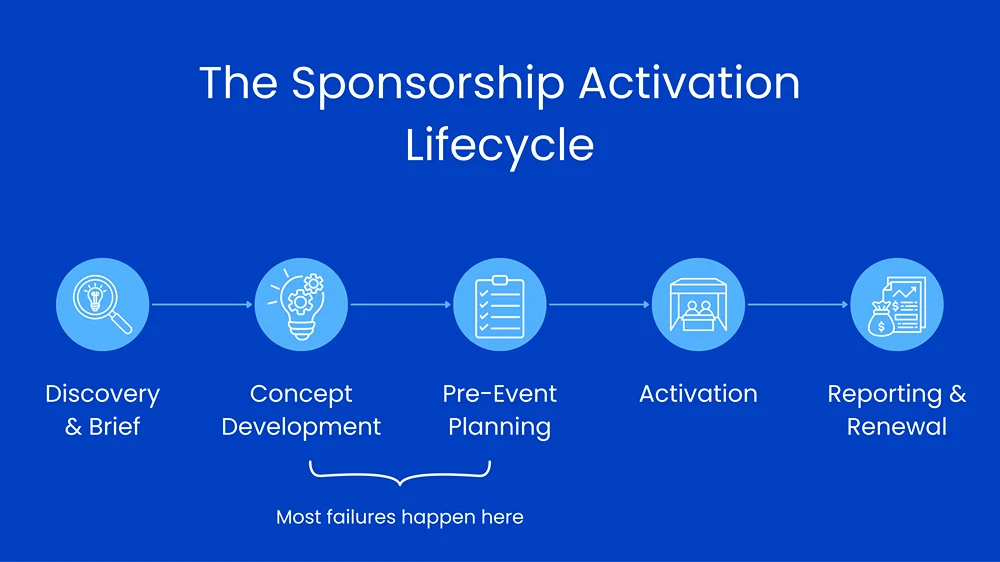
Activation planning starts long before the event. The best partnerships treat it as a collaborative design process, not a deliverable handed off after signing. As any experienced rights holder knows, activation and fulfillment is the hardest part of the whole process. Here's how the cycle runs:
Discovery and Brief
Rights holder and sponsor align on audience data, available inventory, and business objectives. This is where the best ideas come from. A brand targeting 18–34-year-old fans has different needs than one entertaining corporate clients in a hospitality suite. Without this conversation, activations become generic and lackluster.
Concept Development
Both parties develop a concept tied to agreed objectives — covering the experience itself, staffing, tech, content rights, and how performance will be tracked. Rights holders who arrive at this stage with activation concepts already prepared win stronger sponsorship deals.
Pre-Event Execution Planning
Before the event, lock down:
- Setup logistics and venue access
- Staff credentials and sponsor contact lists
- Collateral and asset deadlines
- Digital integrations and platform access
- Social amplification plans
- Measurement baselines and tracking setup
This is where complexity accumulates and where sponsorship management software pays dividends. If you want to see how this stage connects to the broader sponsorship lifecycle, from prospecting through renewal, it's worth understanding how each phase sets up the next.
On-Site Activation and Post-Event Reporting
The activation runs, data is captured, and content is posted in real time. When it wraps, reach, engagement, lead volume, and other agreed metrics are compiled into a fulfillment report — the foundation of every renewal conversation.

What Creative Event Activations Can Achieve
Activations can serve a wide range of goals:
- Brand awareness
- Lead generation
- Product trial
- Hospitality
- Content creation
- Community goodwill
That breadth is both a strength and a risk. Sponsors who try to accomplish everything at once produce activations that lose focus and results that are hard to read. Narrow the primary objective to one or two goals and design around them.
Brand Awareness and Fan Affinity
Activations build a relationship between a brand and a positive experience. They create memory and affinity that outlast the event, especially when paired with social amplification. This is the right primary goal for brands entering a new market or trying to shift perception.
Lead Generation and Product Trial
Activations can be engineered to capture qualified contacts through contest entries, app sign-ups, or badge scans. All these require a clear value exchange where attendees give information in return for something worth having. Events are also one of the few settings where brands can put a product in someone's hands in a context that makes them want to engage with it. The setting does part of the work, but activation design has to do the rest.
Hospitality and Relationship Building
VIP experiences, suites, and exclusive access programs serve sponsors chasing the right room rather than the largest audience. The metric here is qualitative — conversations had, relationships advanced — rather than impressions delivered.
Types of Creative Event Sponsorship Ideas

Experience-First Fan Activations
Fan zones and interactive hubs give attendees a reason to engage directly with the sponsor. The best ones offer something to do—a challenge, a simulation, a game— not just something to look at.
- A hydration brand sponsoring a recovery zone at a marathon.
- A financial services company hosting a sports economics trivia contest at a fan fest.
Rights holders: package these with digital exposure and social amplification rights. The activation concept should be part of what you're selling, not something you leave the sponsor to figure out.
Surprise and Delight Moments
Unexpected sponsor-funded moments generate outsized social sharing and goodwill.
- A free food truck
- Sponsored transportation vouchers at event's end
- A performer drop-in
The surprise is the magic. It gives fans something worth telling others about and connects the brand with generosity rather than commerce. Rights holders can package these as premium, limited inventory.
Digital and Social-First Activations
Branded hashtag campaigns, social walls, and UGC (User-Generated Content) contests extend reach beyond the venue with measurable engagement data. The best social activations feel like something fans would do naturally, with a small nudge and a reason to tag the sponsor. App-based integrations go deeper.
- Sponsored stats overlays
- In-game push notifications
- Content unlocked through engagement
These form trackable links between fan behavior and sponsor touchpoints.
Content and Media Integrations
Sponsors woven into content fans actively choose to consume — a team's behind-the-scenes series, a post-game recap segment, a branded podcast episode — earn association with content people chose to watch rather than tolerated. Rights holders who have developed content programs can offer these as standalone inventory with genuine audience data behind them.
Community and Cause-Driven Activations
Charitable tie-ins, youth programs, and sustainability initiatives build affinity that lasts past the event.
- A donation pledged per goal scored
- A youth clinic the day before a tournament
- A recycling program with the sponsor's brand attached to the outcome
These work when the cause genuinely aligns with the sponsor's values. Rights holders can create "community partner" tiers that give purpose-driven brands a differentiated position with real storytelling value.
VIP, Hospitality, and Season-Long Programs
Field access, meet-and-greet packages, and hospitality suites serve sponsors chasing intimate, high-value engagement rather than mass reach. When executed with care, these are high-margin inventory items and high-value relationship tools.
A VIP experience that falls short does more damage than a modest activation that delivers exactly what was promised. Sponsors who extend this logic across a full season, with activations that evolve across multiple events, build the kind of repeated fan exposure that single-event placements can't replicate. Rights holders who offer that continuity earn sponsors who invest more deeply and stay longer.
| Ready to build activation inventory your sponsors actually want to buy? See how SponsorCX helps rights holders manage every asset from proposal to fulfillment → Schedule a Demo |
How to Build a Sponsorship Activation Strategy That Works
Most sponsorship programs underperform because of strategy failures, not execution failures. The activation concept wasn't the problem. The problem was the mismatch between what was designed and what the audience wanted— or the absence of a measurement plan until someone asked for a recap.
Start with Audience Data
Before any concept is discussed, both parties need a shared picture of who will be in the venue:
- Demographics — age, gender, household income, occupation
- Psychographics — values, lifestyle, interests, and what they care about beyond the event itself
- Behavioral patterns — purchase habits, brand loyalty, how they engage with content and advertising
- Attendance motivation — are they die-hard fans, casual attendees, corporate guests, or families? Each group responds differently to activation formats
- Purchase intent — where are they in a buying decision, and is this event a context where they're open to brand engagement?
Rights holders who bring this data to the table are easier to partner with. Sponsors who study the audience before pitching are easier to execute with. The best activations start with data, not with the idea. That’s what drives value.
Define the Goal Before the Budget
Budget follows strategy, not the other way around. Define the primary objective first:
- Brand awareness — reaching new audiences and building recognition in a market
- Lead generation — capturing qualified contacts through structured data collection
- Product trial — putting the product in front of the right people in the right context
- Hospitality — deepening relationships with high-value clients and prospects in an intimate setting
Once the objective is clear, the concept follows. Once the concept is clear, the cost follows. Starting with the budget produces activations built around what money allows — not what the strategy requires.
Lock Down Measurement Before the Event
Building a measurement plan after the activation has already run means missing baselines, missing tracking codes, and having difficult conversations with sponsors. Establish KPIs, data collection methods, and reporting format before the event. Both sides need to agree on what success looks like before it either happens or doesn't.
Design for Shareability and Build Fulfillment Systems
Activations that generate organic social content extend reach far beyond attendance. Design for the photo moment, the shareable experience — not as a gimmick, but as something worth documenting.
And for rights holders managing multiple partners: tracking every deliverable across signage placement, credentials, content deadlines, and activation setup doesn't scale on spreadsheets. Build fulfillment tracking into a repeatable workflow before the season starts.
Where Results Are Made: Executing on Event Day
Strategy gets you to the starting line. Execution determines whether you cross the finish line. Even well-planned activations fail when staff is undertrained, setup is late, technology doesn't work, or the sponsor's team and the rights holder's team are operating off different information. A few things that consistently separate clean executions from chaotic ones:
- A single point of contact on both sides with authority to make decisions on the day.
- A written run-of-show covering setup windows, activation timing, staffing, and contingency plans.
- Any technology-dependent elements tested days before the event — not hours before.
- A defined data capture process so metrics are recorded as they happen, not reconstructed afterward.
Sponsors who staff activations with people who understand both the fan experience and the brand's objectives get substantially better results. Rights holders who support setup with experienced staff protect the relationship and improve the outcome.
How to Measure Event Sponsorship ROI
Measurement is where many sponsorship programs stall. Either data wasn't collected systematically, metrics were never agreed on upfront, or reporting focused on outputs ("we had 12,000 attendees") rather than outcomes ("the activation generated 340 qualified leads").
Key Metrics
Match metrics to the activation's primary goal. Common categories:
- Reach and impressions: total audience exposed, across in-venue, broadcast, and social.
- Engagement rate: interactions per impression — scans, entries, comments, app interactions.
- Lead volume and quality: contacts captured, with source tracking.
- Brand lift: pre- and post-event survey shifts in awareness, favorability, or purchase intent.
- Content performance: views, shares, watch time, and sentiment on branded content.
- Hospitality outcomes: meetings held, relationships advanced, follow-up conversations initiated.
ROI Formula and Attribution
The standard formula: ROI = (Attributed Revenue − Sponsorship Cost) ÷ Sponsorship Cost. In plain terms, a sponsor who invests $20,000 in an event package and traces $160,000 in closed business back to that activation is looking at a 7x return. For a deeper look at how to build that calculation across different activation types, SponsorCX's sponsorship ROI guide walks through the metrics and methods in detail.
Attribution is always the sticking point. Was that deal closed because of the activation, or would it have happened anyway? Perfect attribution in sponsorship is rare. What matters is choosing a consistent model and applying it the same way every time. Consistency builds credibility faster than precision does.
Nielsen's research shows that a 1-point gain in brand metrics such as awareness and consideration drives, on average, a 1% increase in sales — which is why even activations that don't produce immediate leads are worth measuring carefully.
Reporting as a Renewal Tool
The challenge isn't usually tool availability — event app analytics, QR tracking, promo codes, CRM data, and social listening are all accessible. The challenge is having a plan for how data flows into a coherent fulfillment report. Rights holders who deliver clear, data-backed post-event recaps consistently outperform those who don't on renewal rates.
| Struggling to pull post-event data into a report sponsors trust? SponsorCX centralizes activation tracking and fulfillment reporting in one place → See It in Action |
Six Common Mistakes That Undermine Sponsorship Activations

Most of these aren't dramatic failures. They're quiet ones — things that erode value gradually and make renewal harder than it needs to be.
1. Treating Activation as a Checkbox
The activation runs, the box gets checked, nobody evaluates whether it worked, and next year's program defaults to this year's regardless of results. Without an evaluation cycle, there's no improvement.
2. Misaligned Expectations
Rights holders oversell the audience or the asset. Sponsors expect engagement the venue and format can't deliver. When reality doesn't match the pitch, the relationship suffers regardless of who was technically correct. Honest conversations at the proposal stage protect both parties.
3. No Agreed Metrics Before the Event
If both parties haven't defined success before the activation runs, they'll disagree on whether it succeeded after. That makes renewal conversations adversarial rather than collaborative.
4. Audience-Activation Mismatch
A sponsor activating in a way that's irrelevant to the fan base, or that interrupts what fans came for, creates negative brand association rather than positive engagement. Audience fit matters more than activation budget.
5. Over-Relying on Passive Placement
Signage and logo integration are components of a package, not a substitute for activation. Rights holders who don't help sponsors think beyond passive presence are leaving engagement and renewal revenue on the table.
6. Skipping the Post-Event Report
Sponsors who receive no structured recap have nothing to take back to leadership to justify renewal. The absence of a report signals that the rights holder either doesn't have the data or doesn't value the relationship enough to produce it.
How SponsorCX Strengthens Your Activation Program
Managing one sponsorship is manageable. Managing a full portfolio with multiple partners, multiple events, multiple asset types, multiple reporting requirements is a different problem. Spreadsheets and email chains become the bottleneck.
The Utah Grizzlies ran their entire operation across five separate spreadsheets — fulfillment errors were common and reports took days to compile. After moving to a dedicated platform, they cut fulfillment errors by 40% and reclaimed 20 staff hours a week.
SponsorCX centralizes everything: inventory, deliverables, fulfillment tracking, and the post-event reports sponsors trust. Rights holders get a clear view of every asset across every partner. Sponsors get visibility into what's been delivered and what's performing. Both sides stop chasing information and start building on it.
The common thread through every best practice in this guide is that none of it scales on manual processes. SponsorCX is the system that makes it repeatable.
You make activations happen. We make it simple. Schedule a friendly demo today.