
The partnership manager is walking the corporate execs through a sponsorship review. The marketing manager nods. Finance wants more clarity. Then someone asks the question that everyone was thinking but was hesitant to ask: “So, why doesn’t this feel like a partnership?”
There were assets and activations, but no feeling of shared ownership, no clear outcomes, and no sense that both sides were moving in the same direction. It was a wake-up call. It begs the question; can things be different?
At some point, most every brand leader has looked at a sponsorship and thought, “We’re spending a lot of money… but are we really partnering with anyone here?”
It’s a good question.
Sponsorships and partnerships are often used interchangeably, but they are not the same thing. The difference affects ROI, renewals, internal buy-in, and whether your sponsorship portfolio feels like a profitable investment or a never-ending budget debate.
For brands, this distinction matters more than ever. As budgets tighten, scrutiny increases, and leadership asks harder questions, brands are rethinking how sponsorships should work.
Let’s take a closer look.
This article breaks down the partnership versus sponsorship conversation in plain language. It explains why so many sponsorships fall short, and outlines what brands must change to build collaborative brand partnerships.
What’s the Difference Between Sponsorship and Partnership?
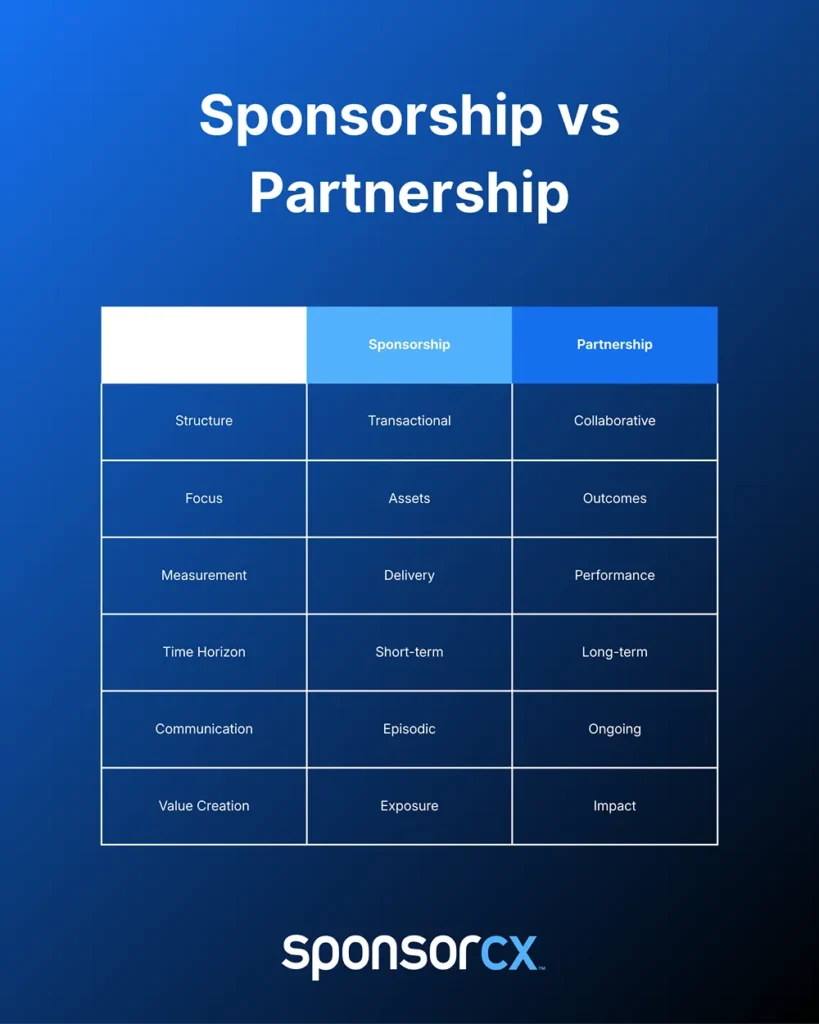
Before we talk about what’s broken and how to fix it, we need to get clear on definitions. Brands and properties often use the same words to mean very different things. When that happens, confusion reigns. The difference between sponsorship and partnership looks simple. In practice, it’s not. Sponsorships focus on deliverables while partnerships are built on collaboration.
A Sponsorship Is Transactional by Design
A sponsorship traditionally operates as a buy-and-deliver transaction.
The brand:
- Pays a fee
- Receives a defined set of assets
- Activates those assets to as best it can
- Wants to know how the sponsorship performed at the end of the cycle
Think:
- Logos
- Signage
- Digital placements
- Hospitality
- On-site activations
This isn’t bad. Sponsorships can and should deliver value. But when a sponsorship is treated only as a transaction, success is measured by delivery, not impact.
Did the assets run?
Did the logo appear?
Did the event happen?
Good questions, but not strategic.
A Partnership Is Collaborative and Outcome-Oriented
Mutually beneficial partnerships are built around shared goals and collaboration.
Instead of asking, “What did we buy?”, partnerships ask:
- What are we trying to achieve together?
- How will we measure success?
- How do we adapt to change?
In a partnership:
- Both sides are invested in outcomes
- Strategy evolves over time
- Communication is continuous, not sporadic
- Performance is reviewed, not just reported
This is why partnership versus sponsorship is more than semantics. It’s a difference in mindset, it’s different in the way it operates, and engenders different expectations.
Why Don’t Many Sponsorships Feel or Act Like Partnerships?
If partnerships are clearly better, why do so many sponsorships never get there? Because the system isn’t designed for it. Short-term sponsorships focus on visibility. Strategic partnerships are designed for sustained value and mutually beneficial business outcomes. Here are some of the most common reasons brands feel stuck in sponsorship mode.
1. Sponsorships Are Sold, Not Built
Most sponsorships begin with a deck, a pitch, and a rate card.
That process emphasizes:
- Assets
- Exposure
- Impressions
Not:
- Strategy
- Integration
- Long-term value
Brands buy what’s presented, even when it doesn’t align perfectly with business objectives. Partnerships require a slower, more intentional start.
2. Goals Are Vague or One-Sided
Ask a brand sponsor and a property what success looks like, and you’re likely get two very different answers.
Common brand-side goals:
- Drive awareness in a new market
- Increase trial or usage
- Increase sales
- Support customer acquisition
- Strengthen community relevance
Common property-side goals:
- Fulfill assets
- Retain the sponsor
- Sell the next deal
Without clearly aligned objectives from both sides, the relationship defaults to asset delivery, not win/win partnership behavior.
3. Measurement Is an Afterthought
Many sponsorship strategies still rely on:
- Post-event recaps
- Impression estimates
- Photo galleries
- Anecdotal feedback
Those materials may show what happened, but they rarely show why it mattered.
Without real measurement, optimization never happens. And without optimization, partnerships can’t evolve.
4. Communication Is Sporadic
In many sponsorships, communication spikes at three pivotal moments:
- Contract signing
- Activation delivery
- Renewal discussion
Long periods of silence separate each moment.
True partnerships require regular check-ins, shared dashboards, and visibility into progress. Without that, brands feel disconnected. Those are the investments that are the first to go.
5. There’s No Operating System
Here’s the truth. You can’t manage partnerships with spreadsheets, inboxes, and shared folders—not at scale. Manuel processes make it hard to see the bigger picture.
Sponsorship models that work require systems that support collaboration, accountability, and transparency. If these aren’t part of the equation, even well-intentioned partnerships relapse into sponsorship habits.
What Does a True Brand Partnership Look Like in Practice?
Let’s paint a clear picture.
So, what does it look like when things work? When a brand stops buying logos and starts operating as a strategic collaborator, the differences show up quickly and consistently. Brands need tools that keep sponsorships, contacts, assets, and timelines centralized and visible.
1. Shared Objectives, Defined Early
True partnerships begin with alignment, not assets.
Before inventory is finalized, both sides agree on:
- Primary business goals
- Target audiences
- Success metrics
- Non-negotiables
Alignment supports broader brand priorities, not just event visibility.
2. Flexible Activation Models
Partnerships allow room for adjustment and course correction.
Instead of locking everything into a pre-determined checklist, brands and properties:
- Test activations
- Refine messaging
- Shift emphasis based on performance
This is especially critical in strategic partnerships in sports, where seasonality, performance, and fan behavior change constantly.
3. Ongoing Performance Reviews
Partnerships replace recaps with conversations. Regular reviews focus on:
- What’s working
- What’s not
- What should change next quarter
This cadence builds trust and momentum and prevents surprises at renewal time.
4. Mutual Accountability
In collaborative brand partnerships, accountability flows both ways.
Brands commit to:
- Activation execution
- Promotion
- Measurement inputs
Properties commit to:
- Asset delivery
- Data access
- Optimization support
When both sides are accountable, outcomes improve.
5. Clear Visibility into Value
Strong partnerships don’t rely on gut feel.
They provide:
- Real-time tracking
- Centralized reporting
- Transparent performance metrics
Visibility turns sponsorship from a marketing expense into a strategic investment.
What’s Possible? 3 Brand Partnership Examples
Here are three real-world examples in which brands transcend transactional exposure and create value together.
1. Nike × Apple: Fitness First
Nike and Apple teamed up to create the Nike+ Apple Watch and integrated fitness ecosystem. Instead of simple co-branding, the two companies combined their strengths—Apple’s wearable tech and Nike’s fitness culture—to offer measurable value to users and extend both brands into each other’s communities. This long-running collaboration has reinforced lifestyle positioning for both companies.
2. Spotify × Starbucks: Rewards and Sound
Spotify and Starbucks built a partnership that went beyond a sponsorship check to tie music and coffee loyalty together. Starbucks customers could influence store playlists and earn music perks through Starbucks Rewards, creating a loop of engagement that benefited both brands. Shifting from exposure to behavior-driven collaboration boosted the customer experience on both sides of the relationship.
3. GoPro × Red Bull: Content and Culture
GoPro and Red Bull partnered together for shared storytelling. The brands co-created high-energy content, events, and media that reflect both identities—adrenaline, adventure, action sports—driving engagement far beyond traditional impressions. This partnership turned into ongoing co-branded initiatives and viral media, so much more than periodic sponsorship placements.
These examples show how a true partnership takes shape: aligning on audience, co-creating value, and building measurable engagement rather than merely checking off impressions.
How Does the Partnerships vs. Sponsorship Difference Impact ROI, Renewals, and Internal Buy-In?
This is where the rubber meets the road. The difference between sponsorship and partnership shows up most clearly when brands evaluate performance internally. A structured ROI framework combines exposure, engagement, and audience insights to help brands quantify value.
ROI: From Guesswork to Confidence
Sponsorships often struggle to prove ROI because they weren’t designed to. Partnerships are different. When goals are defined, metrics are tracked, and performance is reviewed regularly, ROI conversations more often turn into renewals.
Instead of saying: “Here’s what we delivered…”
Brands can say: “Here’s what this partnership helped us achieve.”
The difference matters.
Renewals: From Anxiety to Alignment
Many sponsorship renewals feel rushed and uncomfortable. Why? Because value hasn’t been shown along the way.
In partnerships:
- Progress is continuously documented
- Wins are regularly reinforced
- Adjustments are already underway
When it’s time to discuss renewal, the decision is a forgone conclusion.
Internal Buy-In: From Skepticism to Support
The biggest impact of partnership thinking might just be internal. Brand finance teams, executives, and other stakeholders don’t care about passion—they want proof. Collaborative brand partnerships provide:
- Clear narratives
- Documented outcomes
- Fewer surprises
That builds trust, reduces friction, and makes future investments more likely.
What Must Brands Change Today to Move from Sponsorship to Partnership?
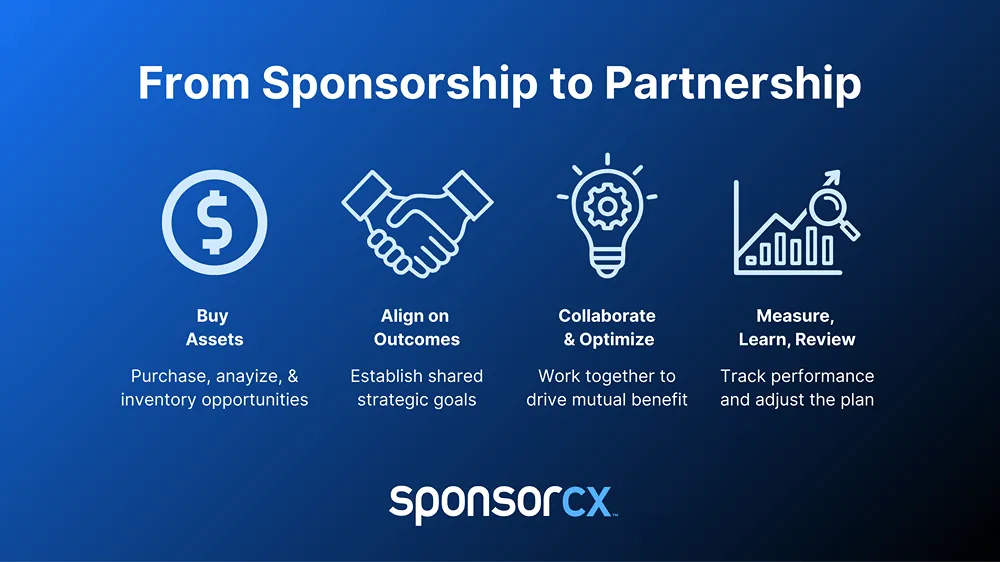
This is the burning question. Partnerships don’t happen by accident. It’s time for brands to evaluate not just a platform’s technology but whether it behaves like a true sponsorship partner. That’s where SponsorCX excels.
1. Change the Questions You Ask
If you’re still asking:
- How many impressions?
- How big is the logo?
You’ll keep getting sponsorships.
Start asking:
- What problem does this partnership solve?
- How do we measure success?
- What’s the evolution of this over time?
Better questions lead to better deals.
2. Demand Strategic Alignment
Brands must stop accepting inventory just because it’s available. If an asset doesn’t support your objectives, it’s not a partnership asset—it’s just noise. Strategic partnerships succeed because they value how what fits above how much there is.
3. Invest in Measurement, Not Just Activation
Activation gets attention. Measurement earns trust. Brands that want partnerships must invest in systems and processes that track performance continuously, not just at the end.
4. Treat Partnerships as Ongoing Relationships
Partnerships require joint stewardship. That means:
- Regular communication
- Shared planning
- Transparent reporting
If your sponsorship only comes up twice a year, it’s not a partnership.
5. Embrace Evolving Sponsorship Models
The sponsorship world is changing.
Brands that cling to static models will struggle to justify their spending. Those that embrace evolving sponsorship models that are grounded in collaboration, data, and adaptability, will build portfolios that deliver ROI.
Why This Distinction Matters a Lot More Today
Brands are under pressure to do more with less. That pressure exposes weak sponsorship strategies quickly. The good news? The path forward is clear.
By shifting from transactional sponsorships to collaborative brand partnerships, brands gain:
- Better outcomes
- Stronger relationships
- Clearer ROI
- Greater internal confidence
The difference between sponsorship and partnership is real.
It’s operational.
It’s measurable.
And it’s increasingly non-negotiable.
Because in a world in which every dollar is questioned, partnerships don’t just feel better—they perform better too.
Once you experience a true partnership, going back to buying logos feels a little like using a flip phone in a smartphone world.
Ready to Turn Sponsorships into True Partnerships?
You already know what’s broken. You’ve felt the friction, answered the tough questions, and worked to prove value. You need clarity, structure, and a system that helps partnerships work.
Our purpose at SponsorCX is to guide brands from transactional sponsorships to collaborative, partnerships. Our platform provides strategy, accountability, and transparency that enables you to lead with confidence and achieve desired results.
If you’re ready to build partnerships that perform, schedule a demo of SponsorCX and see what’s possible when the right guide is at your side.