You review the season with your biggest sponsor. They want to know which activations drove redemptions, which touchpoints reached their target demographic, and whether the halftime experience they paid for moved the needle. You have data. You have impressions. But can you answer those three questions with any certainty?
These are the questions fan engagement tools are built to answer. Fan engagement in sports has always been the goal. The right tools make it a manageable and reportable.
Fan engagement tools include:
- Mobile apps
- Loyalty platforms
- Gamification software
- CRM integrations
- In-stadium technology
- Sponsorship management platforms
Strong sponsorship teams understand how each tool supports the broader engagement strategy.
Today’s market reflects how seriously the industry has started taking this. According to Future Market Insights, the global fan engagement market was valued at $7.2 billion in 2025. It’s projected to reach nearly $37.9 billion by 2035, driven by digital innovation and the growing commercial value of engaged audiences. That growth is already reshaping how properties build sponsor packages and how brands evaluate the ROI of sports partnerships.
This article covers what fan engagement tools are, how they work, which types matter most, and how to build a strategy that connects fan behavior to sponsor results.
What Are Fan Engagement Tools?
Fan engagement tools are the software platforms and technologies sports organizations use to strengthen fan engagement in sports across every touchpoint: digital, in-venue, and between events They range from email marketing platforms to AI-driven personalization engines.
What they share is purpose. Each tool is built to do one or more of the following:
- Capture fan data: who your fans are, how they behave, what they respond to
- Communicate with fans: deliver relevant content, offers, and experiences at the right time
- Create fan experiences: in-stadium activations, digital games, loyalty programs, and interactive content
- Measure fan behavior: track how fans respond to each touchpoint and what that means for sponsor value
These tools matter because fan engagement creates value. A sponsor paying for signage buys exposure. A sponsor paying for a fan loyalty activation buys behavior data, redemption metrics, and a direct line to a specific segment. The second is more valuable. The ability to prove it often determines whether renewal conversations are successful or not.
How Fan Engagement Tools Work

At the center of any effective system is data: clean, connected, and actionable. Here is how the pieces fit together across a typical sports property:
- Fans interact across touchpoints: buying tickets, downloading your app, scanning a sponsor QR code, or joining a loyalty program.
- Each interaction builds a fan profile: segment, frequency, content preferences, sponsor activation history.
- Tools use that data to personalize the next interaction: a targeted push notification, a loyalty reward timed to purchase behavior, a sponsor offer aligned with a fan segment.
- Outcomes are tracked: did the fan redeem the offer, attend the event, share the content?
- Those outcomes flow into reporting, giving your team and sponsors a clear picture of what worked.
The organizations that use fan engagement tools most effectively are the ones with clean data pipelines, tools that connect to each other, and a consistent process for turning fan behavior into decisions. Good execution matters more than technology. Digital engagement does not replace the live experience. It extends the relationship beyond game day. A fan who downloads your app because of an in-stadium prompt becomes a year-round digital relationship.
What Fan Engagement Tools Can Achieve
Done well, a well-designed fan engagement program delivers:
- Higher season ticket retention: actively engaged fans renew at significantly higher rates than those whose only touchpoint is the event
- Better sponsor activation ROI: targeted, data-driven activations produce traceable redemption metrics sponsors can evaluate
- New revenue streams: loyalty programs, premium content tiers, and personalized merchandise drops create monetization that passive fan relationships cannot
- Stronger renewal conversations: the more fan behavior data you capture, the more specific and credible your sponsor reports become
- Confident sponsorship pricing: properties with proven fan engagement data can price inventory based on demonstrated value, not estimates
A useful benchmark: research published in 2025 on AI's role in sports marketing found that data-driven fan engagement programs correlate with a 35 to 50 percent increase in fan engagement and improve marketing targeting accuracy by more than 60 percent. Data infrastructure is what makes that level of precision possible. For properties investing in digital fan engagement, infrastructure quality is the variable that separates programs that scale from those that plateau.
Types of Fan Engagement Tools
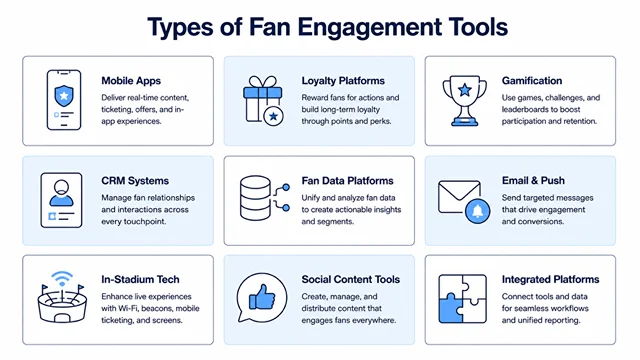
Mobile Apps and Fan Portals
A dedicated team app is one of the highest-value digital assets a property can own. Unlike social media, you control the experience and the data. Apps give fans real-time access to scores, exclusive content, ticket management, and sponsor activations; every interaction is a data point that builds fan profiles. A 2025 IBM global study of more than 20,000 sports fans found that 82 percent of fans attending live events use a mobile app during the event. Ninety-one percent of those users engage during live action.
Fan Loyalty and Rewards Platforms
Loyalty programs reward fans for specific behaviors: attending games, purchasing merchandise, sharing content, interacting with sponsor activations. The best platforms are configurable; you can tie rewards directly to sponsor-branded actions and report on those interactions as activation deliverables.
Gamification Tools
Prediction contests, trivia, pick-em competitions, and leaderboards give fans a reason to return beyond game results. For sponsors, gamified experiences offer a branded context that goes beyond signage: a sponsor presents a halftime prediction challenge, and every submission is a tracked, attributed interaction.
CRM and Fan Data Platforms
A sports CRM gives your team a centralized view of every fan relationship: purchase history, communication preferences, attendance, loyalty status, and sponsor activation interactions. Fan data platforms go further, connecting data across ticketing, app, email, and point-of-sale into unified profiles. This is the foundational layer; without it, personalization and attribution are both guesswork.
Email and Push Notification Platforms
Segmented email campaigns and targeted push notifications remain among the most cost-effective fan engagement channels available, especially for smaller properties. When connected to your fan data platform, these can trigger automatically based on fan behavior: a lapsed fan receives a targeted offer; a high-frequency attendee receives early access to a premium experience.
In-Stadium and Event Technology
AR overlays, digital signage, second-screen content, and sponsor activation kiosks connect physical presence to digital data. A fan who scans a sponsored display creates a logged interaction your team can report to the sponsor. That is the difference between a passive impression and a documented engagement.
Social Media and Content Tools
AI-assisted content scheduling, social listening, and short-form video tools help you maintain consistent fan relationships outside of game days. For sponsors, social channels are where branded content performs most visibly. Social analytics are an important component of any activation measurement report.
Integrated Fan Engagement Platforms
Some vendors combine loyalty, gamification, community features, content, and analytics into a single environment. These fit properties looking to consolidate their tech stack. The tradeoff is that all-in-one solutions sometimes sacrifice depth in specific areas. Prioritize what matters to you rather than chasing more features.
How to Build a Fan Engagement Strategy That Works
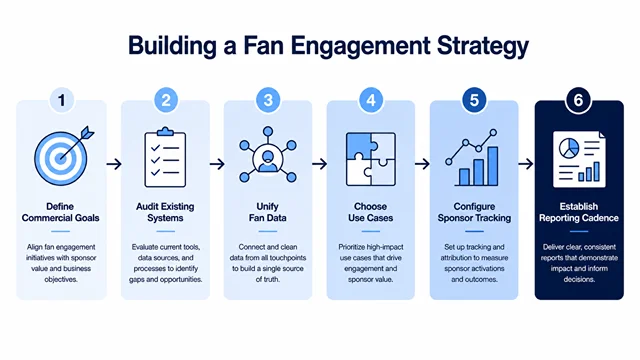
Most fan engagement programs underperform because the strategy is missing. Tools without a strategy produce data without decisions.
Step 1: Start with Sponsor and Commercial Outcomes
Before selecting any platform, define what success looks like for your sponsors and your property by the end of the season. Specific is better than general. "Increase app sessions" is vague. "Increase monthly active users by 20 percent and tie three sponsor activations to in-app behavior by Q3" is strategic. The commercial outcome defines which fan behaviors you need to influence, which defines which tools to use.
Step 2: Audit What You Already Have
Most properties have more fan data infrastructure than they are using. Before adding new tools, inventory what exists: ticketing system, CRM, email platform, app, loyalty program, social analytics. Identify where data is collected but unused, where systems are not connected, and where fan behavior is happening without being captured.
Step 3: Prioritize Data Unification
A fan who buys a ticket, downloads your app, and redeems a sponsor offer presents three separate data points in three separate systems. You need to connect them. Linking ticketing, app, CRM, and loyalty data into unified fan profiles makes personalization and attribution possible. You do not have to do it all at once; connecting two key systems is a meaningful first step.
Step 4: Choose Tools by Use Case, Not Feature
Every vendor demo is designed to impress. Your job is to evaluate each tool against a specific problem. Choose tools that address the challenges you have, not the ones you might have in five years. You can always add complexity later as the program matures.
Step 5: Build Sponsor Deliverables into the Architecture
Before your season begins, decide exactly what data each sponsor will receive: which fan interactions count as attributable to their activation, how those interactions will be tracked, and in what format results will be reported. Then configure your tools to capture exactly that. Our overview of sponsorship deliverable management walks through how SponsorCX centralizes this process.
Step 6: Set a Reporting Cadence and Hold to It
Sponsors gain confidence when communication is consistent, not just at renewal time. Define how often each sponsor receives engagement reports, what those reports contain, and who produces them. Build the reporting workflow into your tool configuration from day one.
If you are in the planning phase and want a cleaner way to manage sponsor deliverables and reporting, see how SponsorCX can help. Request a demo.
Execution: Where Results Are Made
Strategy sets the direction. Execution determines whether sponsors trust the program. The gap between a well-designed program and one that underdelivers almost always comes down to execution.
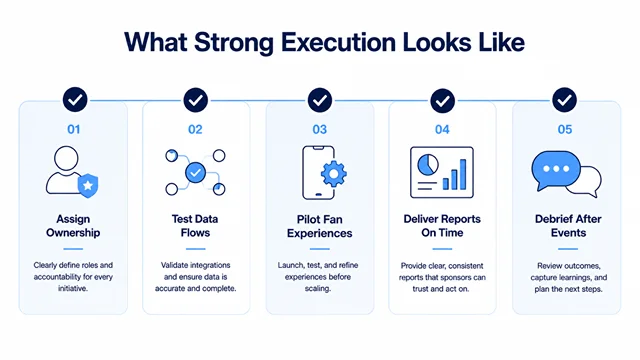
- Activation ownership is documented: every sponsor activation has a named owner responsible for confirming tools are configured, data is flowing, and reporting is on schedule
- Data flows are tested before each event: one failed tracking period can undermine an entire activation report
- Fan-facing experiences are piloted with real users: team assumptions about how fans use app features or kiosks are frequently wrong
- Reporting is delivered on schedule, not just when results are strong: consistent updates build more sponsor trust than sporadic good news
- The team debriefs after each event: a short review, not a long meeting; catch execution failures early before they compound
Execution at scale including multiple sponsors, multiple activations, and multiple reporting deadlines running simultaneously, is where manual processes break down. One missed deliverable or broken report can put a renewal at risk. L.E.K. Consulting's 2025 Sports Survey confirms that the next generation of fans expects personalization and digital touchpoints alongside live events. Meeting that expectation requires more coordination than most teams currently have in place.
How to Measure the ROI of Fan Engagement Tools
Key Metrics
- Fan acquisition: new registrations, app downloads, email list growth, loyalty sign-ups, first-time attendees
- Fan retention: season ticket renewal rate, repeat attendance, app monthly active users, churn by segment
- Engagement depth: average interactions per fan per month, gamification participation rate, loyalty redemption rate
- Sponsor performance: branded activation interactions, offer redemption rate, sponsor-associated content reach, revenue influenced by sponsor promotions
- Revenue contribution: per-fan revenue across all categories, premium product attach rate, merchandise revenue tied to engagement campaigns

ROI Formula
ROI = (Revenue Attributed to Fan Engagement – Program Cost) ÷ Program Cost × 100
Attribution is where this formula gets complicated. Be direct about that with sponsors. Fan behavior rarely traces directly to a single touchpoint. Most properties use a combination of last-touch attribution, multi-touch distribution, and incrementality testing. Perfect attribution is not the goal. A defensible, consistently measured number tracked the same way across seasons is.
Tools for Measurement and Reporting
- Fan data platforms and CDPs: centralize fan profiles and behavioral data for segmentation and analysis
- Google Analytics 4: track digital engagement across app and web properties
- Social listening tools: measure fan sentiment and sponsor-associated content performance
- Sponsorship management platforms: track deliverable completion and produce sponsor-facing reports
- BI tools such as Tableau or Power BI: build dashboards combining fan engagement data with financial performance
Sponsors need results in a format they can share internally with their own leadership.
Want a cleaner system for tracking fan engagement outcomes and reporting them to sponsors? See SponsorCX in action. Book your demo.
Common Mistakes in Fan Engagement Programs
- Buying tools before defining outcomes. If your team cannot name two or three specific, measurable outcomes before evaluating a platform, you are not ready to buy.
- Treating engagement data as a reporting exercise only. If data only shows up in reports, you are underusing it. Build a workflow that also flows it forward, into next season's strategy and activation design.
- Measuring activity instead of behavior. Impressions and app opens are activity metrics. Sponsors want behavior metrics: redemption rates, repeat purchases, retention lift.
- Segmenting fans too broadly. Dividing fans into season ticket holders and single-game attendees is categorization, not segmentation. Effective fan engagement tools allow targeting based on behavior, geography, purchase patterns, and content preferences.
- Building sponsor reporting as an afterthought. If your tools are not configured to capture sponsor-specific interaction data from the first activation of the season, retroactive reporting is an estimate. Decide what each sponsor needs before the season starts.
- Neglecting the opt-in problem. Personalization depends on fan data, and fan data requires explicit consent. Properties that ignore this risk incomplete fan profiles and potential compliance issues. Make the value exchange clear: data for a better experience.
- Underestimating integration complexity. Fan engagement platforms rarely connect cleanly to existing ticketing, CRM, and loyalty infrastructure out of the box. Plan for integration time and budget.
- Launching fan engagement ideas without an internal owner. Even the best fan engagement ideas stall without clear ownership. Deliverables get missed, reports go out late, and sponsors notice. Every activation needs a named person whose job it is to manage it.
How SponsorCX Strengthens Your Fan Engagement Program
As your fan engagement platform mix grows in scope, the operational challenge grows too. More sponsors mean more activations, more deliverables to track, and more reports to produce.
SponsorCX is built around four capabilities that map directly to the challenges of running a fan engagement program at scale:
Centralize. Every sponsor, activation, deliverable, and fan engagement data point associated with a sponsor program lives in one place. No more hunting across inboxes and spreadsheets to answer a sponsor's question mid-season.
Automate. Reminders, approval workflows, and reporting schedules run without manual follow-up. Your team focuses on work that requires judgment, not remembering to send a file.
Track. Activation progress, deliverable completion, and fan engagement metrics tied to sponsor programs are visible in real time. When a sponsor asks how a campaign is performing in week six, you have an answer.
Report. Sponsor-facing reports are produced from the same data your internal team uses, keeping everyone aligned and eliminating inconsistent numbers reaching different stakeholders.
Properties that manage multiple sponsor partners with different deliverable structures understand why a centralized system matters. The fan engagement program is only as credible as your ability to report on it accurately and consistently.
The sports properties using SponsorCX show up to renewal conversations with clean data, a clear story about what their fan engagement program delivered, and a credible plan for next season.
Ready to connect your fan engagement tools to a smarter sponsorship management system? Request your SponsorCX demo today.
You make sponsorships happen. SponsorCX makes it simple.