
For sponsorship and partnership teams, the hardest part of the job isn't closing the deal; it's everything that comes after. A real-world example is KU Alumni’s Jayhawk Community Partners. It illustrates the operational challenges of partnership management.
Like many others, KU Alumni’s Jayhawk Community Partners relied on spreadsheets, manual reminders, and individual workarounds. That created confusion around deliverables, deadlines, and fulfillment.
All too often, a promising proposal gets lost in translation, buried in endless email threads, or tracked across disconnected spreadsheets. The results? Missed deliverables, strained partner relationships, and questionable ROI.
Strategic partnership management helps organizations choose partners, align their goals, and deliver on shared commitments. It begins with the first meeting and runs through delivery, reviews, and the final decision to renew or exit.
This article explores the strategic decisions and agreement terms that go into making a successful partnership. Our guide to partner management covers the ongoing coordination, communication, and follow-through.
What Makes Strategic Partnerships Work?
A strategic partnership supports a business priority for both the property and the brand. Each side brings something valuable to the table. That might include funding, distribution, know-how, audience access, or the ability to deliver an experience.
A supplier can also become a strategic partner when the relationship includes shared development or long-term business goals. Don’t assume that every vendor relationship is transactional.
The Strategic Partnership Management Lifecycle
Most partnerships move through a familiar cycle:
- Assess fit. Determine what each organization needs and whether the proposed partner can help.
- Structure the deal. Agree on contributions, deliverables, ownership, timing, and measures of success.
- Launch the work. Introduce the delivery teams and turn the agreement into a shared plan.
- Manage performance. Track commitments, resolve issues, and review results while there is time to respond.
- Renew, adjust, or exit. Decide whether the relationship still serves both organizations and what should change.
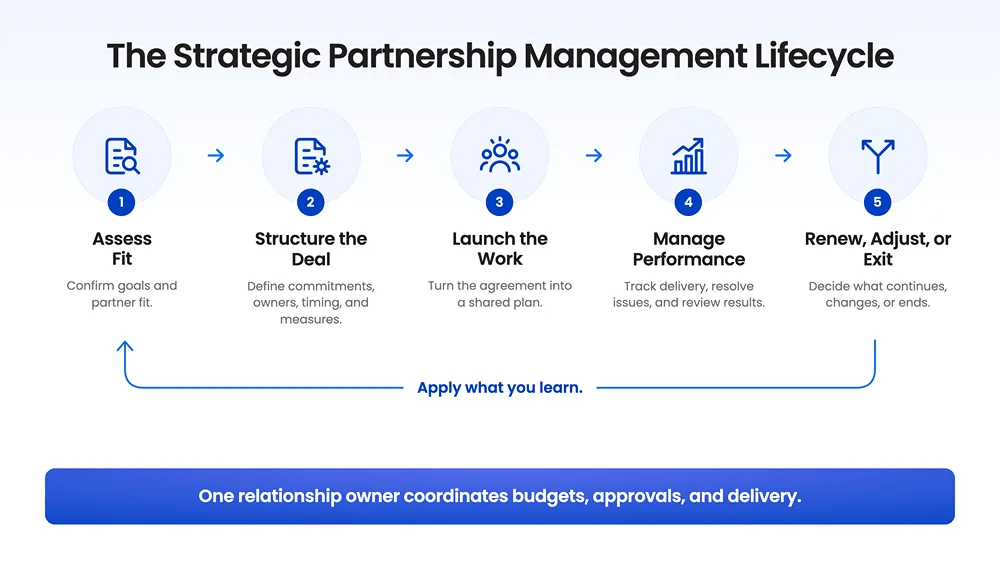
The relationship owner keeps this cycle moving, with the help of those responsible for budgets, approvals, and delivery. They need access to decision makers on both sides so changes can be discussed with people who have approval authority.
How to Build Strong Partnership Deals
Define What You Offer and What You Need
Before you consider a sponsorship package, focus on the business problem you want to solve or opportunity you want to exploit. Be clear about what you’ll contribute and what you need from the other organization.
Harvard Business School Online’s guide to negotiating strategic partnerships recommends defining your objectives, limits, and alternatives early, then understanding what the other party needs.
For example, think of a regional grocery chain partnering with a community sports club. The grocer wants local families to try its prepared meals by sampling at youth clinics. The club wants funding for youth clinics and an engaging experience for participating families.
The proposal could include meal sampling at clinics, a redeemable offer, and promotional support. The club provides access and runs the events; the grocer supplies funding, products, and staff.
Both sides should also identify potential challenges. They might include refrigeration, staffing, and health and sanitation requirements.
Select Partners Who Can Deliver
A familiar name isn’t enough. Check whether the opportunity fits your goals.
Ask for information that helps your team make a decision:
- Audience fit: Who will the partnership reach, and how does that overlap with the partner's intended customers or community?
- Strategic fit: How does the proposal support each side’s goals?
- Delivery capacity: Who will supply the staff, products, space, and approvals?
- Working relationship: Are the decision makers accessible? Can both sides resolve any disagreements that arise?
- Conflicts: Do existing commitments limit the proposed rights or activities?
Treat slow replies or fuzzy ownership as problems to solve, not proof the partner is unreliable. Identify the owner and lock down the resources you’ll need before you proceed.
Involve the people responsible for fulfillment while the deal is in development. McKinsey's guidance on managing business partnerships recommends bringing operational leaders into negotiations early so expectations and responsibilities can be hammered out together.
Turn Proposals into Working Partnership Agreements
A deal should lay out what each side will receive and what it will contribute. Before finalizing the agreement, work through the following questions.
| Deal element | Question to resolve |
| Objective | What outcome matters to each organization? |
| Rights and deliverables | What is included, in what quantity, and during which dates? |
| Contributions | Who supplies funding, people, creative materials, products, and equipment? |
| Ownership and approvals | Who delivers each item, who approves it, and by when? |
| Measurement | What evidence will be collected, who supplies it, and when is it reviewed? |
| Changes and missed delivery | Who can authorize changes, and how will affected commitments be addressed? |
| Renewal or exit | When will the parties decide what comes next, and what must be completed at the end? |
Use this as an operational discussion checklist. Have the appropriate advisers incorporate agreed terms into the contract. Be sure to include provisions for brand use, exclusivity, data, payment, and termination.
In the grocery example, “sampling at youth clinics” is too. The commitment should identify the clinics, service hours, space, staffing, product logistics, and evidence of delivery. It also covers what happens if a clinic is canceled.
For more on shaping benefits around sponsor priorities, read what sponsors really want.
Agree on a Process for Making Changes
A make-good activity should support the original objective and match the promised value.
Let’s suppose the grocer can’t staff one of the planned clinics. Both sides should discuss workable make-good options and get needed approvals. Get evidence of the approved change in writing.
Let the working team handle routine decisions. Send budget, scope, or strategy changes to the appropriate decision makers. This gives people room to work while keeping oversight where it belongs.
Move from Agreement to a Shared Plan
The handoff from sales to asset delivery deserves particular attention. Review the objectives and commitments with the people who will carry them out. Include the partner's team.
For each deliverable, record its owner, due date, dependencies, approval contact, and proof of performance. Link it to the relevant agreement so someone new taking over the account can understand the purpose of the task.
In our grocery example:
- The club's event lead owns space and access.
- The grocer's field team owns product delivery and staffing.
- A marketing contact approves promotional copy.
- The relationship manager checks that these activities come together before each clinic.
Time updates around decisions and deadlines. Check in often before launch and send brief written updates between events. Cover what’s done, what’s next, and what needs attention.
When a deadline is at risk, explain the consequence and the decision needed. “We need approval by Thursday to print for Saturday” gives the partner a specific timeline.
If the handoff depends on copying agreement details into several separate files, explore SponsorCX's sponsorship management platform to see how agreements, inventory, and fulfillment can stay connected.
How to Measure Partnership Performance
Before launch, choose a few partnership KPIs tied to your objective and confirm who will supply reliable data. Only track what helps you make decisions.
Separate Delivery from Results
Fulfillment shows that commitments were completed. Outcomes show what the partnership achieved. Both belong in a review, but they answer different questions.
For a partnership similar to the hypothetical grocery partnership, use measures such as these:
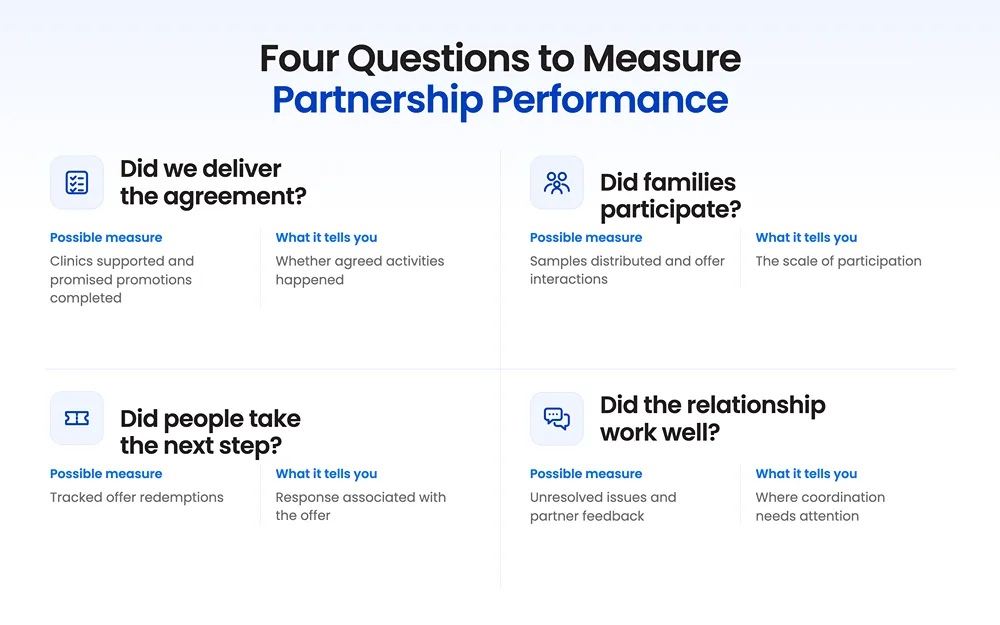
Compare results with a baseline or comparison group where possible. Without either, focus on delivery and participation. Avoid claiming improvements that the data can’t support.
Our sports sponsorship measurement guide provides more detail on matching evidence to objectives. For financial evaluation, see how to measure sponsorship ROI beyond impressions.
Review Performance While You Can Still Act
Schedule reviews early so you can make adjustments.
If the clinics are well attended but offer redemption is low, review the offer, redemption process, and follow-up before assuming the partnership didn’t work. If promotions often arrive late, revisit the approval process and lead times.
Assign an owner to each action. Then update the shared plan to track progress.
Make Partnership Renewal a Deliberate Decision
Ask three questions:
- Does the partnership still fit both organizations?
- Do the benefits justify the required resources?
- Can open problems be resolved?
Renew when the relationship is still mutually beneficial. Adjust if the goal is still achievable but changes are needed. Consider ending the partnership if priorities have diverged or commitments have become unrealistic.
A partnership can also end because it accomplished its purpose. Document remaining obligations and the agreed handoff so the relationship concludes cleanly and amicably.
How to Overcome Common Problems
The Partners Want Different Outcomes
Revisit each side’s goals. A sponsor seeking sales leads needs more than audience reach figures. Align expectations before adding activities, then update the plan and metrics together.
Approvals Keep Blocking Delivery
Discover what’s blocking approval. Confirm the approver, provide complete materials, set realistic timelines, and name a backup if needed. Escalate unresolved issues before the deadline.
The Team Has Promised More Than It Can Deliver
Compare staffing, inventory, and timing to what you’ve promised. Flag gaps with the partner early and align on fixes. Next time, bring delivery owners in before writing the proposal.
Reports Don’t Demonstrate Value
Did the team track only asset completion when the partner expected results? Identify what extra data is available. Make the report clear about what it shows and what it can’t.
Choose Tools That Support Your Partnership Process
A shared spreadsheet and calendar can support a simple program if kept current. As it grows, watch for information that’s hard to update or find.
Test a new system with one real deal. Can the team find the agreement, check inventory, assign tasks, and verify completion? Can a new account owner quickly understand its status?
For sponsorship operations, SponsorCX connects sales activity and inventory with agreement-driven tasks, scheduling, fulfillment, and reporting. Its property platform also supports sharing proof of performance through the Partner Portal. Confirm the capabilities that matter to your workflow during evaluation.
Frequently Asked Questions
Who Should Own a Strategic Partnership?
Give one person the responsibility of managing the partnership and assign each deliverable to an owner. Involve senior leaders when changes affect scope, spending, or strategic priorities.
What Should a Partnership Plan Include?
Include the objectives, contributions, deliverables, owners, deadlines, approval process, measurement plan, and review dates. Keep it connected to the agreement and update it when both sides approve a change.
How Often Should Partners Review Performance?
Match performance reviews to the delivery schedule and decisions ahead. Review readiness before a major activation, assess results afterward, and leave enough time before renewal to dig into the findings. The right frequency depends on the pace and complexity of the work.
Turning Strategy into Execution
Building a great partnership plan is only half the battle. Effective strategic partnership management turns clear commitments into consistent delivery and measurable results.
As we saw with KU Alumni’s Jayhawk Community Partners, relying on manual spreadsheets and disconnected reminders can create friction around deliverables, deadlines, and fulfillment.
But when the team brought proposals, contracts, inventory, and partnership tracking into the SponsorCX sponsorship management platform, the dynamic shifted. The KU team gained clearer visibility into deal progress, deliverables, and revenue.
Software doesn’t replace the strategic relationship owner, but the right platform removes the administrative friction that bogs down daily execution.
With SponsorCX, your team can stop wasting time on manual tasks and workarounds and start scaling operational efficiency by:
- Centralizing partner information, agreements, and inventory
- Automating tasks and timelines connected to agreements
- Tracking scheduled assets and fulfillment across sponsors and events
- Reporting delivery with connected data and proof of performance
Bring a deal your team is managing to a SponsorCX demo and see how the platform can support the work behind it.
You make sponsorships happen. SponsorCX makes it simple.