
On game day, thousands of fans stream through the gates wearing team colors, checking their phones, and grabbing food on the way to their seats. As they move through the venue, they pass dozens of sponsor messages. Most barely get a quick glance. Others become a lasting part of the day. Fans notice the branded fan zones, the halftime contests, or QR codes that unlock something exclusive.
The difference comes down to whether the advertising adds to the experience or simply competes for attention. That’s the challenge facing both sports organizations and their sponsors.
Stadiums and arenas offer tremendous access to passionate, engaged audiences. But turning those moments into meaningful brand experiences takes more than premium inventory placement. It requires a deliberate strategy that connects sponsorship assets, fan engagement, and measurable business outcomes.
It would be a mistake to treat venue advertising in the same way as jersey patches or naming rights. Signage alone, the physical and digital in-venue category, was valued at $25.78 billion in 2024 and continues to climb, according to Technavio's sports sponsorship market research.
This article breaks down what sports venue advertising is, which formats perform best, why the stadium environment strengthens results, how brands extend the experience beyond game day, and how to measure return on investment.
What Is Sports Venue Advertising?
Sports venue advertising places brand messaging inside or around a stadium, arena, or event venue. Common formats include:
- LED ribbon boards
- Jumbotrons
- Concourse signage
- Naming rights
- Interactive activations
It is bought and sold as inventory, priced by placement, duration, and exposure, in much the same way traditional out-of-home media is priced. Traditional advertising competes for an audience's attention. Sponsorship in the broader sense builds a longer relationship between a brand and a property over time.
Venue advertising sits between the two. It buys space inside a live environment fans already care about and earns attention because of where it appears. A stadium video board and a highway billboard use a similar physical format, but the stadium version reaches an audience that is emotionally locked into the moment. That difference is why planning, pricing, and measurement for stadium advertising all look different from a standard media buy.
Why Sports Venue Advertising Creates Stronger Brand Experiences
Fans don’t arrive as passive observers. They bring real emotional investment with them. That context changes how a brand message impacts fans. Industry analysis of sponsorship recall data has found that well-targeted in-venue strategies can lift brand recall by as much as 30 percent and strengthen brand loyalty by up to 35 percent. That kind of meaningful attention rarely shows up in traditional media placements.
Part of that lift comes from dwell time. A typical game runs two to three hours, and a fan inside the venue sees a sponsor's signage dozens of times over the course of an event. Repetition inside a positive, shared experience builds familiarity faster than repetition inside a passive one. A television viewer can mute a commercial or scroll past it. A fan sitting in section 114 cannot scroll past the ribbon board circling the bowl, and they aren't trying to.
Streaming services skip ads. Social feeds get scrolled past in under a second. A live sporting event remains one of the few places where an audience shows up on purpose and stays for hours, phones in hand but attention mostly on the field or the court. Brands buying into that environment aren't renting eyeballs. They're buying into an experience fans value. That’s a fundamentally different transaction than a standard media buy.
When your team can show a sponsor how its brand showed up throughout an experience the fan chose to be part of, that’s a stronger case than any reach number alone can make. That's the real value of the connection between sponsorship and fan engagement: it turns a placement into a memory instead of a line item.
If you want to see how in-venue impressions connect to reporting your finance team will trust, request a SponsorCX demo and see what that reporting looks like before your next renewal conversation.
The Most Effective Types of Sports Venue Advertising
Not every format performs the same way, and budget should follow performance, not habit. Here are the formats that show up most often in a strong venue advertising plan:
- LED ribbon boards. Continuous, rotating exposure at eye level around the bowl. Strong for repetition and brand recall across a full game.
- Video boards and jumbotrons. High-impact, short-duration spots during breaks. Best for a message that needs motion, sound, or a call to action.
- Field and court signage. Premium visibility that also shows up in broadcast and social clips, extending reach well past the live audience.
- Concourse displays. Reach fans in motion, between plays and during breaks, when they are receptive rather than focused on the action.
- Naming rights. The highest-cost, highest-commitment format, built for long-term brand association rather than a single campaign.
- Premium hospitality. Smaller audience, but the highest-value one: decision-makers, VIPs, and repeat attendees who influence others.
- Interactive fan activations. Physical or digital experiences that invite participation instead of passive viewing.
- Mobile and app integrations. Push notifications, in-app offers, and second-screen content that follow the fan after they leave their seat.
Entry-level placements like concourse posters or in-seat media typically run around $1,000 per game, while digital scoreboard and jumbotron packages fall between $10,000 and $100,000 per season, and premium courtside or dasher-board positions at major venues can exceed $250,000 per season, according to AdQuick's 2026 stadium advertising pricing data. The right mix depends on the sponsor's goal. Broad recall calls for ribbon boards and concourse presence, while a product launch or offer usually performs better on a video board or through a mobile push.
Turning Advertising into Fan Engagement
Visibility gets a brand noticed. Participation gets a brand remembered. The strongest venue advertising campaigns treat signage as the starting point, and then build a path from a static placement to an active one.
QR codes on concourse signage can unlock a discount, in-seat trivia can tie to a sponsor's product, augmented reality filters can play off a mascot or milestone, and sweepstakes can be announced from the video board. Each of these moves a fan from seeing a logo to interacting with a brand.
A minor league team running a between-innings trivia contest sponsored by a local credit union will generate more usable data from a five-minute activation than a season of static signage ever could. That's because fans are opening an app, entering an answer, or scanning a code.
Each of those actions provides a data point: an email address, an app download, a redeemed offer. That data is what turns a signage buy into a measurable asset. Gamification in particular has shown a measurable lift in attention: research from StaffConnect found engagement at gamified events rose by 48 percent compared to events without an interactive layer. That’s a number that changes how a sponsor thinks about the value of their activation budget.
The properties that do this well build it into the placement from the start. These include video board spots that end with a QR code, ribbon board messages that reference a live contest, concourse displays that double as entry points to an app experience. The advertising still runs. But it’s more than visibility. It's designed to create engagement.
How Technology Is Changing Stadium Advertising
Digital signage has replaced static boards in most modern venues. That changes what's possible mid-game. Content can update in real time based on the score, the weather, or even which section of the crowd is loudest. A sponsor's message can shift from a general brand spot in the first quarter to a targeted offer in the fourth, without buying new inventory.
Audience targeting has followed the same path. Venues with connected apps and loyalty programs can serve different content to different sections or even different seats, based on what that fan has shown interest in before. A family section might see a concession offer while a student section sees a social media contest, both running on the same board at the same moment.
AI-driven personalization adjusts creative based on real-time engagement data rather than a fixed rotation scheduled months in advance. Connected stadium infrastructure, from mobile ticketing to cashless concessions, is also generating primary data. Every tap of a card or scan of a ticket adds another data point that can eventually inform which sponsor message a given fan is most likely to respond to.
None of this replaces a strong activation strategy built around measurable outcomes; it just gives that strategy more precise tools to work with. A property that can't answer basic questions about deliverables and performance isn’t ready to use AI-driven targeting. The technology amplifies whatever discipline already exists in the program.
Measuring Sports Venue Advertising ROI

This is where most programs lose credibility because nobody agreed on what to measure before the season started. Effective measurement combines several layers:
- Impressions and reach: how many people were exposed, and how often.
- Engagement: interactions with signage, activations, or app content.
- QR scans and lead generation: direct, trackable actions tied to a specific placement.
- App downloads and conversions: whether exposure translated into a business outcome.
- Brand lift: measured shifts in awareness or favorability among exposed fans versus a control group.
- Sponsor satisfaction and renewal rates: the clearest long-term signal that a program is working.
Modern measurement methods make this easier than it used to be. Mobile device retargeting and footfall attribution techniques now track post-event behavior and link venue visits to later store visits. Brand lift studies compare exposed and unexposed audiences to measure impact. These methods are standard tools today. The full framework for connecting these numbers to a defensible ROI figure is covered in our guide on how to measure sponsorship effectiveness and ROI. The habit that matters most is simple: agree on the metrics before the season, not after it.
Best Practices for Sports Venue Advertising Campaigns
A few habits separate programs that renew from programs that don't:
- Align every placement with a specific sponsor objective.
- Integrate physical signage with digital and mobile touchpoints so the message follows the fan.
- Keep messaging relevant to the moment and the event.
- Measure every activation, even the small ones, so nothing is a guess at renewal time.
- Share results throughout the season instead of saving everything for a single year-end recap.
- Optimize based on performance data, shifting budget toward what's working while the season is still active.
How to Build an Effective Sports Venue Advertising Strategy
Strategy should be driven by business outcomes, not by whatever inventory happens to be open.
- Start with the sponsor's objectives. Define what success looks like before anything else: awareness, lead generation, in-market sales, or another specific outcome.
- Map the fan journey. Trace the fan's path from arrival to departure and note where each objective is most likely to be met, whether that's a concourse display near the entrance or a mobile offer sent during the third quarter.
- Match assets to goals deliberately. A brand chasing broad recall needs different placements than a brand chasing conversions. Treating every sponsor the same way will underperform for most of them.
- Integrate digital and physical experiences. Give a fan who sees a ribbon board a mobile path to act on it, whether that's a QR code, a hashtag, or an app notification tied to the same campaign.
- Define KPIs before the first activation runs. Set these before the season starts, not after it ends, so there's no debate later about whether the program worked.
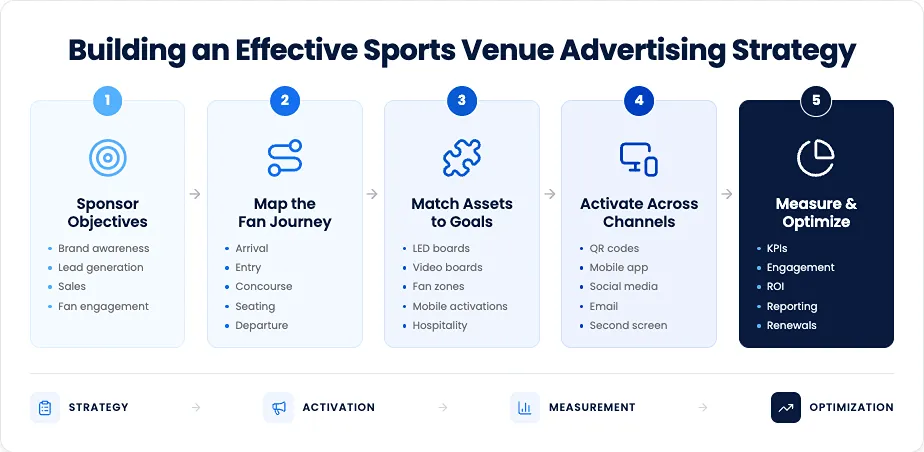
Intentionally building a strategy is where a lot of programs misfire. Inventory gets sold first, and strategy gets built around whatever is left over. When that happens, the sponsor's goals end up bent to fit the available signage instead of the other way around. Flipping that order, goals first, inventory second, is a small change in process that produces a very different renewal conversation. Properties selling into events and tournaments will find a similar logic in our event sponsorship guide, which covers how to structure inventory around what a sponsor is trying to accomplish rather than what happens to be open.
Common Sports Venue Advertising Mistakes to Avoid
Even experienced teams fall into a few recurring traps:
- Treating every sponsor the same instead of tailoring placements to their specific business objectives.
- Focusing on impressions alone rather than engagement and business outcomes.
- Using static signage with no interaction, missing easy opportunities for QR codes, contests, or mobile offers.
- Ignoring the fan journey and placing ads without considering where fans are paying attention and when.
- Failing to integrate channels, so in-venue advertising isn't reinforced by social, email, or mobile.
- Skipping data collection, which makes ROI nearly impossible to prove later.
- Waiting until renewal time to report results instead of sharing performance throughout the season.
The Future of Sports Venue Advertising
The next few years will bring even more personalization.
- AI-driven content that adjusts in real time
- Mixed reality overlays that blend physical signage with digital layers visible only through a phone or headset
- Increasingly cashless, connected venues that generate more first-party data with every transaction
Smart stadium infrastructure will keep making it easier to tie a specific placement to a specific outcome, which raises the bar for what "proof of performance" means.
New technologies don’t change the fundamentals. A sponsorship still has to be built on a clear objective, delivered consistently, and measured honestly. Properties and brands that get the operational side right, tracking every deliverable and reporting on it without a scramble, are the ones set up to take advantage of these new tools as they arrive. Our sponsorship renewal playbook covers how to turn that consistent reporting into renewal conversations that start from data instead of guesswork.
Sports venue advertising works when it earns a place in that walk from the gates to the seats. The fan zones, contests, and QR codes that get remembered are the ones built around a clear goal and measured with the same discipline as any other marketing spend. The static signage that fans "barely register" is usually the sponsorship nobody planned to make interactive, and it's the first one cut at renewal time.
You already know your venue and your fans better than any outside vendor ever will. What separates a forgettable placement from a lasting brand experience is a strategy that starts with the sponsor's goals, an activation that gives fans something to do, and reporting that proves it worked. Build that discipline into every campaign, and sponsor renewals stop being a hard conversation and start being the obvious next step.
SponsorCX brings that discipline into one place. It:
- Centralizes every sponsor asset and commitment
- Automates every task
- Tracks fulfillment
- Reports results
If you're ready to turn your venue advertising program into an experience sponsors can measure and fans remember, schedule a SponsorCX demo and see how it comes together.
You make venue advertising happen. SponsorCX makes it simple.